
While Europe is preparing to launch the digital euro, the liquid seems to play extensions. In reverse of futuristic predictions, the species stand up to dematerialized payments, embodying a tenacious transgenerational and territorial attachment. Why do tickets resist? Is it a simple adoption delay or a preference revealing deeper tensions in our societies? Three functions – transaction, value and security reserve – give cash a more resilient role than announced. Decryption of a resistance which says a lot about our relationship to uncertainty.
In short
- The cash remains in the majority in 52 % of payments in stores in 2024.
- Young people store cash at home as a precaution from the pandemic.
- 62 % of Europeans want to keep the cash payment option.
- The ECB promises a coexistence between digital Euro and traditional fiduciary currency.
Fractured Europe: when the reality of cash goes beyond digital fiction
The dream ofA Liquid -free worldas in Australia, persists in certain decision -makers. However, European reality proves them wrong. In 2024, 52 % of store purchases are still paid in cash. A statistic Who disturbs the supporters of an entirely digitalized finance.
The payment map draws a net cleavage: Germany, Austria and Switzerland retain between 69 % and 73 % cash payments, compared to only 28 % in Sweden. Ireland, with 59 %, is also among the loyal bastions of the ticket and the room.
In France, 51 % of adults still use cash dailya moderate decline of 5 points compared to 2023. This decline does not sign a rupture, but a slow erosion.
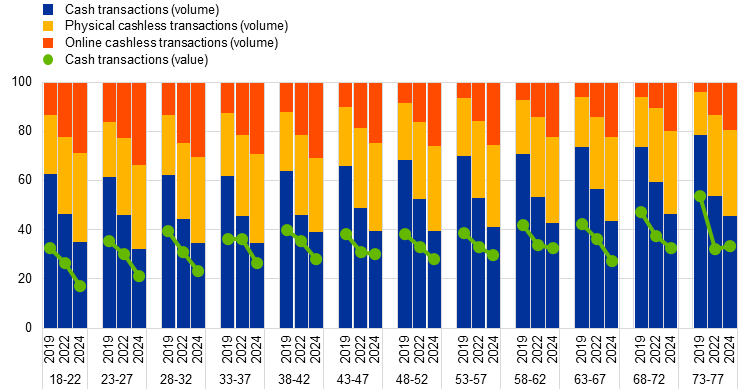
Young people, however hyperconnected, continue to keep species for certain uses. Seniors use them more for their current expenses.
This duality suggests a more complex reality: Cash does not resist in inertia, but by necessity and preference.
The standardization of means of payment seems to hit rooted local logics, where the cash remains a reassuring, almost cultural benchmark.
When uncertainty strikes, the cash regains braid
In a world where everything becomes digital, Liquid money remains a tool of trust. In 2022, cash at home jumped, especially among 18-37 year olds. This age group, however considered ultra-digital, sees in the cash a fall back solution.
THE BCE space report confirms it: Young people keep more liquid money that older generations to face the unexpected. The reason? The cash requires any network, any authorization, and it remains usable in the event of computer failure.
It's a rampart against digital fracture. A weapon against banking exclusion. A tangible object in an ever more volatile finance.
Cash is also seen as a reserve of value, in particular during crises. During the pandemic, its perceived importance has clearly progressed in all age groups.
But public policies are struggling to decide. Should we speed up innovation, or support monetary resilience? Between technological acceleration and perceived security, the liquid is forced to rethink the fundamentals of our economy.
A hybrid finance: preserve the cash without braking the digital euro
The digital euro, the CBDC of Europe, will not sound the end of cashsay the officials of the ECB. It will complete the existing offer. Under their terms, it will be a ” Digital expression of cash” – A dematerialized version of fiduciary currency.
And yet, 62 % of Europeans still claim that it is important to be able to pay in cash. Even in the most digitally advanced countries, this option remains crucial.
There Suedeoften quoted as Cashless pioneerhad to review his copy. His government now recommends keeping at least seven days of cash expenses at home.
Europe does not wish to reproduce this excess. Its 2030 trial strategy focuses onA solid coexistence between species and digital currency. The objective is to preserve universal access to cash, while preparing future digital uses.
Cash and finance in 5 key figures:
- 52 % of cash payments in cash in 2024;
- 69 % to 73 % cash in Germany, Austria, Switzerland;
- Only 28 % in Sweden;
- 58 % of Europeans worried about the confidentiality of digital payments;
- 62 % want to keep the choice of cash.
This hybrid model reflects a democratic principle: finance must guarantee everyone the means of payment that suits them.
If the use of cash decreases in the long term, some analysts think that Bitcoin could get out of it. Unlike Central Bank digital currencies, Bitcoin promises controlless control, integrated rarity and resistance to monetary policies. A future without species could therefore redistribute the cards … for the benefit of the decentralized king.
Maximize your Cointribne experience with our 'Read to Earn' program! For each article you read, earn points and access exclusive rewards. Sign up now and start accumulating advantages.


