
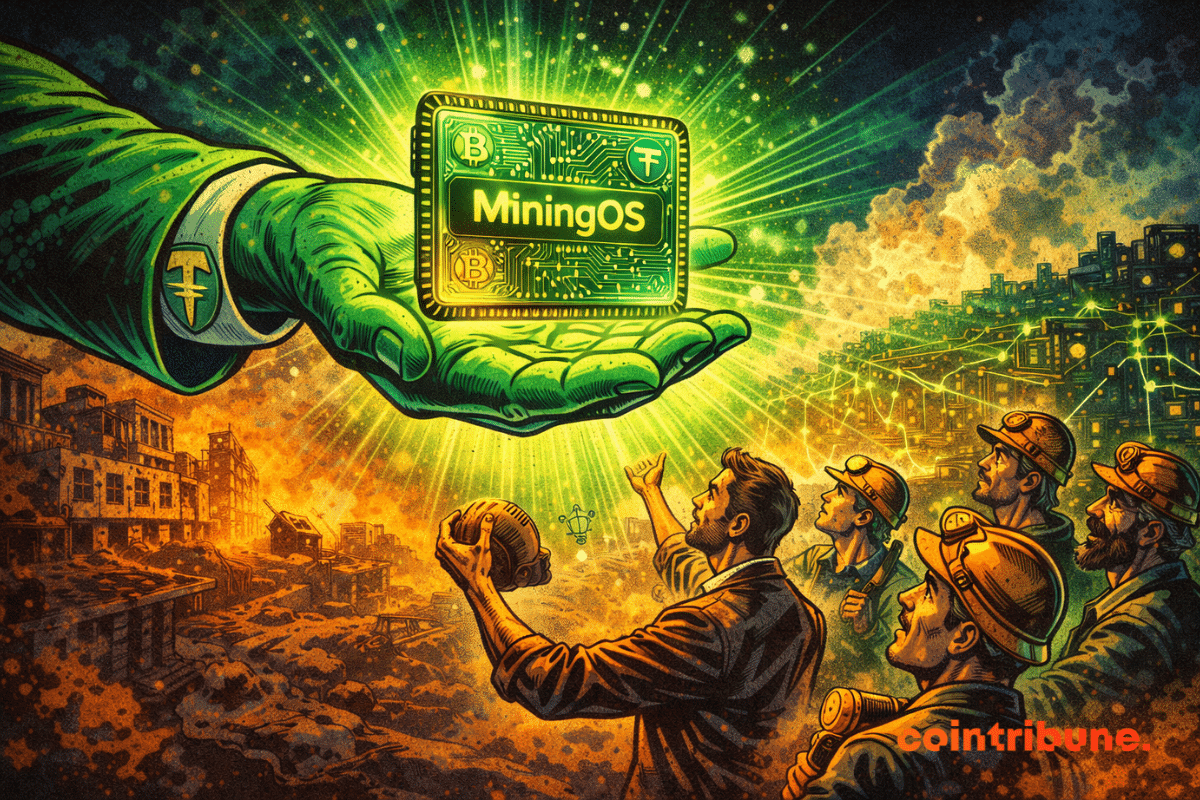
Tether and gold are a long love story. But between Tether and bitcoin, it’s a completely different adventure – made up of technical ambitions and strategic repositioning. The stablecoin giant USDT no longer intends to be content with being a financial pillar of the crypto world: it now wants to build the infrastructure. And with the launch of MiningOS (MOS), its new open-source bitcoin mining system, Tether is establishing itself where we least expected it: at the heart of the machine.
In brief
- Tether unveils MiningOS, an open source system revolutionizing the management of bitcoin mining operations.
- MOS allows you to monitor energy, hardware and performance on mining sites of all sizes.
- The software is under the Apache 2.0 license, making the code free, modular and interoperable.
- The launch is part of Tether's strategy to expand its empire beyond the USDT stablecoin.
Tether and Bitcoin: an assumed technological alliance
Presented in San Salvador during the Plan ₿ Forum, Tether's MiningOS (MOS) redefines the standards of bitcoin mining. It is aboutan open-source operating system enabling the management and automation of mining operations at all scales — from small domestic installations to industrial farms.
Designed around a modular, decentralized architecture, MOS coordinates energy, machine health and infrastructure performance in a single environment. This project, published under the Apache 2.0 license, wants to make mining more accessible and less dependent on Asian giants.
Paolo Ardoino, CEO of Tether, summed up the project's philosophy by saying:
Mining OS, or MOS, is designed to make Bitcoin mining infrastructure more open, modular and accessible. Whether it's a small operator managing a few machines or a large-scale industrial site, the same operating system can scale without relying on third-party centralized software.
With this initiative, Tether is no longer limited to the issuance of USDT. He becomes a field player, building the technical tools that will support the bitcoin network of tomorrow.
From stablecoin to infrastructure: Tether's strategic shift
Since 2025, Tether has increased its forays into unexpected areas: gold tokenization, energy payments, and now, mining infrastructure. This shift is explained by a clear vision: securing the Bitcoin ecosystem to strengthen the solidity of the global crypto economy.
By unveiling MOS and its Mining SDK, the firm wants to encourage a new generation of independent miners capable of competing without depending on proprietary solutions. It is a step towards technological and energy sovereignty, particularly in emerging countries like El Salvador, where Tether anchors its influence.
On X, Paolo Ardoino confirmed this commitment :
Tether Mining OS is now completely open source. A complete operational platform, capable of adapting as well to a domestic installation as to an industrial site, or even to several geographical areas.
Through this alliance, Tether becomes a key link in the crypto-sphere: an infrastructure provider, a trust builder and, perhaps, the silent engine of the next Bitcoin era.
Some figures and facts to remember
- Official launch: February 2, 2026, at the Plan ₿ Forum in San Salvador;
- License: Apache 2.0 – open source, without hardware dependency;
- Architecture: modular, peer-to-peer, interoperable;
- Innovation: Mining SDK for developers and operators;
- BTC price: $77,341 at the time of writing.
While the crypto market is going through a turbulent period, the Bitcoin mining sector is also experiencing turbulence. In the United States, production fell by more than 50% after a series of winter storms. In this climate, Tether's initiative resonates as a sign of resistance and adaptation in the Bitcoin ecosystem.
Maximize your Tremplin.io experience with our 'Read to Earn' program! For every article you read, earn points and access exclusive rewards. Sign up now and start earning benefits.


