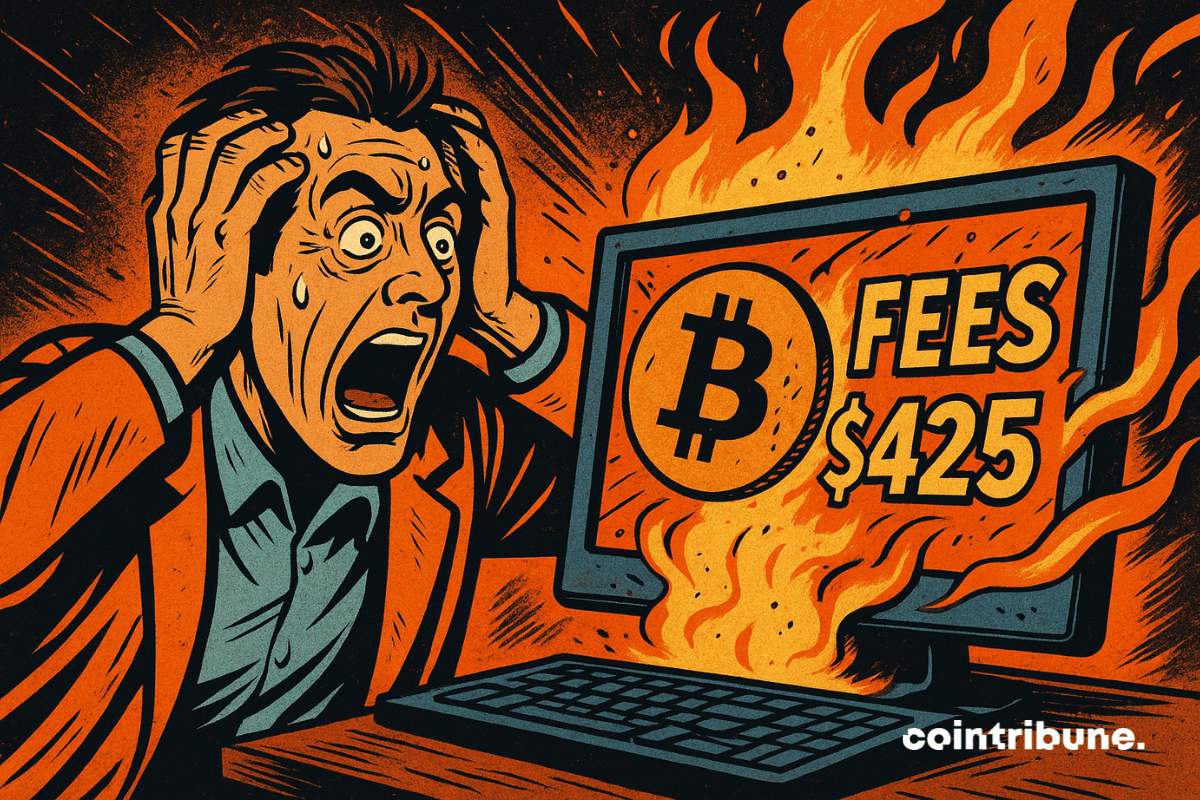
The spring of 2025 may be soft, the Bitcoin blockchain heats up like never before. On Sunday, the BTC Prize has come close to $ 106,000 again, awakening from old Fomo reflexes. However, the noisiest indicator is not rating, but these micro-monetors that add up: transaction costs. With a mobile average of $ 2.40 – a dollar more than at the beginning of the month – they are already beating the annual record. Behind this apparent crop hides a filter radiography of the state of the network and the psychology of holders.
In short
- Average costs reached $ 2.40, record 2025, while transactions drop by 35 %.
- Over 14 m BTC sleep out of Exchanges, groaning the available offer and muscular the demand for block space.
- Between recent Halving and Price close to $ 106,000, a tender shock is looming for the market.
Bitcoin: costs that fly away while the Cale
The first paradox is obvious: fewer transactions, but more expensive. Since the peak of the 507,000 daily transfers of April 22, the pace has dropped by 35 % to cap around 330,000. However, the average cost is climbing.
How to explain this big gap? First, the blocks are no longer filled with simple P2P transfers. They now host heavier operations: ordinal inscriptions, “runes” BRC-20 post-halving, off-chain offs off-chain. Each operation occupies more bytes; From then on, Less transactions are enough to saturate the available space.
Then, the Halving of April, by dividing the subsidy of minors, moved the remuneration to the costs.
The validators relay primarily the packages offering the most generous premium. Result: the mempool resembles the line of a select club; Who wants to enter the porter. The mechanical increase in the entry ticket is therefore not (only) a sign of consumer adoption, but also of internal competition for a space that has become more rare.
Finally, the price effect plays in full. As long as the BTC sails above $ 100,000, sending some Satoshis costs “only” the equivalent of a coffee. Psychologically, the user accepts this additional cost, convinced that the same BTC will be worth more tomorrow.
The illiquid offer: a pressure powder maker
While the costs are soaring, another metric flashes in red: the illiquid offer. Glassnode now lists 14 million BTCs between little spending hands, an absolute record. In other words, nearly two-thirds of the circulating bitcoin sleeps in portfolios whose owner only affects the USB key, never at the “Send” button.
This scarcity of units available on platforms brings out a known scenario: the tender shock. If it is enough for a spark of request for the order notebooks to be emptied, The outbreak of costs becomes a prologue, not an epilogue. Traders have understood this well: we do not attend an exodus, but to a sit-in of the Hodlers, more unwavering than during the episodes of 2017 or 2021.
In addition, the domination of Bitcoin on the global market resumes colors after an Altcoins parenthesis. This rebound suggests that the recent Bitcoin underperformance was more of a redistribution of liquidity than a paradigm shift. In other words, the “king” remains king; He had just given himself a short rest.
What consequences for investors, companies and users?
From a strategic point of view, these record costs are life-size stress-test. The scholarships that have been slow to optimize their transaction aggregators or deploy Taproot Batch today pay the high price. Conversely, those that already exploit Lightning Network reduce their costs and capture the flows of pressed users.
For the long -term investor, reading is double. Yes, high costs can scare the newcomer. But they mainly testify to a living network, saturated with requests and where minors remain encouraged to secure the blocks, even after the compression of the awards. Clearly, the more the bill climbs, the more the infrastructure proves its resilience.
Finally, the individual must review his automatisms: program his shipments during the hollows of Mempool, favor the wallets which finely consider the costs, or even split his UTXO before peak periods. Otherwise, he may see half of his micro-transaction go to Satoshis dust.
In 2025, the term “costs” is no longer a simple technical cost; It becomes an advanced indicator of economic, social and even psychological health of the Bitcoin protocol. Each Satoshi paid to minors tells a story: that of an offer that is becoming scarce, a demand that insists on and a digital asset which, despite sixteen years of existence, still succeeds in surprising. The next time you click on “Send”, take a second to contemplate these few hundred … They may be tracing the curve of the next bullish wave.
Maximize your Cointribne experience with our 'Read to Earn' program! For each article you read, earn points and access exclusive rewards. Sign up now and start accumulating advantages.