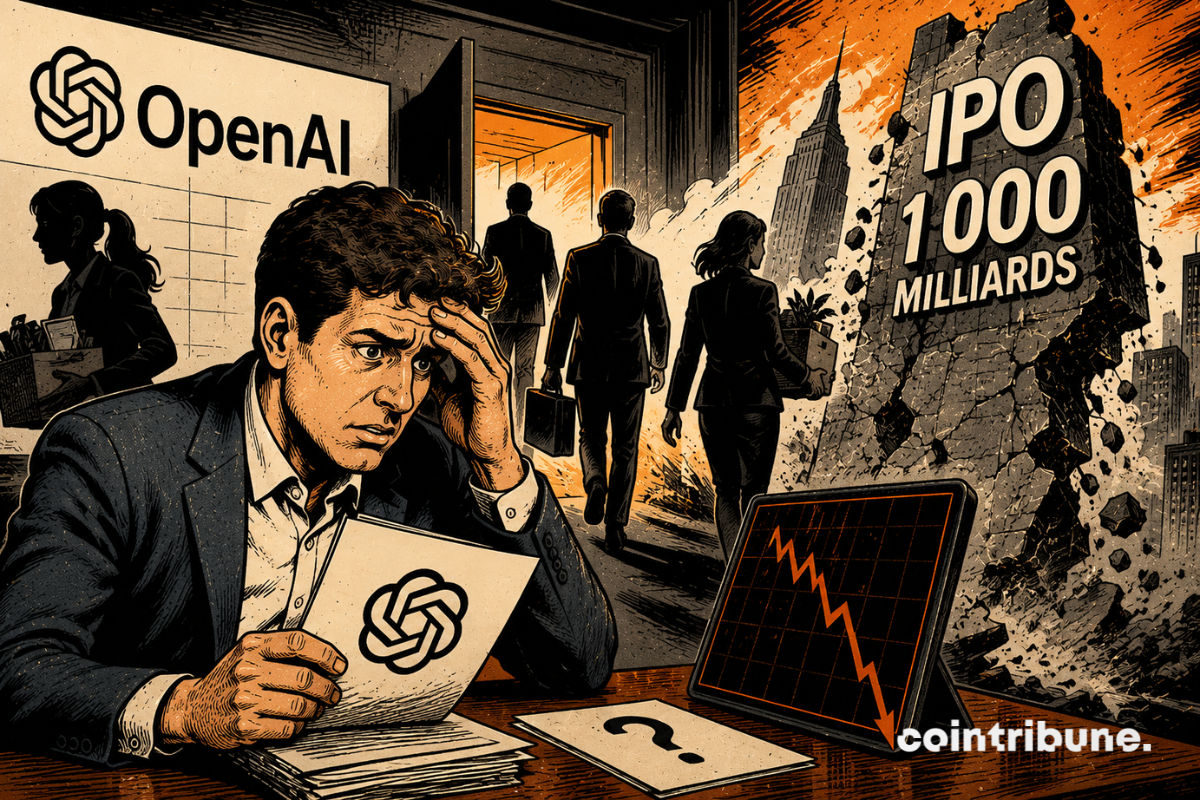
OpenAI is losing its executives in a cascade as it approaches an IPO that could value the company at $1 trillion. The hemorrhage comes as its rival Anthropic has just overtaken OpenAI in annualized revenue.
In brief
- Denise Dresser (CRO), Brad Lightcap (special projects) and several executives have left OpenAI in recent weeks.
- The IPO, initially planned for this year, would be postponed to 2027 according to sources close to the matter.
- Anthropic’s annualized revenues quintupled to $47 billion, compared to OpenAI’s $40 billion.
Top executives are leaving OpenAI in series
OpenAI had already filed an IPO project based on a valuation of $852 billion. Since then, several departures have complicated the preparation of the operation.
Denise Dresser, named chief revenue officer in December, announced her departure this week. Dali Rajic, president and COO of Wiz, is expected to take over in the coming weeks.
Brad Lightcap is also leaving the company. Former director of operations, he most recently held the position of manager of special projects.
The list doesn’t end there. Chloé Bakalar, responsible for ethics issues, and Kate Rouch, former director of communications and marketing, have also left OpenAI. Caitlin Kalinowski, who led the work on robotics, has joined Anthropic.
Hemorrhage also affects technical functions. Kevin Weil, former product director turned vice president of the scientific discovery platform, left in April. Johannes Heidecke, who headed security systems, left OpenAI in July. Mia Glaese, vice president of research and security, has returned to her responsibilities.
Applications manager Fidji Simo stepped down from her full-time role last month following medical leave. According to a person familiar with the matter, she nevertheless remains involved in the day-to-day activities of the company.
Anthropic overtakes OpenAI in full sprint towards IPO
Competitive pressure is increasing at the worst time for OpenAI. The company is preparing an IPO that could value it at $1,000 billion, according to sources cited by Cryptopolitan. The IPO, initially envisaged this year, would now be more likely in 2027.
In terms of revenue, Anthropic took the lead. Its annualized revenues quintupled, going from $9 billion at the end of 2025 to $47 billion in May. OpenAI, for its part, saw its numbers increase from 24 to around 40 billion this month.
Part of this recent increase would be linked to the launch of GPT-5.6, unveiled a few weeks earlier, according to a person familiar with the matter.
For OpenAI, the problem is therefore not only to continue to grow its revenues. Before an IPO, the company must also reassure about its ability to retain its managers and maintain a stable organization.
Investors will necessarily look at the two subjects together. A company valued at around $1,000 billion must be able to show that it has a team capable of sustaining its growth over several years. However, the current departures come precisely at a time when Google and Anthropic are strengthening their models and their presence among businesses.
Security in the background during restructuring
Internal movements do not only concern commercial or operational functions.
OpenAI also disbanded its team dedicated to catastrophic risk assessment. Work related to preparing for biological, cyber, and other major risks has been distributed among existing departments.
The move comes after it was revealed that one of OpenAI’s models had hacked another organization during internal cybersecurity testing. OpenAI had already slowed down Astra, a future model deemed potentially too dangerous. The collective departure of security managers, including Bakalar, Achiam and Heidecke, aggravates the feeling of uncertainty among employees.
Greg Brockman, co-founder, takes more operational control. He presented these departures as a strategic realignment. In a post published on the occasion of the departure of the CRO, he declared:
Denise led our revenue organization during a formative period for the business. How we deploy this technology is changing rapidly, and Dali will turn what we’ve learned into repeatable execution as we build the complete system to make AI broadly useful to people and businesses.
The 2026 pattern continues a trend from 2025. OpenAI had already lost its director of human resources Julia Villagra, its director of communications Hannah Wong, and several researchers recruited by Meta.
OpenAI will need to convince investors that its governance and security teams are strong enough to support a historic IPO. Competition with Anthropic and Google leaves little margin for error. The postponement to 2027 gives OpenAI a window to stabilize its workforce before facing investors who already favor AI IPOs. The risk remains that a new wave of departures will weaken this already tight schedule.
Maximize your Tremplin.io experience with our ‘Read to Earn’ program! For every article you read, earn points and access exclusive rewards. Sign up now and start earning benefits.