
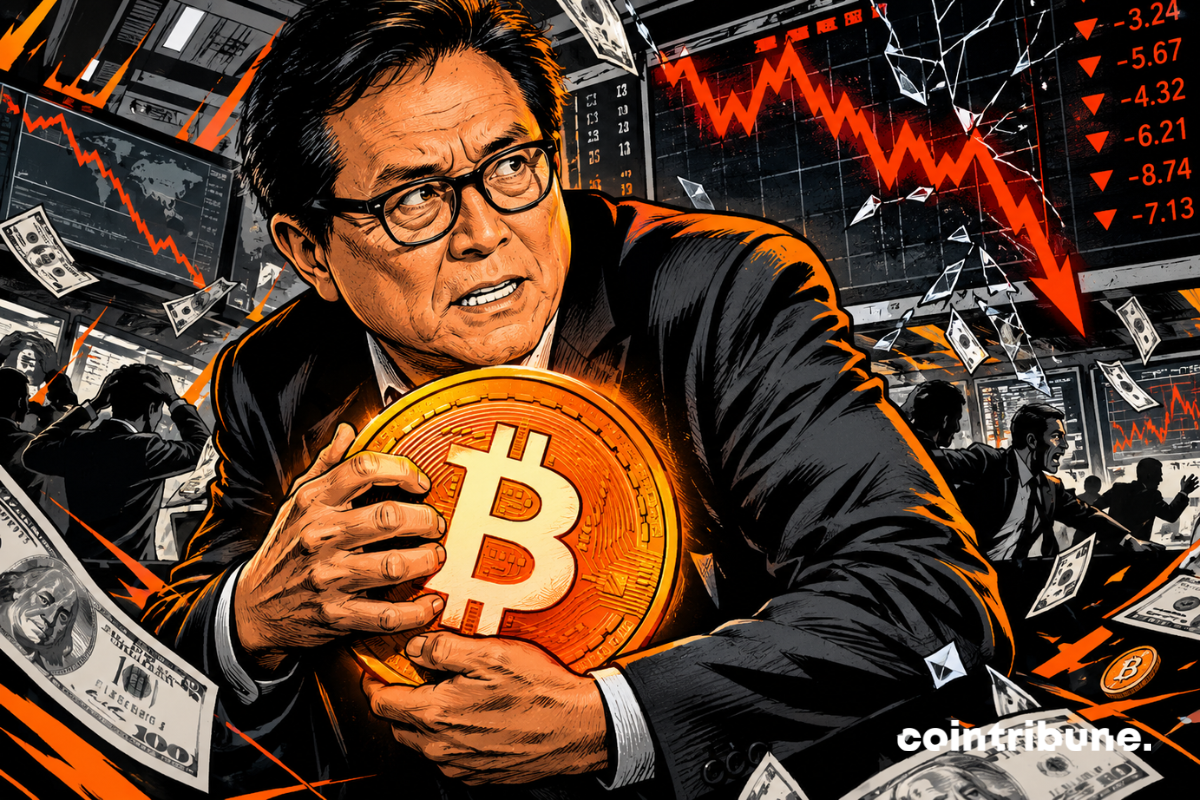
Since September 15, Robert Kiyosaki has affirmed that “the greatest crash in history” has already begun. According to him, the movement started from Europe and Japan before gradually reaching other markets. In this scenario, bitcoin would be one of the assets capable of weathering the storm. Some bond indicators give weight to his concern, but the data does not yet show widespread panic.
In brief
- On September 15, Kiyosaki claims that the crash began in Europe and Japan.
- The Japanese 10-year yield reached 3% in early September, a first since 1996.
- The IMF estimates that global public debt will reach 100% of GDP in 2029.
- Bitcoin is trading around $80,300 on September 20, after a rebound from its low point of the week.
Japan gives credence to part of its scenario
In July, Robert Kiyosaki already designated four assets likely, according to him, to resist the next crash. On September 15, he went further by asserting that the crash predicted for years had finally begun.
He cites several factors: the “AI frenzy”, the war in Iran, global debt and the retirement of baby boomers.
In the bond market, some numbers are hard to ignore. The yield on the Japanese 10-year bond reached 3% on September 1, its highest level since 1996. Reuters explains this increase by concerns linked to inflation, public finances and Japanese monetary policy.
Bitcoin.com News reported the same week borrowing costs at ten-year highs in Germany, France and the United Kingdom.
The technology sector is also under pressure. Five ECB economists recently estimated that a correction in technology valuations was possible. However, this is not enough to speak of a crash.
Bitcoin does not yet confirm the panic
If a historic crash were really underway, the markets would normally be more likely to bear its marks. However, bitcoin is currently trading around $80,300. After hitting a low point on September 16, it has since regained some of the lost ground.
This development contrasts with the scenario of widespread collapse. Investors are certainly more cautious in the face of rising bond yields, but Reuters reported on September 15 that there was no sign of panic on American stocks.
Kiyosaki, for his part, continues to favor gold, silver and bitcoin. He also claims to buy bitcoins during corrections. However, a few days of rebound are obviously not enough to invalidate his scenario: they simply show that the predicted crash has not yet produced the effects described.
A global debt that remains under surveillance
One of Kiyosaki’s arguments is based on debt. On this point, the IMF figures clearly show a tense situation. The April 2026 Fiscal Monitor estimates that global public debt represented almost 94% of GDP in 2025 and could reach 100% in 2029.
But the IMF does not foresee a sudden collapse of the markets. Rather, its analysis highlights growing budgetary pressures, high interest charges and increased vulnerability in bond markets.
The problem therefore remains less the existence of risks than their translation into a real crash. For the moment, Kiyosaki’s alert is based on very real tensions, but its most extreme scenario remains to be demonstrated.
Maximize your Tremplin.io experience with our ‘Read to Earn’ program! For every article you read, earn points and access exclusive rewards. Sign up now and start earning benefits.


