

The cryptocurrency market is taking a new step in its recognition among major investors. In its projections for 2027, JPMorgan Asset Management assigns bitcoin a compound annual return of 10% over the long term. This estimate exceeds those of several traditional asset classes, including U.S. stocks and diversified portfolios. However, this perspective is accompanied by significant risks, linked in particular to the volatility and uncertainties surrounding the relationships between financial investments.

In brief
- JPMorgan projects a 10% compound annual return for bitcoin over ten to fifteen years.
- This projection beats estimates for U.S. stocks (7.5%) and private equity (9.8%).
- The bank estimates the annualized volatility of bitcoin at 55% and highlights the instability of its correlations.
- BlackRock recommends exposure of 1% to 2%, while Bank of America suggests 1% to 4%.
- Grayscale highlights the diversification potential of bitcoin despite the risks associated with its evolution.
JPMorgan includes bitcoin in its long-term return forecasts
On November 4, Zach Pandl, Director of Research at Grayscale, commented on the inclusion of bitcoin in JPMorgan Asset Management’s investment assumptions for 2027. This development marks an important step in the institutional valuation of cryptocurrencies. L’study examines over 200 major asset classes and provides return, volatility and correlation estimates. This data allows managers to compare different investments over a ten to fifteen year horizon.
According to figures relayed by Grayscale, JPMorgan forecasts a compound annual return of 10% for this asset. This estimate exceeds those of other investment categories presented in the report. US large-cap stocks have an expected return of 7.5%, while private equity comes in at 9.8%. For its part, a portfolio composed of 60% stocks and 40% bonds presents an annual forecast of 7%.
JPMorgan has published its market hypotheses on October 19, based on data finalized in September. The study covers more than 200 asset classes and takes a ten to fifteen year horizon. It serves in particular as a reference for investors who define their strategic allocations. The chart studied by Grayscale combines forecast returns with historical correlations measured as of September 30, 2026. It indicates that bitcoin’s correlation with major US stocks is as high as 33%.
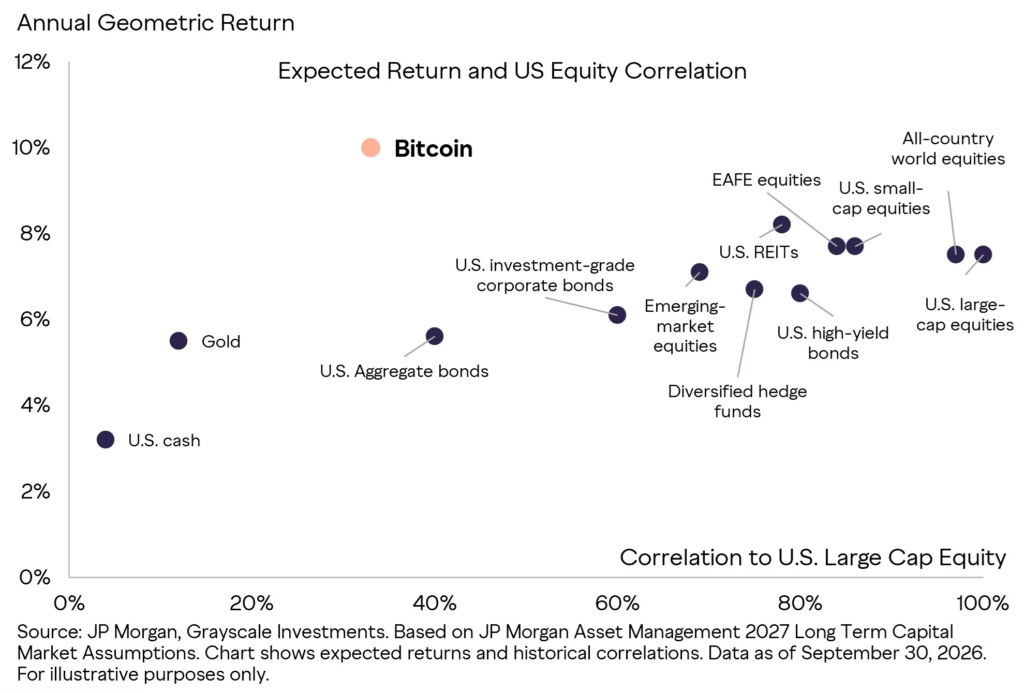
Gold has a lower correlation to major U.S. stocks, but its expected annual return is 5.5%. This comparison allows us to distinguish two important characteristics for investors. An asset can help diversify a portfolio without necessarily offering the highest projected return. JPMorgan’s estimates thus place cryptocurrency in a special category. They highlight higher return potential, but also specific risk parameters.
Volatility Complicates Bitcoin’s Role in a Portfolio
The expected return is not enough to determine the place of an asset in an investment strategy. JPMorgan retains an annualized volatility assumption of 55% for bitcoin. This level reflects potentially significant price variations on the financial markets. The bank also warns that correlations with other assets can change over time. This instability complicates the assessment of the overall risk of a diversified portfolio.
This reservation explains why JPMorgan excludes cryptocurrency from its main covariance matrices. These charts are used to measure how the returns of multiple investments move together. They help managers assess the effect of a new position on overall risk. When correlations become unstable, models lose some of their reliability. Investors then have less visibility to precisely calibrate their exposure.
The study also describes the investment characteristics of this asset as speculative. It links its evolution to monetary easing, but also to adoption, regulation and liquidity. These factors can modify its behavior and influence its future returns. The authors point out that its fundamentals differ from those of traditional cash flow-generating assets. This difference makes projections more complex, even over several years.
Grayscale uses JPMorgan’s assumptions to examine the possible benefits of diversification. Zach Pandl highlights the combination of a high expected return and a relatively low correlation with large US stocks. However, it does not present these parameters as performance guarantees. Their evolution will depend on market conditions and the links between investment categories. The contribution of bitcoin to the portfolio will therefore remain linked to these changes.
BlackRock and Bank of America regulate digital allocations
Recommendations from major financial companies show different approaches to cryptocurrency allocations. In June, BlackRock describe 1% to 2% exposure to bitcoin as a potential complementary diversifier. This range aims to add a source of return whose behavior may differ from traditional investments. The analysis also compares its contribution to risk with that of exposure to the main technological stocks.
BlackRock warns, however, that a larger position could significantly increase the overall risk of the portfolio. This warning is consistent with the reservations expressed by JPMorgan on market volatility. A limited allocation does not produce the same effects as a significantly larger position. Managers must therefore examine the weight of each asset and the ability of their clients to withstand marked variations.
In December 2025, Bank of America recommended an allocation of 1% to 4% in digital assets for certain eligible customers. This orientation was aimed at investors comfortable with high volatility. It concerned digital assets in the broad sense and favored regulated investment vehicles. The recommendations applied to Merrill’s wealth management businesses, Bank of America Private Bank and Merrill Edge.
These recommendations show that large banks are seeking to regulate exposure to cryptocurrencies. The ranges proposed, however, remain different depending on the establishments and profiles concerned. BlackRock favors a more limited exposure, while Bank of America considers a higher range. In both cases, institutions take into account the risk associated with these investments. They therefore do not present these allocations as rules applicable to all investors.
Grayscale Launches Model Portfolios for Advisors
On September 14, Grayscale launched four model wallets designed for financial management professionals. These models offer different investment combinations made up of exchange-traded products linked to cryptocurrencies. They provide a framework for advisors who wish to incorporate this asset class into their allocations. However, professionals retain responsibility for decisions made for their clients.
Portfolios use weighting based on the market capitalization of assets. Grayscale also plans quarterly rebalancing to adjust proportions over time. Each strategy caps the weighting of an asset at 40% of the model portfolio. This limit prevents a single position from taking up too large a portion of the proposed allocation. However, it does not replace the individual analysis of each investor.
These tools complement the recommendations made by several major financial players. Ranges from BlackRock and Bank of America show that institutions are considering measured exposures. Grayscale’s models, in turn, provide structures that advisors can adapt. They do not automatically determine the final distribution of assets. The choice of weightings remains the responsibility of professionals and depends on the constraints specific to each portfolio.
Over the long term, JPMorgan’s forecast places bitcoin among the assets with the highest expected compound return in its study. However, this outlook must be considered against an annualized volatility of 55% and unstable correlations. The recommendations of BlackRock and Bank of America illustrate the search for a balance between diversification and risk control. The future place of cryptocurrency will therefore depend on its actual performance, its adoption and its relationships with other markets.
Maximize your Tremplin.io experience with our ‘Read to Earn’ program! For every article you read, earn points and access exclusive rewards. Sign up now and start earning benefits.