
Imagine a world where Internet connections fail one after the other. In this chaos, a study by the Cambridge Center for Alternative Finance shows that Bitcoin would remain standing, even if 72% of underwater cables were to break. How is this possible?
In brief
- Bitcoin would withstand a 72% breakdown of underwater cables, proving exceptional resilience in the face of internet disruptions.
- Thanks to its decentralization, 64% of Bitcoin nodes are invisible and protected, limiting the impact of targeted attacks or massive outages.
- Cable outages do not affect the stability or price of bitcoin, with almost zero correlation, reinforcing its credibility.
72% of submarine cables down? Nothing to worry about Bitcoin
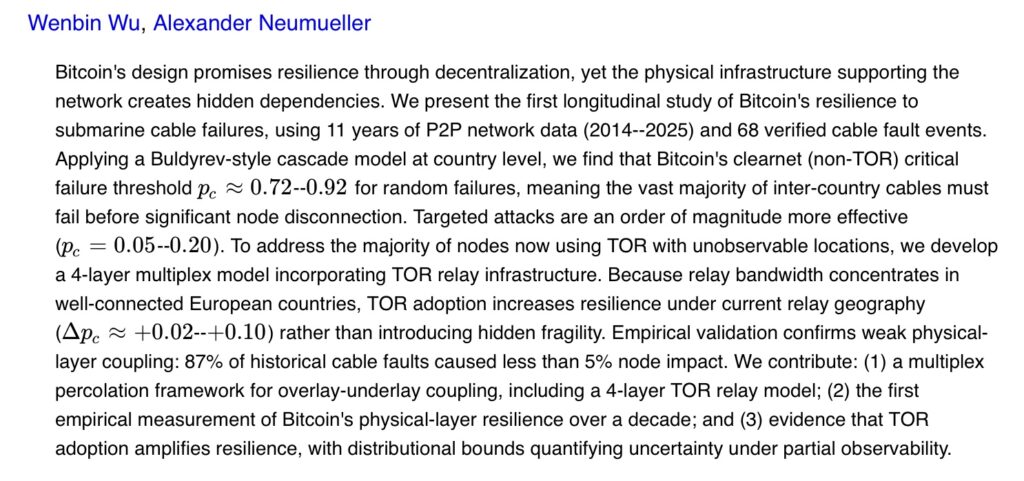
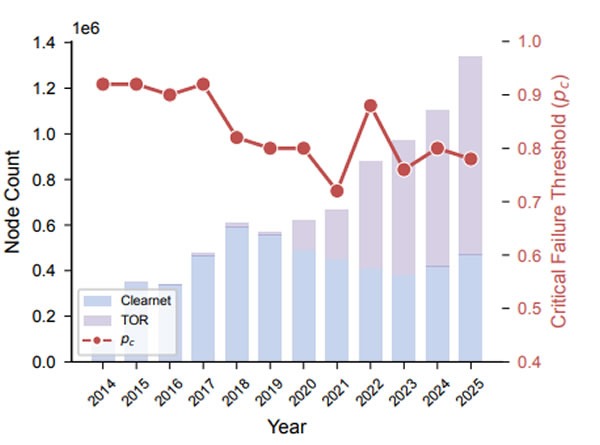
Researchers Wenbin Wu and Alexander Neumueller analyzed 68 historical submarine cable failure events. Their conclusion is clear: 72% to 92% of these infrastructures would have to fail to significantly disrupt the Bitcoin network. A threshold well beyond the usual disaster scenarios.
This resilience can be explained by the decentralization of the network. Unlike traditional banking systems, Bitcoin does not depend on a central point. In effect, each node in the network acts as an independent guardian, capable of maintaining transactions even in the event of major disruptions.
An architecture that reassures investors looking for stability and the data speaks for itself. 87% of past outages had less than a 5% impact on Bitcoin nodes. Further proof that the crypto queen is designed to withstand digital storms.
Why internet outages don't affect the price of bitcoin
Contrary to expectations, submarine cable outages have almost no impact on the price of BTC. The researchers calculated a correlation coefficient of -0.02, proving the absence of a link between these events and the fluctuations of bitcoin. An independence which can be explained by the decentralized nature of the blockchain.
In addition, clearing mechanisms built into the network allow transactions to be automatically redistributed to operational nodes. So, even in the event of a major disruption, the market remains stable. A characteristic that reassures and reinforces the credibility of bitcoin as a safe haven.
However, despite its robustness, Bitcoin is not completely safe. Indeed, attacks targeted on “chokepoints” (points of concentration of submarine cables) could theoretically threaten the network. The researchers estimate that a critical failure threshold of 0.05 to 0.20 would be sufficient to create localized disruptions.
Bitcoin proves once again that it is much more than just a crypto: it is an infrastructure designed to withstand the worst crises. With 72% of submarine cables expected to fail to impact it, BTC is positioned as a must-have asset for investors seeking stability.
Maximize your Tremplin.io experience with our 'Read to Earn' program! For every article you read, earn points and access exclusive rewards. Sign up now and start earning benefits.


