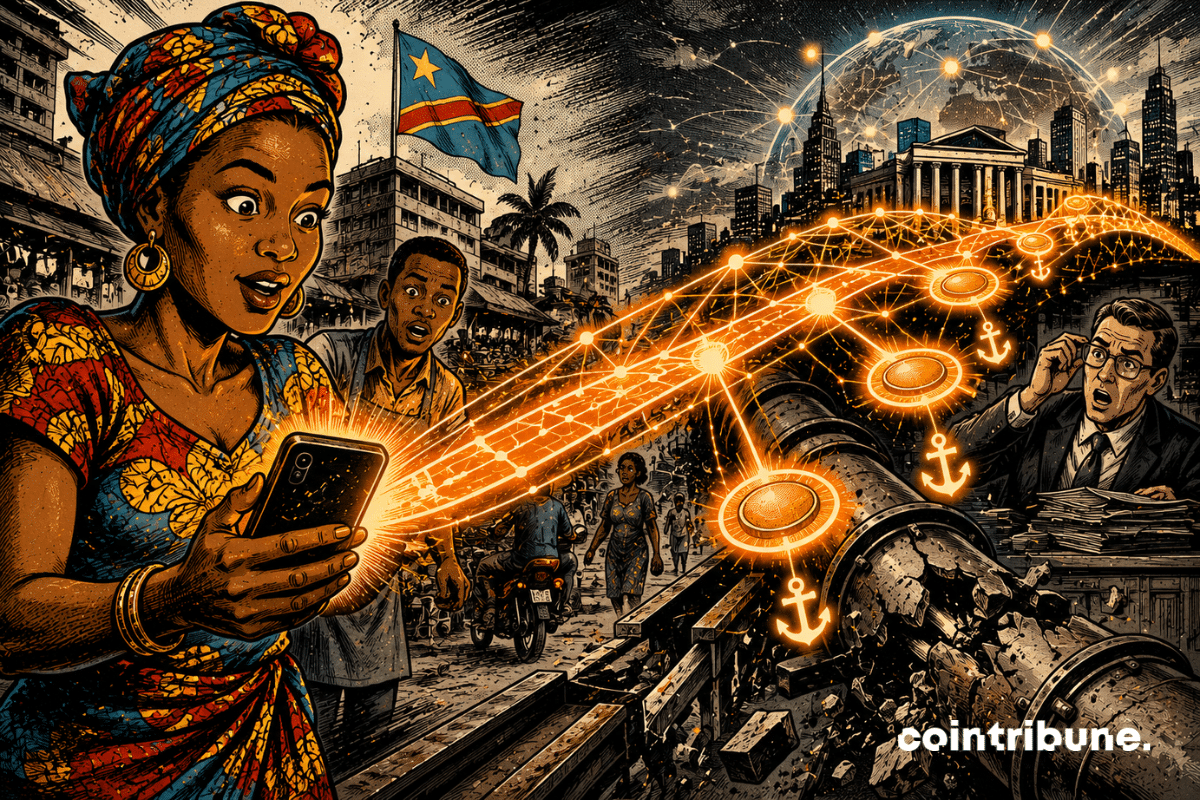
Visa, M-Pesa and Onafriq are testing stablecoins in the DRC to settle cross-border mobile transactions. The project aims to make transfers faster, cheaper and smoother, without necessarily changing the visible user experience. Payments continue to go through mobile money, but settlement takes place in the background using digital dollars.
In brief
- Visa is testing stablecoins with M-Pesa and Onafriq in the DRC.
- The project aims for faster and cheaper cross-border payments.
- The issue of digital dollarization remains sensitive for regulators.
Stablecoins enter Congolese mobile money
Stablecoins are arriving in an area already familiar to the Congolese: mobile money. Visa, M-Pesa and Onafriq want to test an infrastructure where cross-border payments are settled via digital assets backed by the dollar. This initiative extends the experiments already carried out by Visa in stablecoin payments.
The idea is not to ask the user to open a crypto wallet or manage a private key. The customer continues to use a mobile money interface. The change is mainly located in the financial engine which regulates the transaction between the partners.
For the DRC, this choice is strategic. The country combines high use of the dollar, growing adoption of mobile money and significant needs for cross-border payments. Stablecoins can therefore become a discreet, but powerful technical layer.
Visa seeks to reduce transfer friction
Cross-border transfers remain expensive and slow in sub-Saharan Africa. Several operations still go through intermediary banks, with cumulative fees and sometimes long settlement times. Stablecoins can reduce this dependence on classic rails. A transaction settled on blockchain can be confirmed more quickly and at a lower cost, especially when partners already have compliance and liquidity infrastructure in place.
Visa is not discovering this terrain. The group has been testing the use of digital assets in its regulations for several years. The expansion to the DRC shows that stablecoins are no longer just a subject for trading. They become a possible solution for everyday payments.
Onafriq plays an important role here. Its network connects mobile wallets, banks and fintechs in several African countries. By combining this scope with Visa infrastructure, the test can observe how stablecoins perform in a real-world environment.
Stablecoins promise speed, but pose a monetary question
The main interest of stablecoins lies in their relative stability. Unlike bitcoin or ether, their value is generally indexed to a traditional currency, often the US dollar. This makes them more suitable for international payments and settlements.
In the DRC, this characteristic is both useful and sensitive. The dollar already circulates widely in the economy. A dollar-pegged stablecoin can facilitate transactions, but it can also strengthen digital dollarization.
The Central Bank of Congo, on the contrary, seeks to support the use of the Congolese franc. This is where the debate becomes political. Stablecoins can improve the efficiency of payments, while complicating monetary sovereignty efforts.
This dilemma is not unique to the DRC. Several African countries are watching the rise of digital dollars with caution. Nigeria, for example, is already experiencing strong adoption of stablecoins in Africa, particularly for transfers and protection against the depreciation of local currencies.
A test that can exceed the DRC
The Congolese pilot must above all answer a simple question: can stablecoins improve payments without complicating the life of the end user? If the answer is yes, the model could be extended to other African markets.
The use cases are numerous. This could be topping up a mobile wallet from abroad, paying a cross-border merchant, or facilitating business-to-business payments. In all cases, the user first looks for speed, cost and reliability.
However, success will depend on several conditions. Partners will have to guarantee liquidity, secure flows, respect local rules and prevent the product from being perceived as a flight to the digital dollar.
Visa is therefore moving forward with caution, but the signal is strong. Stablecoins are no longer confined to crypto platforms. They enter payment infrastructures used by millions of people. After Visa's tests with USDC on Solana, this experiment with M-Pesa in the DRC confirms that cross-border stablecoins are becoming a major area of competition between payment networks, fintechs and banks.
Maximize your Tremplin.io experience with our 'Read to Earn' program! For every article you read, earn points and access exclusive rewards. Sign up now and start earning benefits.