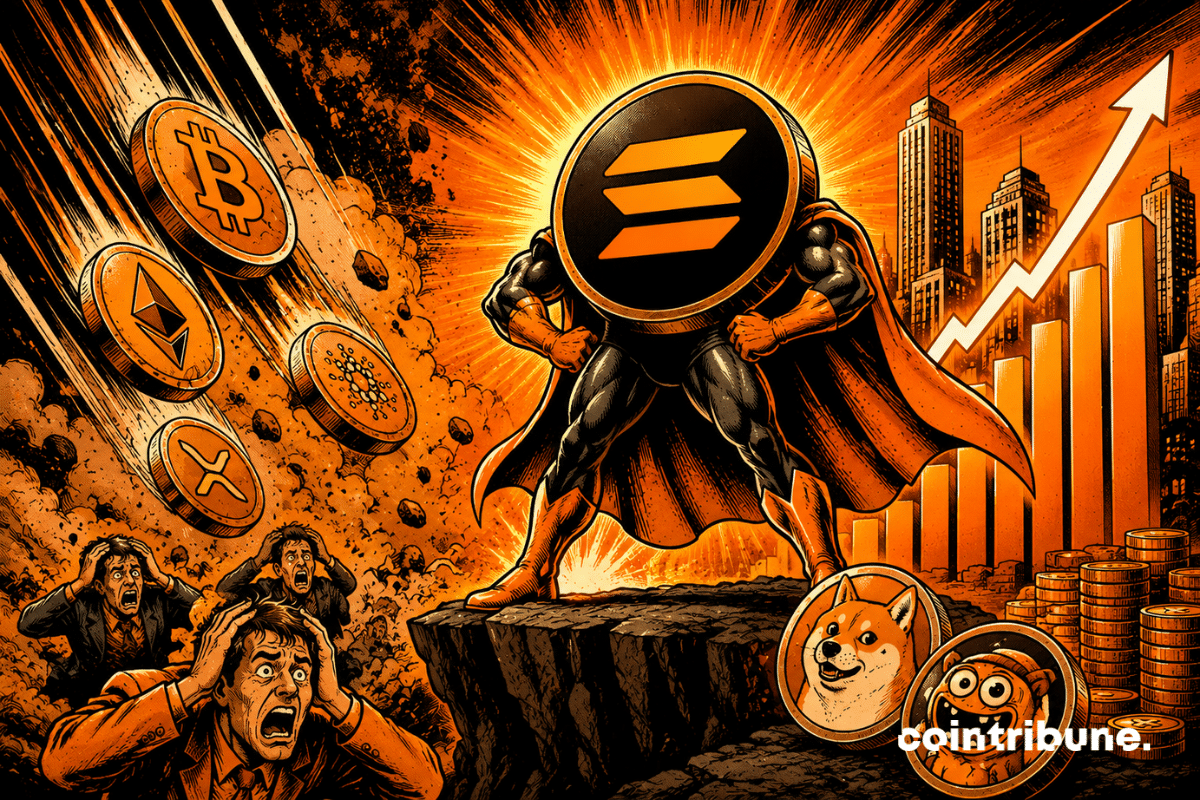
While most altcoins are sinking and seeing their capitalization fall to its lowest level since December 2023, Solana is following a radically different trajectory. Unlike a pressured market, the network is attracting capital at a steady pace and fueling renewed interest around its SOL token. This decoupling, rare in the crypto ecosystem, intrigues investors and analysts alike. Behind this resistance two distinct drivers emerge: a fundamental dynamic driven by the network and a speculative momentum which further strengthens its attractiveness.
In brief
- Solana stands out from the fall of altcoins thanks to strong growth in its on-chain activity and a continued inflow of capital.
- Asset tokenization and DeFi are accelerating network adoption, with record volumes and the number of active addresses now greater than Ethereum in this segment.
- Memecoins and Pump.fun are reigniting speculation, generating a new wave of liquidity that supports demand for the SOL token.
- Prediction markets enrich the ecosystem, while signals from derivative markets invite caution about the SOL's ability to extend its rally.
The explosion of tokenized assets and DeFi on Solana
Solana's bullish momentum found its initial anchor point on June 23, a key date marking the crossing of a historic milestone for the blockchain. On-chain data reveal the following financial milestones:
- The cumulative volume of transfers of tokenized shares on the network has officially exceeded the $10 billion mark, driven by the introduction of trading of SpaceX company shares by the Backpack platform;
- The total value of tokenized assets on Solana, excluding stablecoins, reached an all-time high of $3.5 billion, up from $2.7 billion just a month earlier;
- The network now has 294,274 active addresses dedicated to the tokenization industry (S&P 500, Nasdaq-100 stock indices and corporate credits), clearly ahead of its main competitor Ethereum, which has 204,955.
While the rest of the crypto market fell into a prolonged bearish trend, Solana thus began an upward trajectory entirely disconnected from the traditional indices of the altcoin sector. This technical and operational leadership, supported by the integration of leading corporate credit tokens and stock indices, has enabled SOL to break through major resistances.
By capturing the majority of active addresses in the sector facing the Ethereum ecosystem, the blockchain has transformed its infrastructure into an essential liquidity hub, propelling the price of SOL to its highest level in 30 days to settle at $83.
The fervor of memecoins and the return to the forefront of Pump.fun
Beyond the fundamentals of tokenization, the retail market has injected a second wave of liquidity through a surge of intense activity in the memecoin segment. The trigger was the launch of the token The Black Bull (ANSEM) via the Pump.fun platform, which immediately revived the interest of speculators. This asset reached a market capitalization of $60 million in the space of two days, before continuing its run to reach an all-time high of $112 million.
The project's rollout has remained opaque, with the anonymous developer choosing to allocate approximately 65% of the total supply directly to crypto influencer Ansem's public wallet, a distribution that nonetheless mobilized 74,000 unique addresses in its first three days of existence.
This sectoral excitement directly benefited the network's native infrastructures, first and foremost the PUMP token of the Pump.fun platform, whose increase in weekly gains of 27% allowed it to re-enter the top 100 of the largest global crypto capitalizations with a valuation of $630 million.
Such enthusiasm demonstrates the return of strong liquidity. Individual investors overwhelmingly choose Solana for its speed of execution. This speculative frenzy, although volatile, fuels a daily transaction volume which mechanically supports demand for the SOL token, essential for paying gas fees, reinforcing buying pressure on the spot market in the face of exhausted sellers.
The conquest of prediction markets and derivatives arbitrage
At the same time, the ecosystem is diversifying more strategically with the launch of prediction markets “World » integrated directly into the Phantom portfolio, aiming to capture the enthusiasm of bettors with the frenzy of the World Cup, in direct competition with Polymarket.
This project raised nearly $890,000 in total value locked (TVL) in just forty-eight hours, while aggregator Jupiter rolled out its own version of prediction markets in beta testing. Thus, this extension of use cases towards predictive markets brings a new utility dimension to the network, attracting an audience of bettors who generate constant financial flows uncorrelated from the classic cycles of decentralized finance.
All of these factors present complex prospects for Solana, dependent on the long-term viability of these capital flows. If on-chain activity proves to be particularly vibrant, the examination of derivatives markets invites a much more nuanced analysis of the forces present. Indeed, the appetite for leverage suffered a marked cooling, with the annualized funding rate of SOL perpetual futures falling to 3% after peaking at 11% as the price crossed $75.
Knowing that a healthy bull market generally requires a funding rate between 6% and 12% to offset the cost of capital, this marked drop indicates a strong hesitation among traders to bet on an immediate rise towards $90. The short-term future will therefore depend on the network's ability to convert speculative enthusiasm into lasting commitment, otherwise this decoupling will run out of steam in the face of the persistent gloom of the global crypto market.
Maximize your Tremplin.io experience with our 'Read to Earn' program! For every article you read, earn points and access exclusive rewards. Sign up now and start earning benefits.