The semiconductor industry has become the battlefield of a technological war between the United States and China. Washington, anxious to preserve its strategic advantage in artificial intelligence, has already imposed several restrictions on the export of high performance fleas. Despite these measures, China has continued to progress, which pushes Donald Trump to consider an additional hardening of the limitations that target Nvidia. This project could redesign the balance of the global AI market, and weaken American companies. Between national security imperatives and economic challenges, this decision is part of a strategy that aims to slow down the technological boom in Beijing. However, the effectiveness of these restrictions remains uncertain, while Chinese companies are redoubling their efforts to circumvent these sanctions and develop their own alternatives.
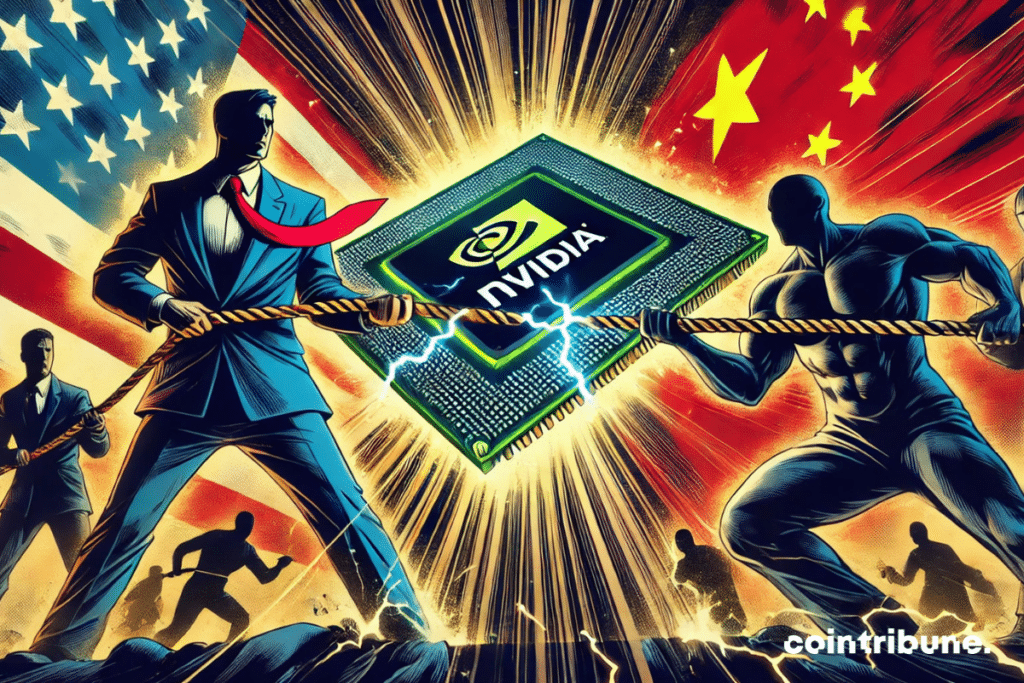
A hardening of restrictions on the NVIDIA fleas
The Trump administration plans to harden restrictions on exports of Nvidia processors to China, and notably targets the H20 chip. Designed as a lightened version of the H100 to comply with American regulations, this chip had to allow Nvidia to maintain a presence on the Chinese market, with a view to respecting the sanctions in force. However, Washington believes that even in this limited configuration, the H20 could contribute to Chinese advances in artificial intelligence.
This decision is part of a fourth wave of restrictions since 2022which illustrates the will of the United States to slow down the technological progression of Beijing. Despite these obstacles, China has unveiled the Deepseek R1, an advanced artificial intelligence model that testifies to its ability to reduce its dependence on American semiconductors. This example feeds the worries of Washington, which fears that Chinese efforts to circumvent these restrictions will end up making these measures ineffective.
An American strategy with mixed results
US restrictions have certainly prevented Chinese companies from buying H100 and A100 chips directly, but they were not enough to block Beijing's technological boom. Faced with these obstacles, the Chinese tech giants have strengthened their use of local semiconductors, produced in particular by Huawei and Biren Technology. This adaptation allows them to gradually reduce their dependence on American technologies, and to continue their advances in artificial intelligence.
In parallel, Chinese firms exploit another flaw: foreign cloud computing services. Rather than buying the prohibited chips directly, they praise calculation power from international actors, and thus escape Washington restrictions. This ability to bypass sanctions causes doubts about the real effectiveness of American measures, which could slow down China without braking its long -term development.
Beyond China, this policy also weakens Nvidia, whose Chinese market represented almost 25 % of turnover in 2022. In addition, with successive sanctions, these sales fell, which pushed the company to rethink its commercial strategy. A new regulatory screw tour would risk aggravating this trend and accelerating the development of Chinese alternative solutions, which would make these prohibitions less and less effective.
The Trump administration is faced with a strategic dilemma. On the one hand, she seeks to slow down Chinese boom in AI, a crucial sector for defense and the world economy. On the other hand, these restrictions are likely to penalize American companies, and deprive them of a lucrative market, in order to encourage Beijing to accelerate its innovations. This technological war could ultimately strengthen Chinese independence and weaken the influence of the United States on the semiconductor industry.
If Washington hopes to slow down the boom in Chinese artificial intelligence, the real impact of these restrictions remains uncertain. Beijing has already proven its ability to adapt, whether by the development of its own semiconductors or by bypassing sanctions via foreign cloud services. In the long term, these measures could accelerate the technological independence of China rather than slowing it down, which would reduce American influence on the semiconductor market. This showdown only intensifies, with consequences that are still unpredictable about the global balance of artificial intelligence.
Maximize your Cointribne experience with our 'Read to Earn' program! For each article you read, earn points and access exclusive rewards. Sign up now and start accumulating advantages.