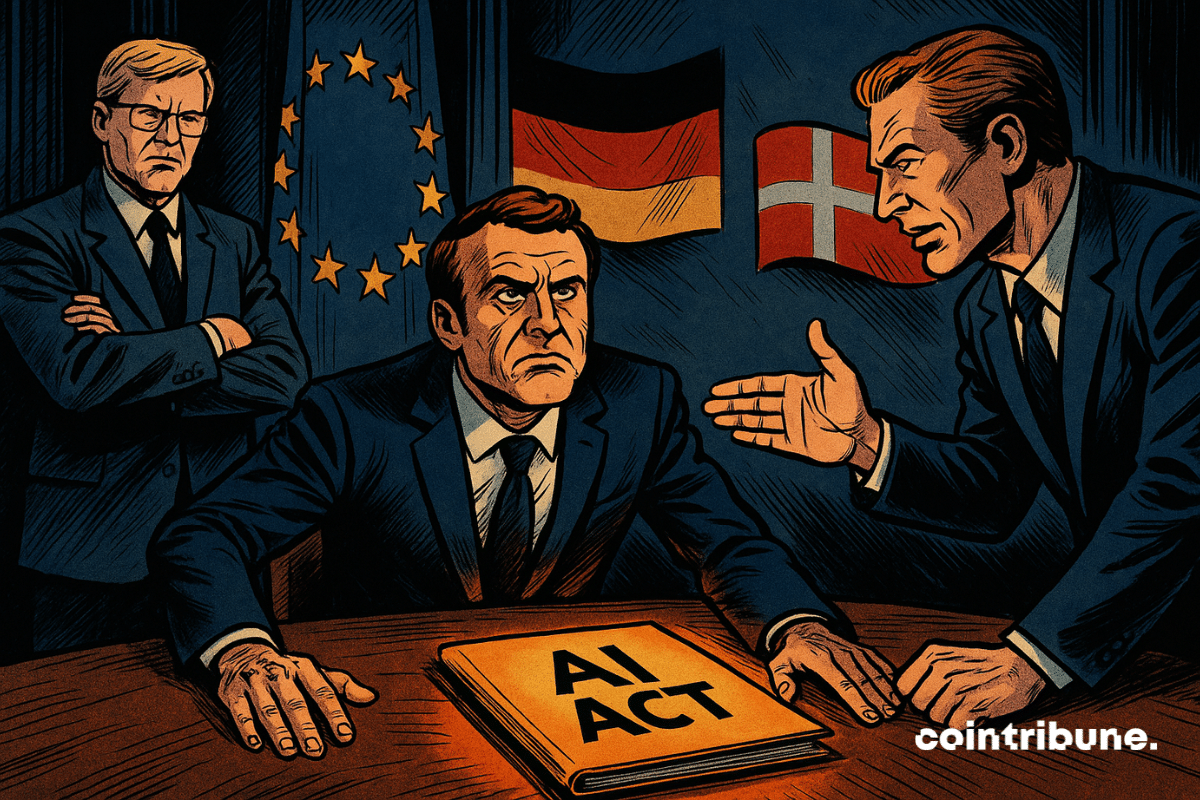
In Europe, the pendulum seems to be hesitating: innovate or regulate, let it run or legislate? Artificial intelligence (AI) crystallizes tensions. While some voices call for a solid ethical framework, others denounce an asphyxiating straitjacket. Should we slow down to move forward better? In Brussels, the lines are moving, the ministers are arguing, the lobbies are active. Behind the civilized speeches, a truth is emerging: Europe is still seeking its path between digital sovereignty and economic pragmatism.
In brief
- Paris and Berlin want to postpone the obligations for so-called high-risk AI for one year.
- Several MEPs fear a maneuver favorable to already well-established technology giants.
- Europe is struggling to compete with massive investments from the United States and China.
- NGOs denounce digital deregulation threatening user rights and transparency.
AI in Europe: when regulating slows down or unleashes innovation
In Berlin, at the digital sovereignty summit, France and Germany called for a 12-month delay of the AI Act's strictest rules on high-risk artificial intelligence systems. Emmanuel Macron pointed out: “
On the AI Act, we are requesting a 12-month delay for compliance of high-risk AI systems. It is also necessary to take advantage of this time to accelerate our innovation agenda.
Echoing this, Anne Le Hénanff, French Minister of Digital Affairs, clarified that “ the AI Act now contains too many uncertainties “. Persistent uncertainties are holding back the momentum for innovation… while the United States and China are widening the gap.
Some members of the European Parliament denounce this proposal. They see it as a threat to the credibility of the Union, an opening to the influence of GAFAM, always quick to take advantage of regulatory gray areas.
But behind this political standoff, the issue is clear: should we secure first or let AI breathe to exist? The debate runs through the ranks of young technological startups, particularly in the blockchain ecosystem, which are awaiting clear legislation to develop without fearing a regulatory reversal with each parliamentary initiative.
EU, digital sovereignty and AI in the global race
The issue goes well beyond simple regulatory compliance. It is about digital sovereignty, a theme that has become obsessive for European capitals. In Berlin, Macron hammered
:
Europe does not want to be the client of big entrepreneurs or big solutions from the United States or China. We clearly want to design our own solutions.
Behind this “European preference”, we read concern: 90% of German companies dependent on digital technology say they are vulnerable to American and Asian domination. The Bitkom report shows a glaring delay: Europe caps at 16 gigawatts of power in its data centers, compared to 48 GW in the United States and 38 GW in China.
Karsten Wildberger, German Minister for Digitalization, pleads for a framework that “evolves over time”. For him, it is better to test, correct, then supervise: “Let's build the products first, then take a hard look at how they work, their security, and the right processes to put in place “.
And at the heart of the debate, artificial intelligence is not alone: crypto-assets, Web3 and decentralized identities are also biding their time in a less restrictive and more competitive framework.
The AI Act as revealing a dilemma: standards, innovation and law
What is at stake with the AI Act is also a test of legal maturity for Europe. The Commission proposes to review the texts, to delay the mandatory labeling of content generated by AI until 2027, to relax the obligations for SMEs. This desire for “digital simplification” could open the famous “Pandora’s box” feared by some MEPs.
NGOs are stepping up to the plate. An open letter signed by several associations warns: the legislative changes envisaged go well beyond simple simplification. They deregulate fundamental pillars of the GDPR and the AI Act.
But the defenders of the postponement speak of a digital future under construction. For them, excess caution could make European AI as slow as it is ineffective. The tension is palpable, including on X (formerly Twitter), where figures from the tech ecosystem are calling for an “intelligent moratorium” – a strategic pause, not an abdication.
Hot spots to watch in the AI debate
- December 2027: new date expected to apply high-risk AI standards;
- 12 billion euros of digital investments promised by European companies according to Friedrich Merz;
- 48 GW vs. 16 GW: power of US data centers versus EU;
- Pandora: name given by NGOs to the reform of the GDPR and the AI Act;
- Brussels, Copenhagen and Berlin: three capitals united to delay sanctions until August 2027.
As the debate heats up, another promise is emerging: that of the digital euro. The ECB presents it as a lever to stabilize and strengthen the European economy. Perhaps the best proof that in this old continent, we continue to seek the balance between control, confidence and competitiveness.
Maximize your Tremplin.io experience with our 'Read to Earn' program! For every article you read, earn points and access exclusive rewards. Sign up now and start earning benefits.