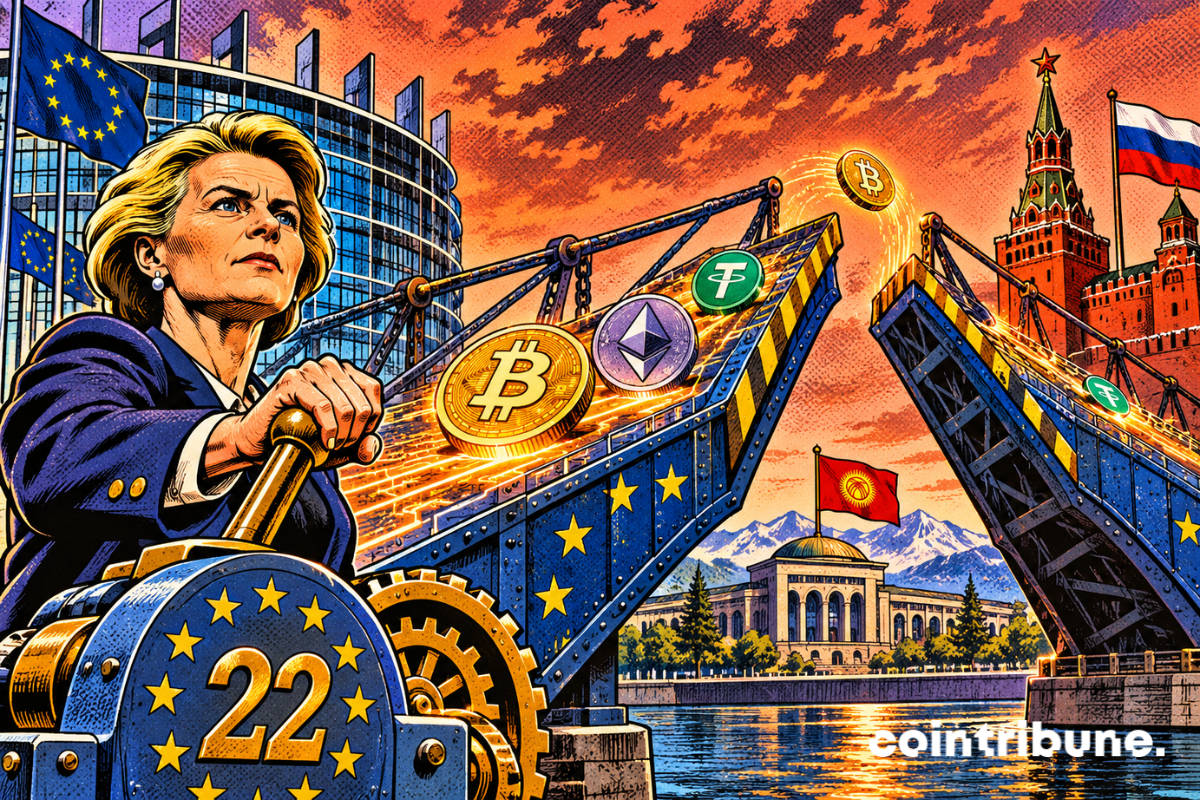
The European Union wants to strengthen sanctions against crypto platforms that allow Russia to circumvent Western financial restrictions. Presented on November 23, 2026 by the European Commission, the 22nd sanctions package also provides for the exclusion of around 60 Russian banks from the SWIFT network. Brussels now intends to increase pressure on intermediaries established in third countries. A working group specializing in sanctions linked to cryptocurrencies has also been created.
In brief
- The EU is preparing new sanctions against crypto platforms linked to Russia.
- Around 60 Russian banks could be excluded from the SWIFT network.
- Brussels has launched a working group specializing in sanctions evasion via cryptocurrencies.
The EU extends its pressure on crypto platforms
The European Commission wants to further reduce Russia’s financing possibilities in connection with the war in Ukraine. Ursula von der Leyen presented on Monday November 23 a new series of measures targeting in particular banking establishments, crypto platforms and payment networks.
Brussels had already banned transactions with crypto providers established in Russia when adopting its 20th sanctions package in April. The new measures must also concern foreign intermediaries who facilitate the circumvention of European restrictions.
At the same time, nearly 60 Russian banks risk exclusion from SWIFT. This financial messaging network allows banking establishments to carry out their international operations.
The European Commission also announced, on November 6, the creation of a working group dedicated to crypto sanctions. This should help improve coordination and enforcement of existing restrictions. The 22nd package must nevertheless obtain the approval of the 27 Member States. The final list of affected platforms has not been made public.
Foreign platforms are increasingly exposed
European restrictions have been extending beyond Russian borders for several months. On July 23, 2026, when adopting the 21st sanctions package, the EU Council extended its ban on transactions to 14 crypto service platforms. The latter were established in particular in Georgia, Panama, the United Arab Emirates, the Marshall Islands, Kyrgyzstan and Belarus.
Brussels had also introduced the possibility of prohibiting transactions with crypto providers established in certain third countries. The scope of this instrument is important. A jurisdiction could be subject to sectoral restrictions if it systematically and persistently fails to prevent crypto activities facilitating sanctions evasion.
Platforms that respect local regulations could then also suffer the consequences of a ban targeting their country of operation. For international crypto companies, regulatory risk therefore no longer depends solely on their own customers. It may also arise from decisions taken against their jurisdiction of registration.
Crypto sanctions have already produced results
The Russian stablecoin A7A5 offers an interesting example of the effectiveness of Western restrictions. Launched in January 2025 and backed by the ruble, this token has recorded more than $102 billion in cumulative transactions, spread across approximately 251,000 operations, according to Elliptic data.
In October 2025, the European Union included A7A5 and several Russian crypto platforms in its sanctions system. By June 2026, the stablecoin’s average daily volume had fallen back to $24.3 million, a 96% decline from its July 2025 peak.
Western sanctions, regulatory restrictions Russians and the unavailability of certain platforms contributed to this drop. The stablecoin, however, continues to operate on the Ethereum and Tron blockchains. This is what makes crypto sanctions so special. Brussels can prohibit transactions with certain intermediaries, but does not have a switch to turn off a public blockchain.
The effectiveness of the restrictions therefore largely depends on the cooperation of platforms, financial institutions and stablecoin issuers. The case of A7A5 nevertheless shows that a digital asset can remain technically operational while losing a large part of its economic utility. For crypto companies, the next package of European sanctions could considerably increase the risks of non-compliance. This threat would even concern companies that carry out their activities far from the territory of the European Union.
Maximize your Tremplin.io experience with our ‘Read to Earn’ program! For every article you read, earn points and access exclusive rewards. Sign up now and start earning benefits.