
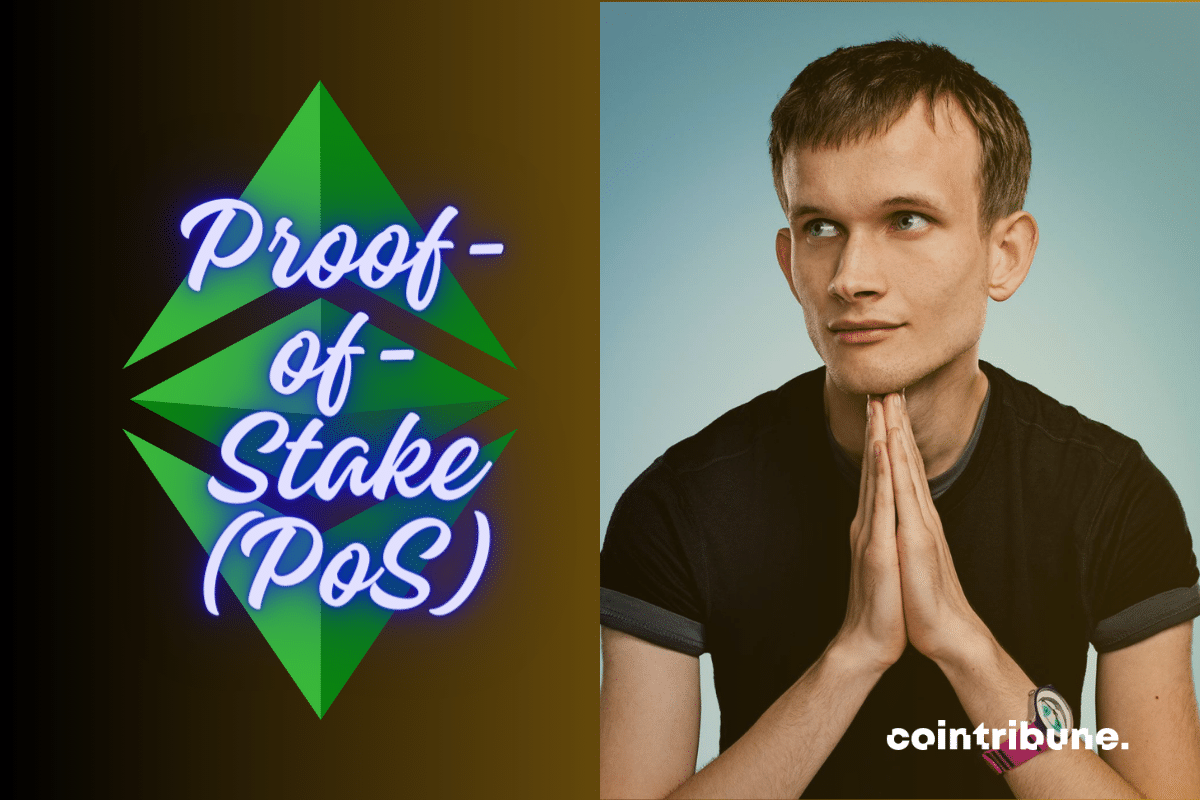
Before ending the year 2023, Vitalik Buterin comes up with a new solution to improve the Ethereum consensus mechanism. Or rather to resolve a problem of systemic complexity at the heart of Proof-of-Stake of 2e largest blochcain in the world. Overview !
Ethereum PoS in danger?
The series of alternate upgrades by Ethereum (The Merge, Spella, Dencun, Holesky…) demonstrate the commitment of its team of developers to propel the network towards previously unreached heights by others.
But Vitalik Buterin, as a co-founder, is the strict, perfectionist type. To his eyes, the Ethereum blockchain has several flaws : lack of network decentralization, excessive use of Layer 1, existence of back doors in all layers 2, inappropriate mode of governance of pools by DAOs, etc.
Although improved by The Merge and Shanghai-Capella, aka Shappella, upgrades, Ethereum’s staking mechanism remains to be improved for Vitalik.
“ In case you missed it: Vitalik Buterin suggests three ways to simplify Ethereum’s proof-of-stake design. »
L’article attached by The Block to this Tweet highlights a Vitalik Buterin determined to resolve a potential issue with Ethereum PoS. But what is really happening? In fact, the proper functioning of the network requires a large number of digital signatures using cryptography by validators.
In the eyes of Vitalik Buterin, this represents a considerable workload for these network guardians. However, the arrival of new validators risks complicating things: the more their number increases, the greater the need for signatures.
To drive the point home, the new improvements planned by the Ethereum team may complicate the process even more. In a while, additional signatures will be added to those already required by the PoS mechanism. Hello heaviness!
And let’s note at the same time that Vitalik Buterin only stakes a tiny part of his ETH due to the absence of multiple signature wallets.
What does the Russian-Canadian genius propose?
Concerned about the future of his blockchain, this IT genius puts three very distinct solutions on the table.
“ A proposal for simplification of PoS: design a model that only requires 8192 signatures per slot (even with SSF), which considerably simplifies and simplifies the implementation of consensus. »
8192 signatures per slot, how to achieve this? “ Assuming a traditional two-round consensus protocol (like what Tendermint uses, and like what SSF will inevitably use), you need two signatures per slot per participating validator. We must get around this reality. I see three main approaches to achieve this », continues Vitalik in his article published on ETH Research.
Here is a summary of these approaches:
- significantly increase the minimum amount of ETH required to operate a validator in decentralized staking pools;
- establish two levels of stakers, the first group being more demanding and the second less demanding;
- randomly select validators according to the slot.
In short, these solutions for the overhaul of Ethereum’s Proof-of-Stake mechanism seem to align with the protocol improvement plan proposed by Vitalik in which he promoted “ minimum viable encapsulation “.
Maximize your Tremplin.io experience with our ‘Read to Earn’ program! For every article you read, earn points and access exclusive rewards. Sign up now and start earning benefits.


