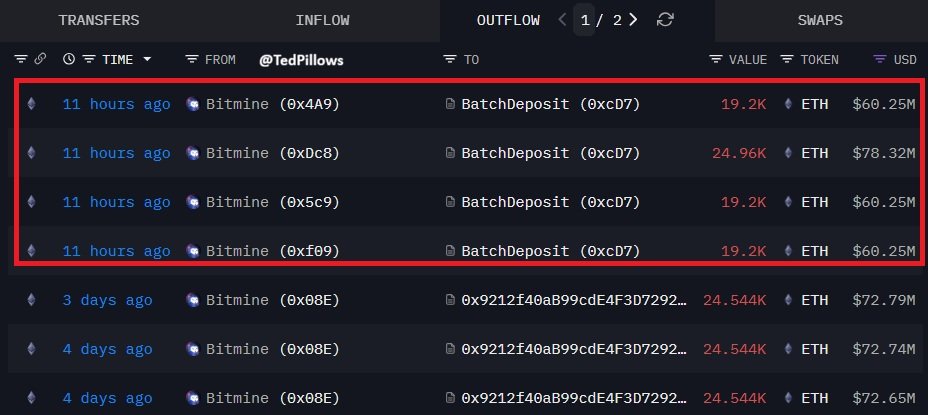
The giant Bitmine has just deposited $259 million in ETH into the Ethereum network, causing unprecedented congestion in the validator queue. With nearly a million ETH pending, this announcement reveals a major trend: the institutional adoption of crypto staking.
In brief
- Bitmine adds +82,560 ETH ($259 million), and the Ethereum validator queue is now close to 1 million.
- 29% of the total ETH supply is locked in staking, reflecting growing institutional adoption.
- This historic congestion raises questions about the scalability of Ethereum and its future in 2026, between yield opportunities and centralization risks.
Crypto: Bitmine propels Ethereum staking with $259 million in ETH
After a first deposit of $219 million in Ethereum staking in December, Bitmine renews the operation, this time staking 82,560 ETH, or $259 million! This operation instantly increased the queue of validators, which now reached 977,000 ETH, with an estimated activation time of 17 days. A record which illustrates the growing enthusiasm for staking, now seen as a stable source of income in the face of the volatility of the crypto market.
This movement is part of a long-term strategy, where Bitmine moves from a speculative logic to a search for passive returns. The data confirms this dynamic from an institutional point of view. In fact, 35.5 million ETH, or 29% of the total supply, are now locked up in staking. A symbolic threshold, which reinforces the credibility of Ethereum as an institutional investment asset. This, by questioning the liquidity of the crypto network in the long term.
Ethereum: what the data says about staking demand
The saturation of the Ethereum validator queue following the deposit of 259 million dollars in staking by Bitmine is not trivial. Historically, spikes in staking activity have often preceded price increases. In June 2025, a similar phenomenon was followed by a doubling of the price of ETH. Analysts therefore see this as a bullish signal for 2026, especially as institutional demand does not weaken.
Bitmine is not isolated: other players like Coinbase or Kraken are strengthening their positions, accelerating the transition towards an ecosystem dominated by big players. This concentration raises questions about the accessibility of staking for small investors, as technical and financial barriers rise.
Ethereum in 2026: towards mass adoption and a new era for staking?
Ethereum is entering a critical phase. Indeed, the crypto network must prove that it can manage the influx of staking requests while maintaining its scalability, in particular via the updates planned for 2026. The challenges are numerous:
- Reduce waiting times;
- Optimize rewards;
- Guarantee security in the face of increasing centralization of validators.
For investors, this dynamic offers opportunities, but also risks. The increased scarcity of ETH in circulation could support prices. But too much concentration in the hands of players like Bitmine could also weaken the ecosystem. For Tom Lee, this trend could propel ETH to $250,000! A bold prediction, but one that is based on a growing correlation between staking, scarcity of circulating supply and the valuation of Ethereum.
Bitmine's announcement confirms Ethereum's shift towards an institutional era, where staking becomes a strategic lever. It remains to be seen whether the crypto network will be able to reconcile growth and decentralization. And you, would you be ready to stake your ETH in this context? The debate on the balance between return and risks is more open than ever.
Maximize your Tremplin.io experience with our 'Read to Earn' program! For every article you read, earn points and access exclusive rewards. Sign up now and start earning benefits.