As the cryptocurrency market took a break in October, following its peaks earlier in the month, many investors shifted from speculation to strategies still capable of generating returns. This change in behavior has caused a surge in stablecoin activity, especially on Ethereum, where transaction volumes have reached records.
In brief
- Stablecoins issued on Ethereum saw a marked increase in transactional activity throughout October, confirming their position as the primary network for stablecoin liquidity and transfers.
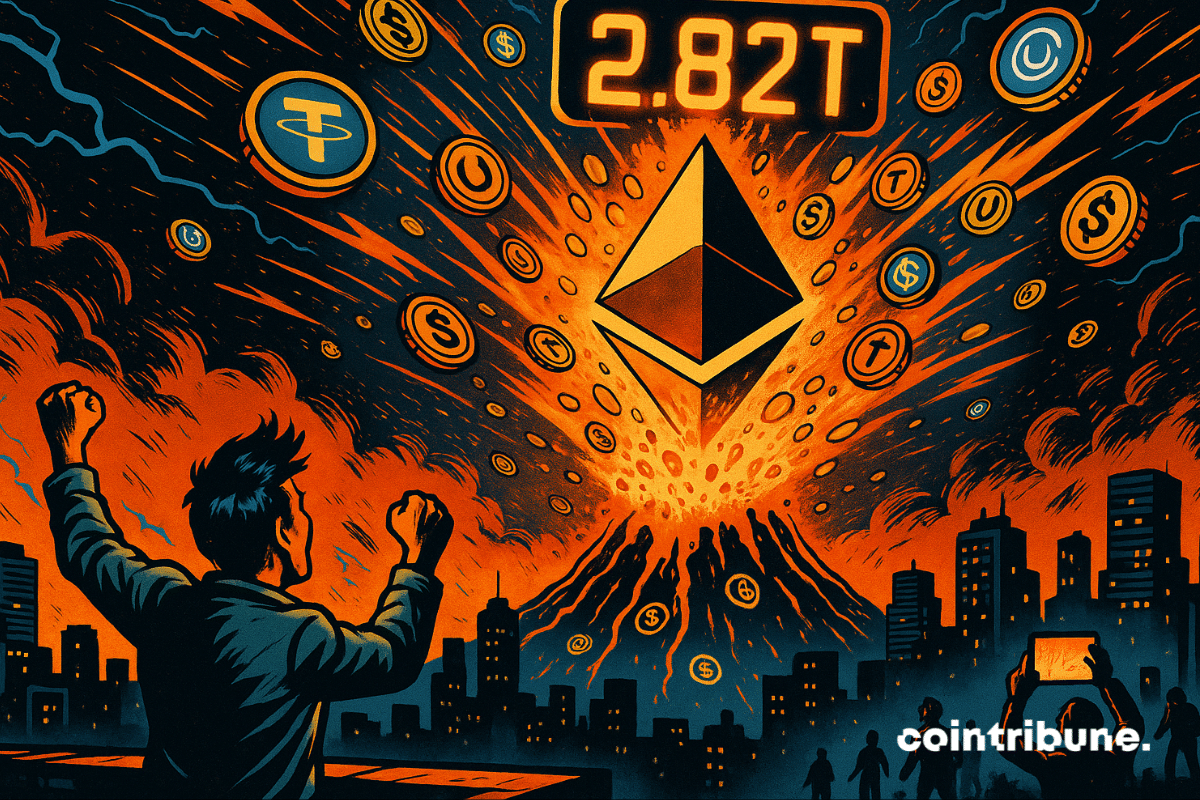
- Monthly trading volume on Ethereum reached $2.82 trillion, breaking the previous record of $1.94 trillion set in September.
- Circle's USDC retained its dominance with a trading volume of 1.62 trillion, while Tether's USDT followed with 895.49 billion.
Ethereum stablecoin volume hits all-time high
Ethereum-based stablecoins saw a marked increase in transactional activity throughout October, signaling renewed demand on the network. Data from The Block showed that the total monthly trading volume of stablecoins on Ethereum reached around $2.82 trillion, surpassing the previous record of 1.94 trillion set in September. The 45% monthly increase strengthened Ethereum's position as the leading platform for stablecoin liquidity and transfer in the crypto ecosystem.
Among individual stablecoins, here is how trading volumes looked in October:
- Circle's USDC dominated the market, reaching a total volume of $1.62 trillion, up from $1.05 trillion in September, maintaining its position as the most actively traded stablecoin.
- Just behind, Tether's USDT saw its volume increase to $895.49 billion from $580 billion the previous month, continuing its strong presence in the market.
- Meanwhile, MakerDAO's DAI saw a slight decline, recording $136 billion, compared to $141.2 billion in September.
- Other stablecoins totaled the remaining volume, with smaller but still notable contributions.
At the same time, the overall value of stablecoins has continued to increase. Data from DeFiLlama showed that the cumulative market capitalization reached $307.58 billionwith Ethereum-based stablecoins accounting for 165.23 billion of that total, or approximately 53.7% of the global stablecoin market, reinforcing Ethereum's continued leadership in blockchain-based finance.
Additional figures from Token Terminal revealed that the total supply of stablecoins on Ethereum has now surpassed $184 billion, an increase of more than $100 billion since January 2024. Transfer activity has also increased steadily, with the velocity of stablecoins also increasing, a sign of increased movement on the network.
Liquidity shifts during market downturns
According to Vincent Liu, chief investment officer at Kronos Research, the rise in stablecoin activity reflects traders prudently manage their funds while the main cryptocurrencies lose value. He added that many investors kept their capital in stablecoins to take advantage of possible buying opportunities during market downturns. These tokens, Liu said, serve as both a hedge against volatility and a short-term yield tool while waiting for new entry points.
The peak of stablecoins came at a time of a more general cooling of the market after several months of strong rallies. Over the past month, Bitcoin has fallen more than 12%, hovering around $107,390 after another 3% decline in 24 hours. Ethereum has also fallen by over 17% over the same period, currently trading around $3,710 after another 4% decline over the past day.
This market correction appears to have prompted traders to shift their holdings to more stable assets, with many favoring this digital asset class as safe investment options while returns remain attractive within decentralized finance protocols.
New drivers of stablecoin growth
To put these numbers into context, Min Jung, research associate at Presto Research, pointed out that stablecoins have been among the fastest growing segments of crypto in recent months. She attributed the latest surge to a mix of market developments, including Circle's impending IPO and the Genius Act, which provided clearer regulatory support for stablecoin operations.
Jung also highlighted that yield farming, particularly those involving liquid yield tokens, has attracted growing interest from traders seeking better returns. At the same time, new stablecoins with innovative mechanisms continue to attract users wishing to diversify their sources of income in the world of decentralized finance.
These factors combined have created an ideal environment for stablecoins to thrive. As traders seek both yield and stability during times of market uncertainty, Ethereum has once again proven to be the preferred network for liquidity, transfer efficiency, and innovation within the digital asset ecosystem.
Maximize your Tremplin.io experience with our 'Read to Earn' program! For every article you read, earn points and access exclusive rewards. Sign up now and start earning benefits.