
While networks like Solana and BNB have gained visibility thanks to their fast trading capabilities and consumer-oriented applications, they remain far behind Ethereum in total capital locked in decentralized finance (DeFi). In its 2025 year-end review, Ethereum revealed that its total value locked (TVL) grew at a significantly higher rate than other layer 1 blockchains. This growth solidified Ethereum's position as the primary hub for large-scale DeFi activity and liquidity.
In brief
- Ethereum consolidated its lead in DeFi in 2025 with total value locked reaching $99 billion.
- Transaction fees fell to their lowest level in five years and Layer 2 solutions reduced costs to less than a penny per transaction, improving accessibility.
- Ethereum recently broke out above key resistance, signaling a possible continuation to higher levels.
Deep liquidity that sets Ethereum apart
In a detailed publication on X, Ethereum claimed to have consolidated its role as a central platform for the digital economy in 2025. The network specifies that more than $99 billion is currently locked in its DeFi ecosystem, more than nine times the amount recorded by the second layer 1 blockchain. This gap highlights Ethereum's unique ability to host intense financial activity and offer deep liquidity pools.
This depth allows the network to efficiently process large transactions, supported by well-capitalized lending markets and ample order books. This makes Ethereum particularly attractive to institutional investors and large-scale players.
Lower fees, increased accessibility
In 2025, the Ethereum mainnet saw its transaction fees drop to their lowest level in five yearswhile Layer 2 solutions offered costs below a penny. This has made everyday uses such as payments, remittances or savings easier. The introduction of new paymaster systems has enabled large applications to take over, or even eliminate, fees for users, lowering barriers to entry and contributing to the rise of Ethereum's TVL.
The ecosystem also saw notable activity in stablecoins and prediction markets, with over $18.8 trillion transacted in stablecoins over the year, and approximately $20 billion in cumulative betting volume across mainchain and Layer 2 solutions.
Major technical updates
Two important updates marked the year 2025: Pectra and Fusaka. These have made wallets easier to use, improved the user experience and strengthened access to Layer 2 solutions. They have also increased the network's capacity to absorb an increasing volume of activity while ensuring lasting stability.
In 2025, Ethereum celebrated its 10th anniversary with several notable milestones:
- The network now hosts over 88 million smart contracts and has reached a record 1.74 million daily on-chain transactions.
- It maintains the largest developer community in the blockchain universe, with 32,000 active contributors and 16,000 new developers registered between January and September.
Course performance and key technical levels
Market dynamics in 2025 reflected this growth. Ethereum reached an all-time high of $4,953 in August, before entering a correction phase in October. Trading at $3,249 currently, ETH recently broke a downtrend line and surpassed key resistance at $3,050. It is now testing $3,445, although a slight pullback occurred after profit-taking.
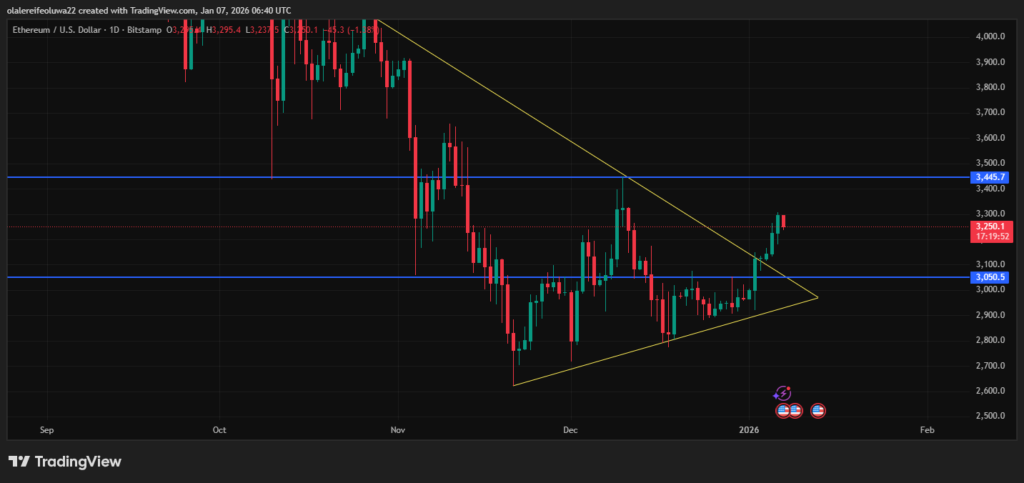
If it manages to reclaim the $3,500–3,600 zone, a strong rebound towards $4,000 could begin, with $5,000 as a long-term objective. Maintaining support at $3,050, however, remains essential to preserve the current bullish momentum.
Maximize your Tremplin.io experience with our 'Read to Earn' program! For every article you read, earn points and access exclusive rewards. Sign up now and start earning benefits.


