

Ethereum and Solana staking reached record levels in the third quarter of 2026, according to the Bitwise report, signed by Kam Benbrik and Rafal Klich and published on October 20 (“Q4 2026” edition, which covers the third quarter). However, yields have declined on both networks. Ethereum had an annualized gross return of 2.63%, up from 2.81% in the previous quarter. Solana’s was 5.99%, compared to 6.38%. This development highlights a paradox: more crypto-assets are immobilized to secure the networks, but the remuneration for staking is decreasing. What is the origin of this drop and what place do transaction fees occupy in validator rewards?

In brief
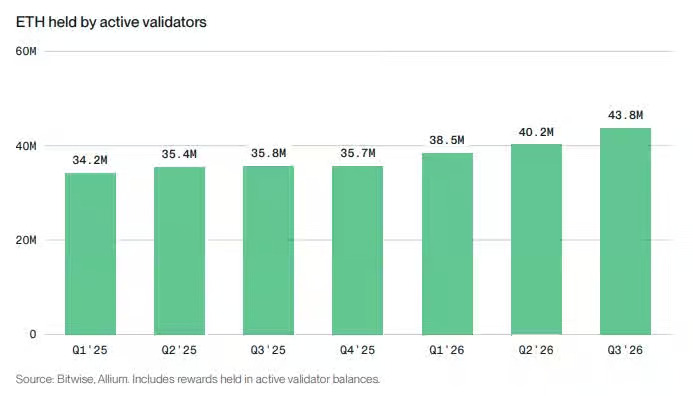
- At the end of September 2026, 43.8 million ETH (nearly 36% of the supply) and 440.5 million SOL (69% of the supply) were staked, according to Bitwise.
- Ethereum’s average annualized return increased from 2.81% to 2.63% in Q3. Solana’s gross returns fell by around 6%.
- Rewards are spread across more tokens. New issuance funds over 96% of Ethereum’s yield and 90% of Solana’s.
- Solana activity: 14.2 billion transactions (+45%) and fees up 49% to $76 million, mainly driven by memecoins.
Ethereum: 35.9% of staked supply, but a gross yield of 2.63%
On Ethereum, 43.8 million ETH were staked at the end of September 2026. This represents 35.9% of the total supply, according to Bitwise. This is a record for the network.
The third quarter showed net inflows of nearly 2 million ETH. This is the sixth consecutive quarter of positive flows. Over the first nine months of 2026, net inflows reach 7.96 million ETH.
In his reportBitwise relies on the declared stake of Bitmine, a company led by Tom Lee and presented by The Block as the leading Ethereum treasury company. According to an SEC filing cited by Bitwise, its staked ETH increased from 0.41 million at the end of December 2025 to 5.07 million as of September 27, an increase of more than 1,000%. The company had already increased its stake to 1.5 million ETH in a previous step.
Why is Ethereum staking yield decreasing?
THE average annualized gross return of Ethereum stood at 2.63% in the third quarter, compared to 2.81% in the previous quarter. Bitwise researchers explain the mechanism: the more ETH staked, the more rewards are distributed among a large number of participants, which reduces everyone’s gain. The decline in execution rewards (tips and MEV) also contributes.
Staking consists of immobilizing tokens to validate transactions and secure the network, in exchange for rewards. A “gross” return is understood, according to Bitwise, before operator fees: it is therefore not necessarily what each investor receives, whose net gain also depends on taxation.
These rewards remain very dependent on the issuance of new tokens, that is to say the creation of new ETH paid to validators. According to Bitwise, 96.3% of the gross yield from Ethereum staking comes from the issuance of new ETH. The rest, or 0.10 points, comes from transaction tips and MEV, revenues related to ordering transactions. However, the Ethereum network revenue (fees and MEV) fell to approximately $40.6 million in the third quarter, compared to $63 million in the second.
Solana: 69% of the staked supply and a gross yield of 5.99%
Solana follows the same trajectory. The network matters 440.5 million SOL stakedor 69% of the offer: a record. Its gross yield fell from 6.38% to 5.99%, a drop of around 6% in relative value (0.39 percentage points).
The activity is clearly progressing. Solana processed 14.2 billion non-voting transactions in the third quarter, or 45% more than in the second, for a roughly stable average cost (around $0.005 per transaction).
Fees paid by users jumped 49% in dollars (33% in SOL) to reach $76 million, significantly more than Ethereum’s approximately 40.6 million (fees and MEV). They are largely carried by the memecoin trading. The volume of tokenized stocks on Solana also increased by 45%, to more than $6.9 billion.
Why is the yield on Solana staking falling?
According to Bitwise, almost 90% of Solana’s gross yield comes from inflation, that is to say from newly issued tokens: most of the rewards therefore do not depend on network activity. The drop in yield is mainly due to the protocol’s disinflation schedule, to which is added a distribution over a slightly larger stake.
The share of inflation fell by 0.53 points, partly offset by a 0.14 point increase in activity-related rewards, such as block pay and Jito tips. Each protocol sets its own emission rules. There decline in Solana’s yield therefore does not reproduce that of Ethereum identically.
Ethereum or Solana: how to compare staking returns?
In the third quarter of 2026, the gross yield reported by Bitwise is higher on Solana (5.99%) than on Ethereum (2.63%). However, this comparison is not enough to determine which option is the most advantageous. Fees, risks, staking terms and asset price variations also matter.
The table below summarizes the main indicators:
| Indicator | Ethereum | Solana |
| Staked tokens | 43.8M ETH | 440.5 M FLOOR |
| Share of total supply | 35.9% | 69% |
| Yield | 2.63% gross annualized (2.81% in Q2) | 5.99% gross (6.38% in Q2) |
| Share of yield from new tokens | 96.3% | almost 90% |
| Fees and MEV in Q3 | approximately $40.6 million ($63 million in Q2) | $76 million ($51 million in Q2, +49% in dollars) |
One thing is therefore certain: Ethereum and Solana staking always attracts more capital. However, its remuneration is mainly based on the issuance of new tokens (and not on the activity of the networks). The next quarterly reports will tell if fees, which are rising sharply on Solana, are taking a more sustainable place in rewards, or if the arrival of new capital continues to reduce the yield per token on Ethereum. File to follow…
Maximize your Tremplin.io experience with our ‘Read to Earn’ program! For every article you read, earn points and access exclusive rewards. Sign up now and start earning benefits.


