
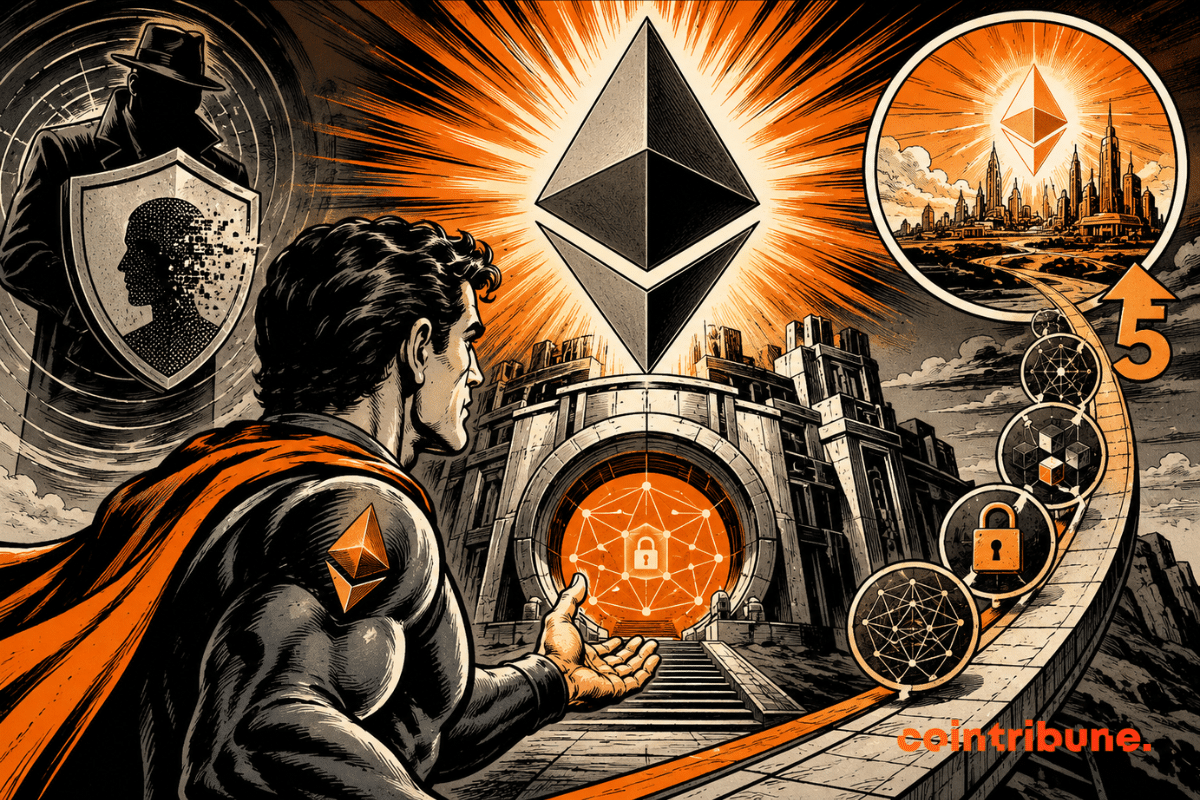
The debate on the future of Ethereum is accelerating around a major technical objective: making Zero-Knowledge the basis of its architecture in order to make the protocol faster, more affordable and more secure. Joseph Lubin, CEO of Consensys, believes that this transition could transform the base layer of the network and bring layers 2 closer to a more unified ecosystem. According to him, Ethereum could become a completely Zero-Knowledge proof-based protocol within the next five years.
In brief
- Joe Lubin believes that Ethereum could become a fully zero-knowledge proof-based protocol within three to five years.
- This evolution aims to strengthen the base layer while improving composability between the main network and layers 2.
- Layer 2 solutions remain important because they serve as a testing ground for ZK technologies before their wider deployment.
- The rollup-focused roadmap is entering a phase of convergence after a period marked by liquidity fragmentation.
- The long-term goal is to make Ethereum faster, more affordable, and more consistent, without weakening its security or decentralization.
Joe Lubin focuses on layer 1
Joe Lubin, CEO of Consensys, believes that the roadmap focused on rollups remains relevant, but he emphasizes one central point: layer 1 must evolve. According to him, ongoing innovations can make this strategy more effective, provided the main chain is strengthened. In his interview given to The Blockhe declares:
I am a big supporter of the acquisition-driven strategy, especially since developments and innovations are underway to make it particularly effective. This includes strengthening Ethereum Layer 1 through initiatives like Lean Ethereum, which could increase the value and impact of this approach.
Joe Lubin, co-founder of Ethereum. Source: The Block.
This orientation, according to Lubin, must notably involve the Lean Ethereum initiative, a long-term proposal led by Justin Drake, researcher at the Foundation, in order to simplify the protocol and integrate advanced Zero-Knowledge cryptography.
In this vision, deploying ZK proof does not only serve to improve performance. It must also reinforce composability between the base layer and layer 2 networks. Lubin thus believes that “Ethereum could become, within three to five years, a protocol entirely based on Zero-Knowledge proof ». This development should help Ethereum maintain its security, while meeting expectations on costs, speed and censorship resistance.
This change comes after several months of re-evaluation of the roadmap focused on rollups. Vitalik Buterin recognized last February that the initial vision had not completely produced the expected effects. Some layers 2 mainly created separate spaces, sometimes described as brand fragments, instead of forming a fluid whole. The stated priority now consists of making the use of the main network more competitive, without abandoning the guarantees of decentralization.
Ethereum relies on ZK proofs to connect layer 1 and layer 2
For Lubin, layers 2 retain an important place in the construction of a global computer. They serve as experimentation environments, where complex technologies can mature before being integrated into the main network. ZK proofs play a key role here, as they already enable rapid verification of certain operations on second-layer networks.
With this logic, Ethereum keeps L2s as a testing ground for verifiable computation, privacy, and throughput. Lubin recalls that the ecosystem has long awaited the central role of zero-knowledge proofs. First intended for layer 2, they could then support layer 1 with several formally verified provers.
Chains like Linea, developed at Consensys, and Gnosis already use these mechanisms to compose transactions synchronously across different networks. Ultimately, this work could enable a single atomic execution context. Users could then move assets between Ethereum-based networks without going through bridges, reducing liquidity fragmentation.
This approach also extends to Besu private networks, a derived version developed by Consensys. According to Lubin, institutions like Citi, DTC and BNY Mellon use this type of infrastructure. The goal is to bring enterprise channels closer to the public ecosystem, while maintaining more seamless integration with existing tools.
From fragmentation to a phase of convergence
Lubin acknowledges that the previous strategy fragmented liquidity. However, he presents this step as an assumed choice:
We knew we were fragmenting liquidity. We knew we needed a modular architecture where the execution would happen elsewhere.
Joe Lubin, co-founder of Ethereum. Source: The Block.
According to him, layer 2s have been given the space to explore their models, build their tools and test different forms of execution. This phase also allowed optimistic rollups to quickly enter the market, while ZK technology matured.
From now on, the ecosystem is entering a phase of convergence. The challenge is to connect existing capacities, rather than multiplying isolated networks. Lubin also emphasizes that “ certain layer 2 technologies should emerge as essential building blocks, while others could lose importance if they do not provide clear value”. The expected solutions must be distinguished by throughput, confidentiality or support for non-EVM applications.
This development also concerns governance. Recent departures within the Foundation have fueled questions, but Lubin dismisses the idea of a second foundation. Rather, it evokes the creation of several groups from the current organization, with missions focused on protocol, ergonomics, scalability and institutional influence.
For Ethereum, the next five years could mark a shift from a dispersed modular architecture to a more coherent structure around ZK proof. If this trajectory is confirmed, the ETH ecosystem will seek to combine almost unlimited capacity, better composability and the maintenance of mainnet guarantees.
Maximize your Tremplin.io experience with our 'Read to Earn' program! For every article you read, earn points and access exclusive rewards. Sign up now and start earning benefits.


