
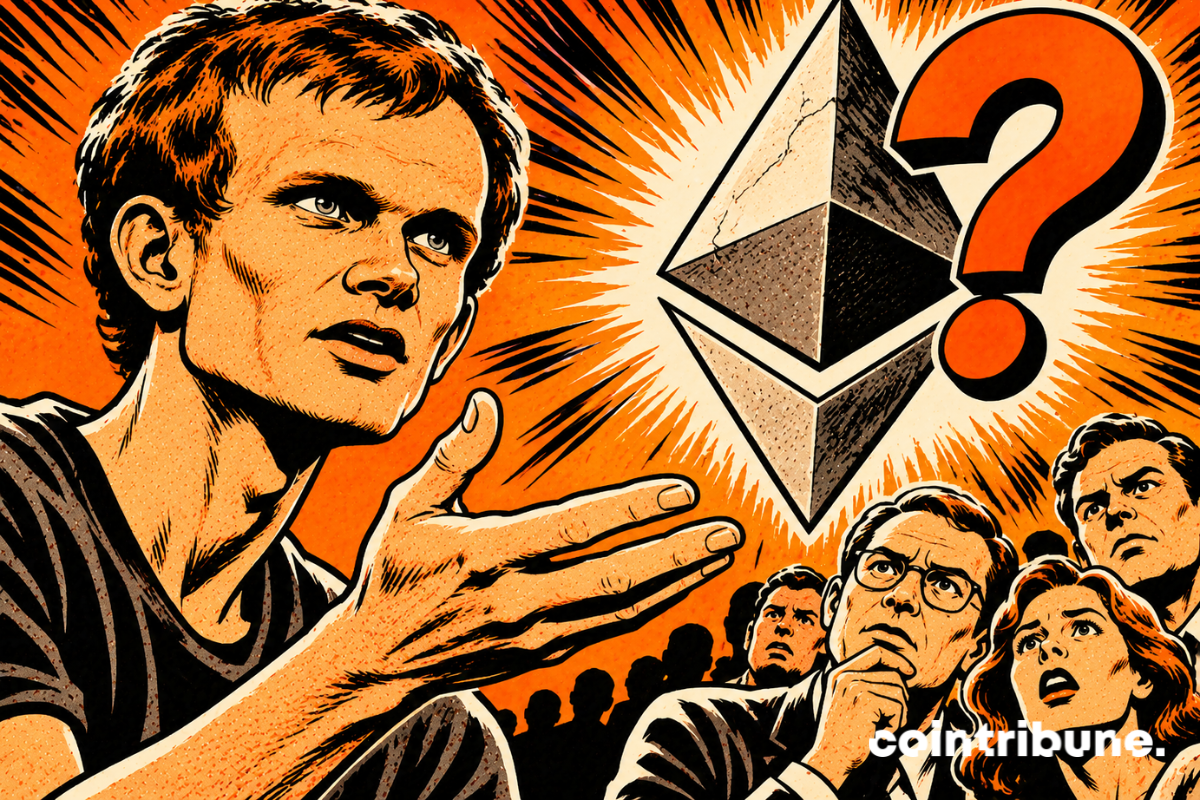
Vitalik Buterin no longer wants the value of ETH to depend primarily on fees destroyed by Ethereum. Its reasoning resolves a contradiction that has become central: the network cannot simultaneously make its transactions less expensive and rely on high fees to support the scarcity of its token.
In brief
- Vitalik Buterin believes that the value of ETH should no longer depend primarily on the fees burned on Ethereum.
- It favors a vision of ETH as a store of value, based on the security and resilience of the network.
- Declining transaction fees and the rise of layer 2 solutions are significantly reducing ETH destruction.
- According to Buterin, maintaining high fees to make ETH more scarce would penalize users and hinder Ethereum adoption.
- The long-term value of ETH is expected to rely more on trust, decentralization, and the network’s ability to withstand crises.
Ethereum renounces making fees its main argument
Since the introduction of EIP-1559 in 2021, a portion of fees paid on Ethereum are permanently destroyed. This mechanism nourished the thesis of “ultrasound currency”. When destruction exceeds emissions paid to validators, the supply of ETH decreases.
Vitalik Buterin now believes that this mechanism should no longer constitute the heart of the token’s valuation. He summary his position thus: “ETH as a store of value makes much more sense than ETH considered as an asset whose value depends on the fees burned”.
His argument is based on several observations:
- The destruction peaks mainly came from speculative activities internal to crypto;
- These revenues would have decreased along with the price of ETH during a crisis;
- Layer 2 networks sustainably reduce fees paid on the main chain;
- Maximizing destruction would incentivize Ethereum to maintain costly transactions.
Buterin does not propose removing EIP-1559. “We should keep it”he specifies, before adding that holders should not worry if destruction remains permanently below 10% of the level necessary to compensate for new emissions.
The evolution is already visible. Ethereum had destroyed approximately 1.48 million ETH in 2022, compared to just 19,200 ETH since the start of 2026 at the time of the source article’s publication. This drop notably reflects the shift of part of the activity towards less expensive layer 2 solutions.
High fees would end up penalizing Ethereum
The new doctrine defended by Buterin breaks the artificial link between the interest of users and that of ETH holders. If the value of the token depends first on the fees destroyed, each drop in transaction costs becomes negative for investors, even when it improves the network experience.
Conversely, seeking more destruction would imply encouraging high costs. Such a strategy would risk excluding individuals and users who most need private, censorship-resistant transactions.
Buterin also contests the idea according to which the destruction would create a real floor for valuation. He cites the theoretical example of a token burning a billion dollars per year: with a discount rate of 4%, this income could justify a capitalization of 25 billion dollars. But this calculation only works if revenues remain stable when the market falls.
However, a large part of the record fees recorded between 2021 and 2023 came from NFTs and speculation. The sale of the Otherdeed virtual lands alone resulted in approximately $180 million in destruction in one day. The NFTs concerned are now trading far from their initial level, which illustrates the unstable nature of this source of income.
Transforming Ethereum into a fee machine would also require more interventionist governance. Buterin believes that a network managed like a large company should massively finance its development. He mentions around 700,000 ETH of annual expenses integrated into the protocol, which could reduce the income of validators by two thirds.
The value of ETH would first depend on its ability to survive
The new story proposed by Buterin is based less on mechanical scarcity than on the solidity of the infrastructure. According to him, the first quality of a store of value is its ability to survive technical, political and economic crises.
Ethereum should therefore prioritize decentralization, security, confidentiality, open code and censorship resistance. Buterin groups these properties under the acronym CROPS. “In the age of AI-driven disruption, stability will be highly valued”he says.
This focus warrants research into quantum resistance, multisignature wallets, privacy tools, and mechanisms preventing arbitrary exclusion of transactions. It also encourages more careful evolution of the protocol, with fewer modifications likely to increase its complexity.
Tokenized assets can reinforce this thesis without causing an explosion in fees. Their presence on Ethereum expands the use of ETH as collateral and a settlement asset, while providing more stable activity than the speculative waves linked to NFTs.
Buterin does not guarantee, however, that ETH will become a store of value comparable to bitcoin. Rather, it redefines the criterion to be observed: less the volume of tokens destroyed than the capacity of Ethereum to remain neutral, secure and usable for several decades. The price of ETH would then no longer be the consequence of the cost imposed on users, but that of the trust placed in the network.
Maximize your Tremplin.io experience with our ‘Read to Earn’ program! For every article you read, earn points and access exclusive rewards. Sign up now and start earning benefits.


