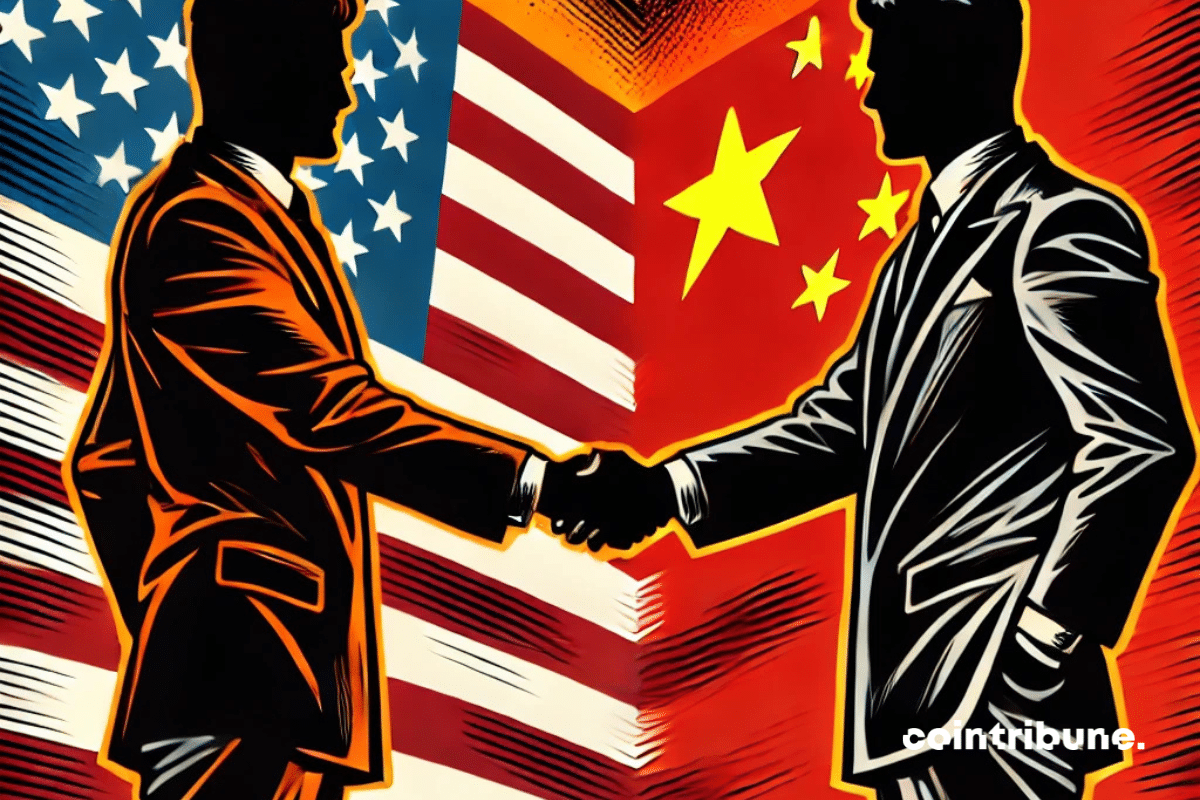
Barely re-elected, Donald Trump announced his intentions to pursue an uncompromising protectionist policy, and sought to impose record customs duties on Chinese imports. An approach reminiscent of his first mandate, where heavy customs sanctions created a precedent in the Sino-American trade war. But this time, in a post-pandemic context where the global economy is still fragile, the repercussions could prove more significant. While Beijing advocates dialogue, the world is preparing for a new phase of commercial confrontation with potentially global effects.
An uncompromising tariff standoff
Donald Trump, freshly returned to the political scene, has expressed his desire to impose customs tariffs of 10% to 20% on all products imported into the United States. Regarding goods from China, rates could reach unprecedented levels, between 60% and 100%. According to Steven Mnuchin, former Treasury Secretary under Trump, these measures are necessary because, according to him, “China is not respecting everything that was signed in the first phase of the trade agreement.” Through the imposition of such taxes, Trump wishes to “force Beijing to return to the negotiating table” and restore fairness that his administration considers compromised by Chinese trade practices deemed protectionist. Mnuchin precise : “we have one-way trade. Our market is totally open to their trade and investments, theirs is closed.”
The objective of this strategy is twofold. On the one hand, it aims to create leverage to force China to further open its market to American companies, and on the other, it also seeks to finance the tax cuts that Trump intends to introduce for American companies. Indeed, this protectionist policy is part of an economic vision where the taxation of Chinese imports could, in theory, allow the United States to recover part of its trade deficit and stimulate domestic industry. However, the effectiveness of such an approach remains debated, as some economists warn of retaliatory effects from China and the potential consequences for the American consumer.
A call for dialogue and warnings from Beijing
Faced with this American offensive, China reacted with a call for “cooperation”. She warned of the effects of escalation. For Chinese President Xi Jinping, there would be “no winners in a trade war”, and it would risk harming the two countries concerned, but also the global economy. Indeed, Beijing tries to maintain a moderate position, and emphasizes that opening discussions is preferable to confrontations which could lead to a spiral of measures and reprisals. However, by recalling the difficulties posed by the Covid-19 pandemic which prevented China from fully respecting the terms of the 2020 trade agreement, Beijing is trying to temporize and remains attentive to Washington's real intentions.
While Trump and his team are counting on customs sanctions to create economic pressure, China could consider countermeasures. However, Beijing seems to be banking on maintaining communication channels, aware that the fallout from a major trade clash could be damaging for its economy, already in a slowdown phase. The caution displayed by Xi Jinping can also be explained by the desire to strengthen ties with other economic partners, such as the European Union, which could find itself in a strategic position in the face of these tensions.
If this toughening policy continues, the impacts could go beyond a simple Sino-American trade rivalry. Europe could be tempted to strengthen its own trade barriers to protect its market from fluctuations in global tariffs. With this in mind, American and Chinese companies, for their part, will have to adjust their supply chains and their international strategies to respond to the new constraints. The outcome of this trade war could also influence the trade policies of other countries, which will have to navigate between the two superpowers to avoid major economic repercussions.
Maximize your Tremplin.io experience with our 'Read to Earn' program! For every article you read, earn points and access exclusive rewards. Sign up now and start earning benefits.