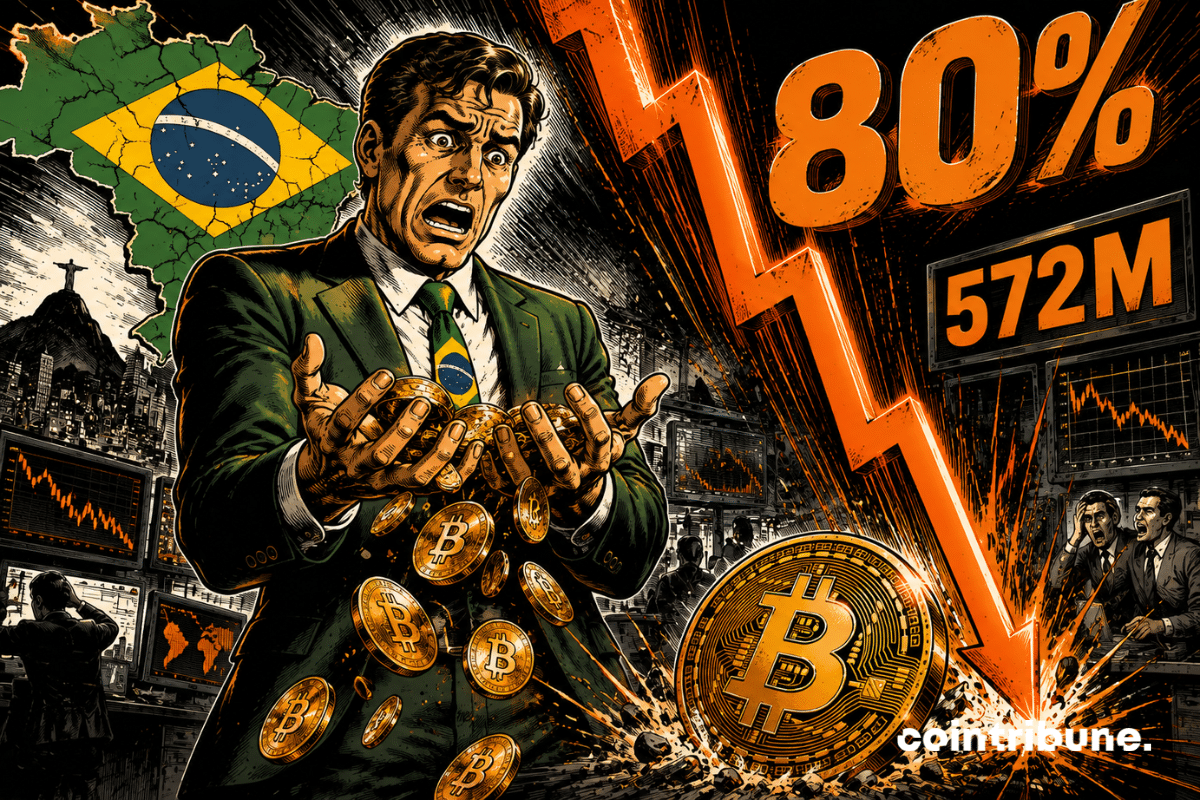
The contrast is striking. In July, Brazilian residents purchased “only” $572 million worth of crypto, according to the balance of payments statement published on August 27 by Banco Central. A month earlier, the counter peaked at 2.6 billion. In the space of thirty days, the plunge is therefore around 80%. Calendar coincidence? It’s hard to believe: July marked the very first month of full application of the new anti-money laundering governance and control requirements imposed on local platforms.
In brief
- Crypto purchases reached $572 million in July, up from $2.6 billion in June.
- The amount is almost 60% lower than that recorded in July 2025.
- Over the first seven months of 2026, cumulative transactions reached $15.25 billion, compared to $7.61 billion a year earlier.
Stablecoins weigh the bulk of the measure
The section followed by Banco Central measures the net acquisition of crypto with corresponding liabilities, mainly stablecoins. It appears in the balance of payments, under “other investments”.
The strengthening of banking supervision of cryptos dates from November 2025: resolutions 519 to 521 create a local status of virtual asset service provider, the SPSAV, and impose on platforms the same anti-money laundering obligations as on banks.
Fernando Rocha, head of the institution’s statistics department, explains in Valor Econômico that this drop in transactions reflects a phase of reorganization of the virtual assets market, in a context of reinforced regulation and supervision. According to him, platform governance and anti-money laundering procedures are among the main factors in this slowdown.
Since February 2, actors must be authorized, identify wallet holders and document the origin and destination of funds, with strict caps on transfers going through unlicensed foreign intermediaries. The banking prudential framework will come into force in January 2027.
A nuance is necessary: part of this decline is undoubtedly less due to a collapse in demand than a shift in flows towards now approved channels. There is currently no official breakdown to confirm this.
Over the year, the trend remains largely positive
The July brake does not erase the basic trajectory: 15.25 billion dollars were invested between January and July, compared to 7.61 billion over the same period in 2025. Gabriel Galipolo, governor of the institution, estimates that around 90% of the country’s crypto activity passes through stablecoins, used most often as a means of payment rather than as a speculative bet.
Banco Central is not seeking to slow down the adoption of cryptos. Above all, he wants flows to go through channels he can monitor, which explains why stablecoins focus most of his attention.
See you at the end of September: the next note from Banco Central will say whether July marked an accident or the start of a lasting plateau. Another deadline to watch is October 1, with the entry into force of resolution 561, which will prohibit settlement in stablecoins in electronic exchange. Fintechs will then have to turn to traditional foreign exchange, a change of rails which is reminiscent of the arrival of MiCA in Europe.
Maximize your Tremplin.io experience with our ‘Read to Earn’ program! For every article you read, earn points and access exclusive rewards. Sign up now and start earning benefits.