In recent months, protocol fees have become the crux of the matter in the Web3 ecosystem. As crypto projects mature, the question “who pays what, and for whom?” » comes back on everyone's lips. Governance tokens, once passive, are transforming into strategic levers. In this dynamic, the activation of fees at Uniswap promises to be a pivotal moment, symbol of a sustainable and assumed structuring of the decentralized model.
In brief
- The “UNIfication” vote validated the activation of fees on Uniswap v2 and v3.
- 100 million UNI tokens were burned to correct the historical lack of fees.
- Uniswap Labs is merging with the Foundation and giving up its traditional revenue streams.
- A legal agreement in Wyoming now binds Uniswap Labs to community governance.
Uniswap reorganizes around its UNI token
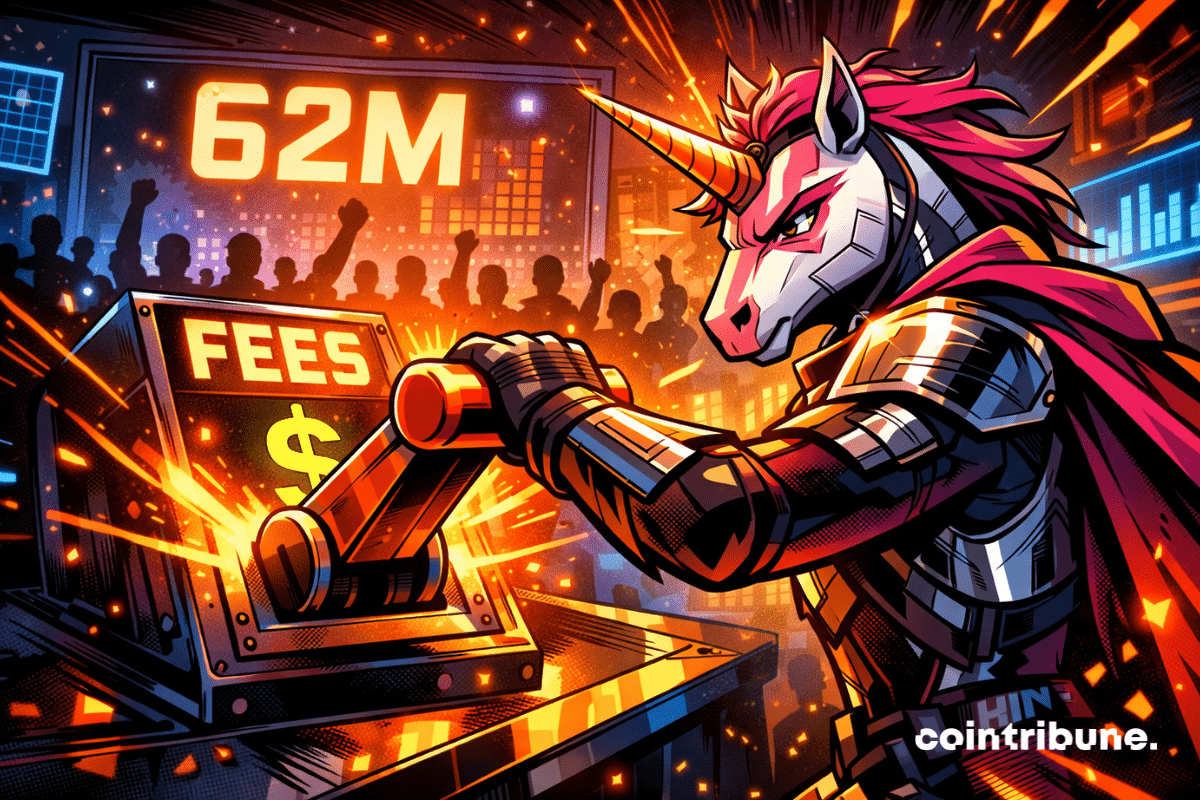
Since 2018, Uniswap has shaped the foundations of DeFi. But 2024 marks a historic turning point. THE “UNIfication” votecarried by Hayden Adams, garnered nearly 62 million votes in favor. A massive mobilization which validated the activation of fees on versions v2 and v3 of the protocol.
Stated objective: to make Uniswap the reference platform for tokenized finance. Labs and the Foundation merge their functions. The interface, wallet and API become free. Revenues will now focus on the growth of the protocol, financed from 2026 by a budget of 20 million UNI.
This change is accompanied by an internal overhaul: previously independent teams are joining Labs. This involves consolidating the ecosystem, while contractualizing the alignment between Uniswap Labs and the DAO. As Hayden Adams summed up on X:
Uniswap Labs will align with Uniswap governance through a contractual agreement, recognized as legally binding in the State of Wyoming under their DUNA law.
A burning mechanism to breathe new life into UNI
Uniswap doesn’t just enable fees. The protocol triggers the immediate burning of 100 million UNI tokens. This action aims to simulate what would have been destroyed if the fees had been active since 2020. It acts as a strong signal to holders: reduce supply, increase scarcity.
Technically, each fee collected is redirected to a contract called TokenJar. The UNI are stored there, then transferred to another contract, the Firepit, where they are permanently burned. This system guarantees the traceability of monetary destruction.
But Uniswap is also innovating in value capture via the Protocol Fee Discount Auction. This mechanism allows certain traders to benefit from fee-free exchanges, provided that they participate in the auction… and therefore in the burning of UNI. The protocol thus diverts the MEV from validators to integrate it into its own economy.
On user butter quips :
Markets estimate that the UNI airdrop will be worth the equivalent of 12 PS4s, or $4,716, if the proposal passes.
Crypto-governance: the Uniswap experience could become a lesson
What distinguishes this Uniswap reform is its legal framework. Thanks to Wyoming’s DUNA law, the DAO becomes a recognized entity. The agreement linking Labs to governance is not a promise: it has legal force.
A series of documents – service, compensation and governance agreements – were put to the vote. Two independent negotiators, Ben Jones and Hart Lambur, ensured the contractual balance. Any future action by Labs must now respect these commitments, for the benefit of UNI holders.
In the crypto world, where DAOs often remain abstract, this initiative offers a concrete avenue. Other projects, like MakerDAO or Synthetix, could take inspiration from it. Structuring governance becomes an issue of credibility on an institutional scale.
Highlights and key figures
- 100 million UNI tokens were burned immediately after the vote;
- The price of the UNI token is currently $6.23;
- The vote brought together nearly 62 million votes, out of a quorum set at 40 million;
- An annual growth budget of 20 million UNI will be put in place from 2026;
- The Protocol Fee Discount Auction could improve LP yields by $0.06 to $0.26 per $10,000 traded.
Last February, Uniswap took another founding step with the launch of Unichain, its own network designed to shake up the competition on Ethereum. This advancement, combined with the activation of fees, propels Uniswap into a new era of technological independence and institutional strength.
Maximize your Tremplin.io experience with our 'Read to Earn' program! For every article you read, earn points and access exclusive rewards. Sign up now and start earning benefits.