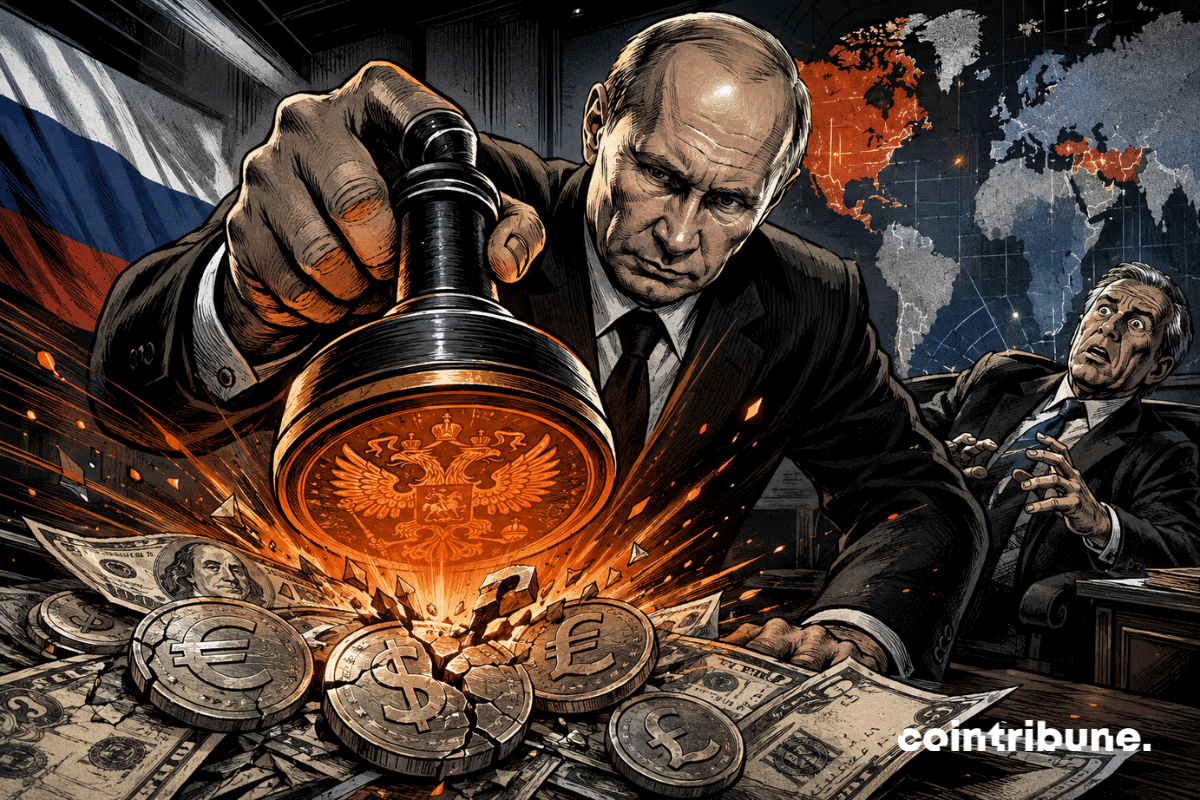
Russia wants to tax and regulate Western cryptocurrencies deemed “hostile”. Behind this measure, Moscow is above all seeking to regain control of a crypto market that has become strategic for its payments, its exchanges and its financial sovereignty.
In brief
- Russia wants to tax Western cryptocurrencies deemed risky.
- Bitcoin, Ethereum and USDT would remain accessible to individuals.
- The real issue is controlling cross-border crypto flows.
Moscow transforms crypto into a tool of sovereignty
Russia is preparing a new tax pressure on certain foreign cryptocurrencies. This offensive is part of a broader tightening, already visible with the Russian project aimed at more strictly regulating crypto. The stated objective is clear: to discourage the use of assets that Moscow considers vulnerable to Western decisions.
This category primarily targets tokens issued by companies located in jurisdictions capable of freezing funds. The Russian argument is therefore not only economic. He is political. A crypto or an asset that can be controlled from abroad becomes, in the eyes of Moscow, a security risk.
The message is quite brutal. Crypto will no longer be treated as a simple speculative market. It becomes a financial frontier. And on this border, Russia wants to choose who enters, who leaves, and at what price.
Bitcoin, Ethereum and USDT remain within the authorized corridor
The future Russian framework should let unqualified individuals access only three assets: Bitcoin, Ethereum and USDT. Everything else would go to a more supervised, more expensive area or reserved for professional profiles.
This choice may be surprising, especially for USDT. Tether can also block funds. But USDT remains too widely used to be dismissed all at once. Suddenly banning it would probably have shaken part of Russian crypto exchanges.
Moscow's logic therefore resembles a cold compromise. Bitcoin and Ethereum maintain their place thanks to their market depth. USDT survives thanks to its massive use. Other assets, like USDC or BNB, become easier to sacrifice.
A tax to repatriate volumes to Russian platforms
The proposed tax is not just punitive. It is also used to direct flows. Moscow wants to push users towards crypto platforms approved on its territory, rather than towards large international exchanges.
The market involved is huge. Russia remains one of Europe's largest crypto hubs by volume received. This is not necessarily because Russian individuals are investing massively. This is mainly because cross-border flows increasingly use digital assets.
In this context, each fee paid to a foreign platform becomes a leak. The new regulations seek to close this gap. It turns compliance into a toll. This movement also extends the Russian strategy around its own crypto exchanges to circumvent sanctions.
A tightening which can also push the market into the shadows
The risk for Moscow is obvious. If fees become too high, some users will seek less visible paths. Regulation can channel a market. But it can also send it to the margins.
The planned restrictions do not stop at taxes. Mandatory tests, annual limits, withdrawal deadlines and supervision of transfers could also be part of the system. For an ordinary investor, access to crypto would become less free and more administrative.
Foreign platforms will have to choose. Obtain Russian authorization, with all the constraints that this implies, or lose access to a still very active market. For some, the calculation will be simple. For others, it will be explosive.
This tightening comes at a time when Western sanctions are increasingly targeting crypto networks linked to Russia. The United Kingdom, the United States and their allies want to cut the circuits used to circumvent traditional financial restrictions.
Moscow responds with an opposite strategy. Instead of shrinking crypto, it attempts to box it into its own framework. She wants to keep the tool, but change the rails. It is a financial plumbing battle, less visible than banking sanctions, but just as decisive.
Basically, Russia is not turning its back on crypto. She wants crypto that is useful, monitored and politically aligned. Individual investors will lose freedom. Foreign platforms will perhaps lose volume, especially since the EU is also targeting crypto platforms in its sanctions against Moscow. The Russian state is trying to regain control.
Maximize your Tremplin.io experience with our 'Read to Earn' program! For every article you read, earn points and access exclusive rewards. Sign up now and start earning benefits.