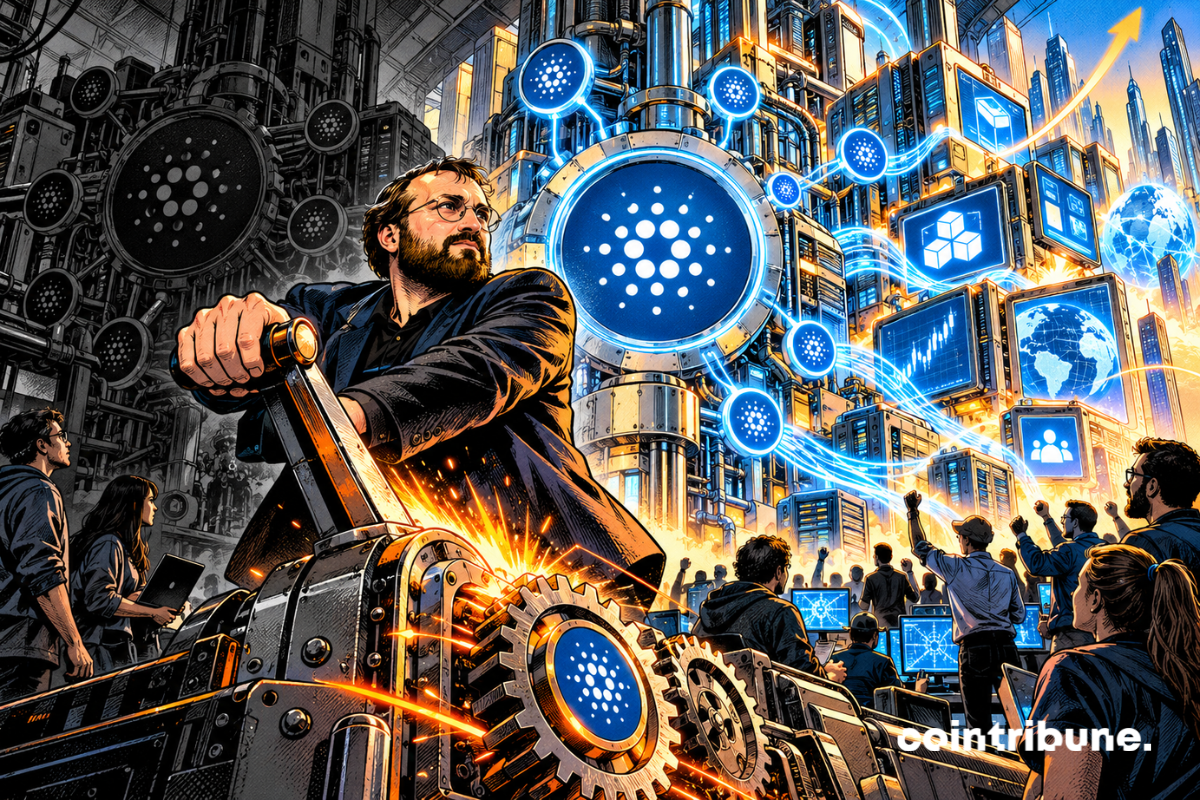
Charles Hoskinson believes that crypto has just entered a phase of exponential growth. During a speech at the United Nations, the Cardano founder compared blockchain to the Internet and artificial intelligence, two technologies whose adoption has accelerated after slower beginnings. Its most concrete example: tokenized stocks, which went from around 600 million to 3 billion dollars.
In brief
- Charles Hoskinson compares the evolution of crypto to that of the Internet and AI.
- Tokenized stocks grew from around $600 million to $3 billion.
- For him, blockchain is entering a phase where its adoption could accelerate significantly.
Hoskinson sees crypto scaling up
Charles Hoskinson starts from a fairly simple idea. Exponential technologies rarely progress steadily. For several years, changes may seem limited. Then the improvement of infrastructure, the fall in costs and the arrival of new users accelerate everything.
The Internet is its main point of comparison. International communications once depended heavily on distance. The network has gradually reduced this constraint until it allows almost instantaneous exchanges on a global scale.
Hoskinson now places blockchain on a comparable trajectory. He also associates this development with artificial intelligence, an area that he already wants to further integrate into the Cardano ecosystem.
AI models become capable of accomplishing more tasks with fewer computing resources. The blockchain is gradually gaining uses beyond the simple exchange of cryptocurrencies. Traditional finance is just beginning to provide several examples.
Tokenized stocks go from $600 million to $3 billion
Hoskinson cites asset tokenization financial statements to illustrate his reasoning. The data presented during his talk puts tokenized stocks from around $600 million in early 2025 to almost $3 billion. The market has therefore multiplied by five in less than two years.
Stocks, currencies, real estate or funds can now be represented on blockchain. Several crypto platforms and financial institutions are also developing infrastructures allowing their on-chain settlement and transfer.
The figure of 3 billion, however, deserves clarification. Market size and trading volumes do not measure the same thing.
By early September, tokenized stocks had also approached $3 billion in weekly spot volume. Robinhood Chain, BNB Chain and Solana were then among the most active networks in this segment.
The use actually integrated into on-chain finance remained much lower, around 5% according to the data reported during this period. Progress is therefore rapid. The market still remains small compared to traditional stock exchanges.
Technological growth does not guarantee price growth
Hoskinson also uses renewable energy to illustrate the errors that can be caused by projections that are too linear. In Germany, renewables represented 55.9% of net public electricity production in 2025, a level difficult to imagine a few decades earlier.
His reasoning focuses primarily on technological adoption. This is not a price prediction for bitcoin, ADA or the entire crypto market. A technology can advance rapidly without all tokens linked to the sector automatically benefiting from this growth.
Cardano knows something about this. Its ecosystem continued to develop Leios, AI and privacy as ADA went through several difficult periods in the markets.
Hoskinson is banking on Midnight in particular to expand the uses of its ecosystem. The privacy-oriented network seeks to combine blockchain, data protection and enterprise applications. The thesis presented at the United Nations therefore goes far beyond Cardano. Tokenization, AI, blockchain settlement and new financial products are advancing in parallel. For Hoskinson, it is precisely this mix that could make crypto change gears.
Maximize your Tremplin.io experience with our ‘Read to Earn’ program! For every article you read, earn points and access exclusive rewards. Sign up now and start earning benefits.