
According to Lorenzo Valente of ARK Invest, crypto hacks have generated $8.7 billion in losses since January 2026. This amount exceeds the $5.6 billion in onchain revenue projected for the year. The Binance hack explains most of this gap, with $6.36 billion in assets affected. Data from DeFiLlama confirms the extent of these losses as of November 11.

In brief
- Crypto hacks total $8.78 billion in losses in 2026, according to DeFiLlama as of November 11.
- Since 2017, crypto hacks have cost $26.9 billion, compared to $47 billion in onchain revenue, according to ARK Invest.
- The October 29 Binance hack represents $6.36 billion, or approximately 72% of the losses recorded in 2026.
- Excluding Binance, crypto losses reach $2.42 billion, or about 43% of projected onchain revenues for 2026.
Crypto hacks account for 57 cents in losses for every dollar gained since 2017
Since 2017, crypto hackers have stolen around $26.9 billion, compared to $47 billion in onchain revenue. This rapprochement represents 57 cents lost for every dollar won by the sector.
Lorenzo Valente, director of digital assets research at ARK Invest, published this comparison on November 12 on X. He summarizes the problem in one formula:
Security is the bottleneck.
Its projection carries the losses caused by crypto hacks from 2026 to 8.7 billion dollarscompared to 5.6 billion in estimated onchain revenue. These are based on:
- extrapolation of data from the first three quarters;
- an estimate of the fourth.
| Indicator | Amount |
| Crypto losses since 2017 | $26.9 billion |
| Onchain revenue since 2017 | $47 billion |
| Crypto losses in 2026 | $8.7 billion |
| Projected onchain revenues in 2026 | $5.6 billion |
THE annual losses would thus exceed onchain revenues for the first time since 2020.
Binance hack accounts for 72% of 2026 crypto losses
On October 29, an attack on Binance affected approximately $6.34 billion in digital assets. This represents nearly 72% of losses recorded in 2026. According to the initial report from Binancethe crypto hack notably exploited the operational infrastructure of the platform.
The preliminary investigation points to a DevOps engineer’s potentially compromised computer, which allegedly provided access to an internal service container. The campaign would have started several months earlier. In September, a false job interview allegedly contributed to compromise an engineer’s IT environment.
The FBI officially attributes the attack to the North Korean group TraderTraitor, in its press release of October 31.
Binance crypto exchange however, distinguishes the amounts allocated from the funds recovered or replenished. As of October 31, the crypto platform declared having frozen or intercepted $2.85 billion and restocked 98% of the affected assets. It is committed to covering losses without passing them on to its users.
Excluding Binance, crypto hacks represent 43% of projected revenue
Without the Binance incident, crypto losses of 2026 reach approximately $2.42 billion. This represents almost 43% of the 5.6 billion projected onchain revenue.
The gap between the two indicators therefore largely depends on a single crypto hack. This comparison nevertheless has a limit: the sources do not specify whether onchain revenues include centralized crypto platforms (CEX) like Binance.
In addition, the losses recorded are gross amounts. The 2.85 billion frozen or intercepted by Binance therefore do not necessarily constitute definitive losses. Decryption: the ratio of 57 cents remains an order of magnitudenot a consolidated balance sheet.
DeFi TVL declines since Binance hack
According to DeFiLlamaTHE losses recorded in 2026 reached $8.782 billion as of November 11, from 342 incidents. The platform also allows tracking the evolution of the total value locked (TVL) in DeFi protocols.
This would have passed from $85.9 billion on October 29 to around $77.4 billion on November 12a decline close to 10%. This development, however, does not demonstrate any causal link with the hack of Binance, which is a centralized crypto exchange.
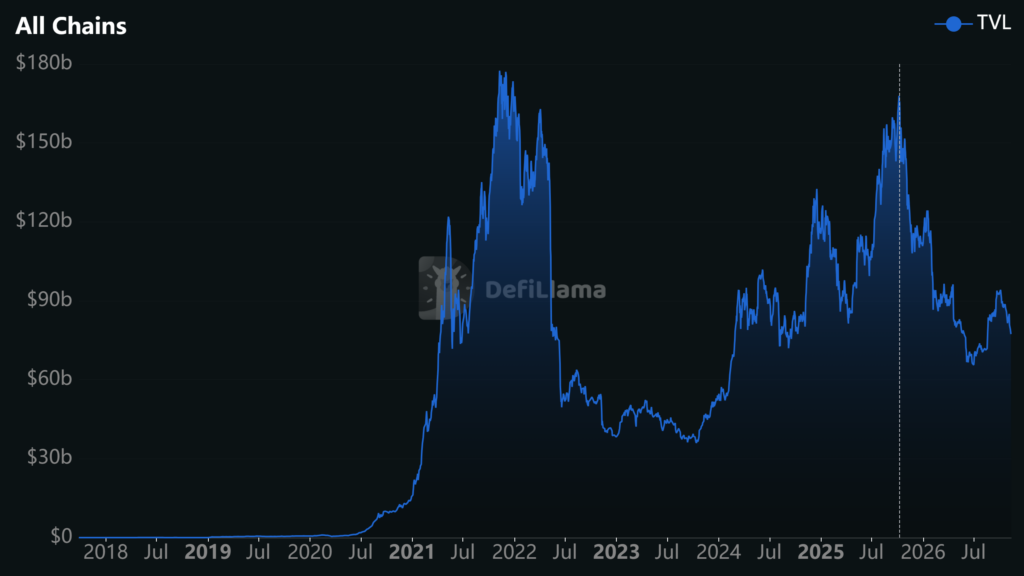
In his incident analysisSentora describes liquidity tensions and withdrawals in certain lending markets, without seeing bad debts in its own coffers. These movements remain to be distinguished from those observed after the Kelp DAO exploit of April 2026.
With $8.7 billion in losses, crypto hacks now exceed onchain revenues projected for 2026. For ARK Invest, security therefore constitutes a major obstacle to the growth of the sector. The exact scope of revenues, the final balance sheet of allocated funds and the evolution of losses nevertheless remain to be monitored.
Maximize your Tremplin.io experience with our ‘Read to Earn’ program! For every article you read, earn points and access exclusive rewards. Sign up now and start earning benefits.