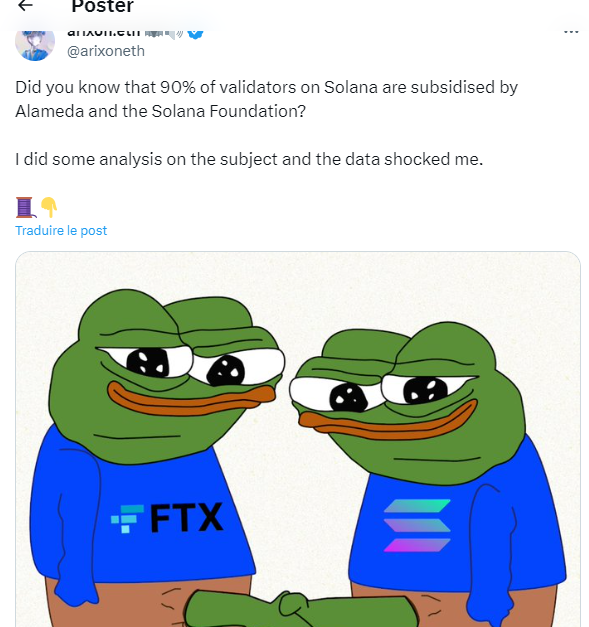
Controversies are brewing in the Solana ecosystem, fueled by allegations that the Solana Foundation and Alameda Research heavily subsidize the network’s validators. The debate is crystallizing around the impact of these subsidies on the decentralization and sustainability of SOL, Solana’s native crypto.
Massive Subsidies to SOL Validators Raises Questions About Crypto Centralization
Solana, a blockchain known for its speed and direct competition with Ethereum, is at the heart of a debate linked to the substantial subsidy of its validators by the Solana Foundation and Alameda Research, the defunct commercial arm associated with FTX.
According to analyst arixon.eth, more than 90% of Solana validators benefit from massive grants from the Solana Foundation and Alameda Research. At first glance, these figures are alarming: out of 1,997 validators, 1,818 would have received delegations from these two entities. In total, they delegated 106 million SOL, with 73 million distributed by the Foundation and 33 million by Alameda Research.
Validators play a vital role in the Solana blockchain. They are responsible for validating transactions and adding them to the blockchain. To ensure network security and decentralization, each node must stake SOL, and this amount of SOL determines their voting power.
The scale of these subsidies raises questions about the centralization of power within blockchain. Arixon.eth suggests that without these “heavy incentives”, the number of Solana validator nodes would be much lower.
More worrying, a notable number of nodes seem to be abandoned, without delegations from standard SOL holders, leaving the question of the disproportionate influence of two entities on the network.
By highlighting these considerable subsidies, arixon.eth warns of the risk of centralization of Solana under the hegemony of two predominant players. This, he argues, could potentially undermine the value of SOLs in the long term and pose a critical dilemma regarding the decentralized robustness of the network.
Funding for stability or manipulation?
Faced with these allegations, Anatoly Yakovenko, co-founder of Solana, intervened to clarify the situation. According to him, although nearly 2,000 validators secure the network, it is their votes, not their respective participation, that are essential to the security and stability of the network.
Every time a node withdraws from SOL, its voting power decreases, pushing the network to rely on other validators to maintain decentralization and security.
The issue of centralization is a hot topic in the crypto world. If Solana benefits from substantial funding from two major entities, it raises legitimate questions about the true decentralization of the network.
However, a question remains: can the current model, criticized for its tendency towards centralization, ensure the long-term stability and security of the network, or should the Solana blockchain revise its delegation strategy to preserve integrity? of its decentralized architecture?
The revelation of exorbitant subsidies to validators is prompting the crypto community to re-examine the governance structures and business models of blockchains and question the delicate balance between incentives and decentralization.
Receive a summary of the news in the world of cryptocurrencies by subscribing to our new service daily and weekly so you don’t miss anything of the Tremplin.io essentials!