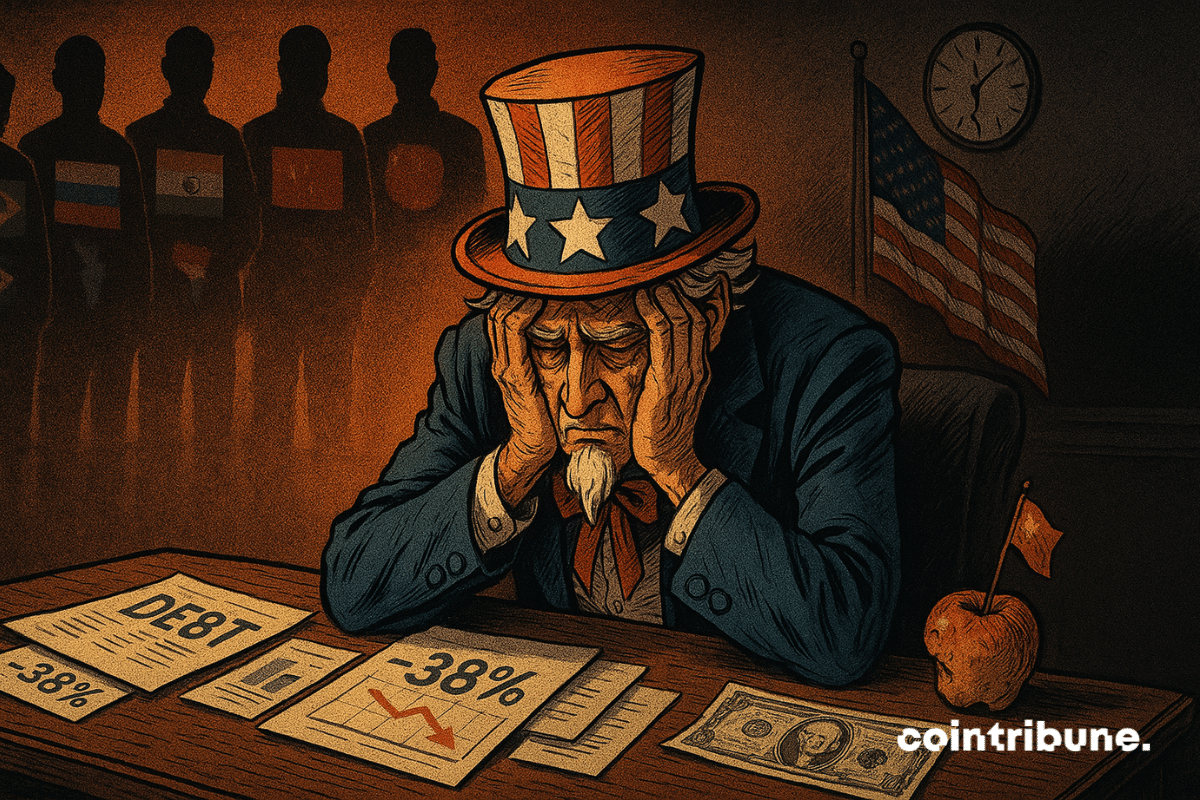
While economic tensions intensify between great powers, a dissonant voice calls into question the dominant story in Washington. According to Boris Kopeikin, chief economist at the Stolypine Institute, the United States trade deficit with China would not be the effect of a BRICS strategy, but a structural weakening of the American economy. This reading relaunches the debate on the deep causes of American imbalances in a world in full reconfiguration.
In short
- The trade deficit between the United States and China feeds strong economic tensions against the backdrop of global geopolitical recomposition.
- The economist Boris Kopeikin says that this imbalance stems above all from a loss of competitiveness from the American economic sectors.
- Unlike the accusations of certain US officials, the BRICS would not be the direct origin of the deficit according to Kopeikin.
- Kopeikin recalls that the United States depends as much on the BRICS as the reverse, making any unrealistic decoupling strategy.
The American deficit: a loss of competitiveness, not a plot of the BRICS
Questioned by the TASS agency on September 9, Boris Kopeikin, chief economist of the Stolypine Institute for Economic Growth, made a clear diagnosis on the causes of the American trade deficit with China, while Trump had launched a shock against the BRICS.
Unlike alarmist speeches relayed to Washington, Kopeikin believes that this imbalance is the symptom of internal weaknesses, not of a front organized by the countries of the BRICS Bloc. He declared ::
“The broad trade deficit of the United States with China and a number of other countries, as well as the growth of national debt, are the consequence of the decline in the competitiveness of several sectors of the American economy, not the policies of other countries.”
This declaration contrasts with that of Peter Navarro, former economic advisor of Donald Trump, who said on Real America's Voice:
“Their exports are like vampires that suck our blood to us with their unfair commercial practices”.
He also described the unstable group BRICS block, going so far as to say that they “Historically hate each other and kill each other”and predicts their collapse without trade with the United States.
Here is what to remember from this first sequence of analysis:
- The deficit is not attributed to foreign unfair practices according to Kopeikin, but to an erosion of the competitiveness of the American economy;
- It points to a structural failure of several American strategic sectors, aggravated by the increasing national debt;
- This reading calls into question the dominant rhetoric in the United States, which frequently targets China or the BRICS as responsible for commercial imbalances;
- Kopeikin's criticism is economical and structural, and not geopolitical. It calls for revival of productivity, rather than a trade war.
This change of angle refocuses the debate on the internal faults of the first world power, and not on a confrontation between blocks. He calls for a reassessment of protectionist discourse, dominating in certain circles of American power.
An economic interdependence: an illusory decoupling between the blocks
As an extension of his analysis, Boris Kopeikin stresses that the United States remains deeply linked to the economies of the BRICS, and vice versa.
“The United States strongly depends imports from China, India and Brazil, just as these countries consider American demand as essential”he said.
To support his point, the economist quotes the premature end of the trade war between Washington and Beijing as a concrete proof of this structural interdependence. This observation casts cold on the ambitions of economic decoupling promoted by certain American political leaders, who bet on internal reindustrialisation to reduce strategic dependence.
This position finds a particular echo in the declarations made the day before by the Chinese president Xi Jinping, at a virtual summit of the BRICS. The leader denounced “Unilateral prices and commercial conflicts initiated by certain countries” which he considers as destabilizing elements of the global economy.
The summit, focused on the challenges of international economic governance, has reaffirmed the commitment of the block to promote multilateralism, economic cooperation and the defense of international trade rules. Certain criticisms in Washington continue to accuse BRICS of exploiting access to the American market, without recognizing the mutual benefits generated by these exchanges.
The implications of these declarations are multiple. On the one hand, they question the viability of an American economic strategy based on the reduction of exchanges with the emerging powers. On the other hand, they reveal the systemic risks that would represent voluntary economic isolation of the United States through the customs tariffs of Trump, in particular on their supply chains and their long-term growth.
Maximize your Cointribne experience with our 'Read to Earn' program! For each article you read, earn points and access exclusive rewards. Sign up now and start accumulating advantages.