
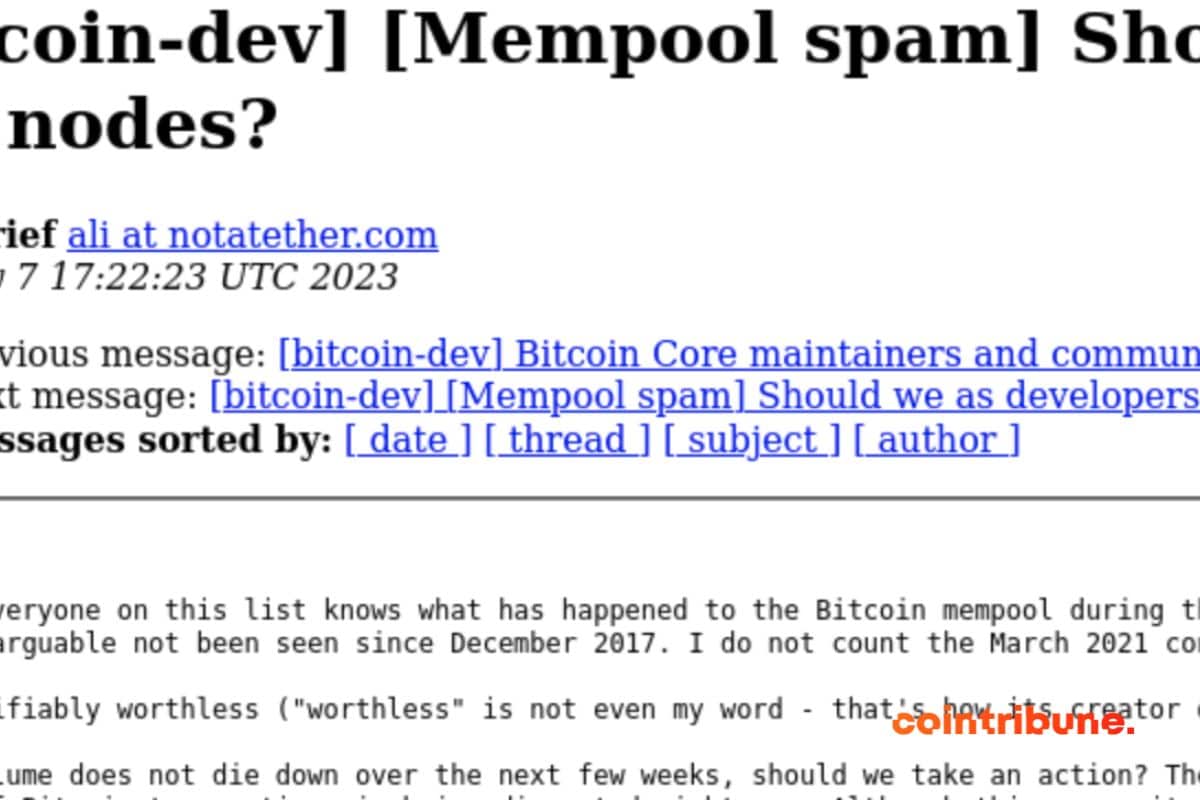
Two Bitcoin developers are stepping up to criticize the rise in transaction fees caused by the BRC-20.
BRC-20 and rising transaction fees
BRC-20 is currently causing an explosion in transaction fees. In essence, BRC-20 allows the creation of tokens (shitcoins). And this thanks to the no less recent Ordinal protocol, a term recently popularized to baptize the JPEGs inserted via “registrations” in the transaction blocks of BTC.
Entries are arbitrary data (like a jpeg) housed in a bitcoin transaction. This is possible since the Taproot update. We explain how Ordinal works in this article:
–Ordinals, improvement or attack?
Ordinal made headlines a few weeks back. Thousands of transactions containing jpegs suddenly accumulated in the mempool, but without really causing a serious increase in transaction fees.
Ordinal’s criticisms then were more related to increasing the amount of disk space needed to maintain a full node. This is a threat to decentralization. Just like the extension of the time necessary for the synchronization of a node (downloading of hundreds of GB).
The trend quickly faded, however, saving us from the confusion between Bitcoin and scams (NFT, shitcoins, etc.) in the popular consciousness. But Ordinal has mutated and some are now using it to generate BRC-20.
Problem, transaction fees have exploded this time. It is necessary at the time of writing these lines to pay between 10 and 20 dollars to insert its transaction into the next block. Even Binance found itself forced to temporarily suspend withdrawals.
Many believe that this bad moment will be temporary. And that in the end, this slump in the mempool is advertising for the Lightning Network while filling the pockets of minors.
Even Michael Saylor, usually a stickler for ethics, is magnanimous, seeing this as an additional catalyst for bitcoin’s appreciation:
“We are witnessing a migration of developers from other cryptocurrencies to Bitcoin. »
Less philosophical, Max Keizer believes that “Ordinals are digital plastic pollution floating in the ocean. Man is a great polluter, whether in reality or in cyberspace”.
Africans are losing patience
The joke has gone on long enough for Anita Posch, bitcoin educator and founder of Bitcoin for Fairness:
“Can someone explain to me how I manage with these fees? she tweeted. “I speak mainly to Africans. They don’t have the privilege like you to pay these high fees. They really need the BTC while you have fun. »
Two Bitcoin Core devs also lost patience, including Ethiopian Ali Sherief:
“Due to the large transaction volumes related to the BRC-20 project, classic BTC transactions have become too expensive and we are seeing massive congestion more seen since December 2017. These worthless tokens (this is how their creator described them ) threaten the harmonious and normal use of Bitcoin, which was created to serve as currency. If volumes do not decrease over the next few weeks, should we take action?
The bitcoin network is a triumvirate of developers, miners, and users. The harmony of bitcoin transactions is currently disrupted and miners are largely responsible for this misuse of the system. Although bitcoin core developers have a habit of not taking action unless absolutely necessary (an example being block size war and segwit), should similar action be taken now […] ?
An alternative would be to apply this “censorship” at the node level by introducing an option to instantly eliminate all non-standard taproot transactions. […]
I know absolutists/libertarians/maximum freedom seekers (I have nothing against that) will be critical of this, but we need to find a solution that can satisfy everyone. We have indirectly enabled something that was not possible before. So we have a responsibility to do something so that Taproot can no longer cause this kind of congestion. »
To which developer Luke Dashjr replied:
“We should have reacted several months ago. It is a mistake that the existing filters have not been extended to Taproot transactions. And since this is a bug fix, there’s no need to wait for the next big update. »
Unnecessary things usually fizzle out. This was the case for NFTs and it will be the same for ordinals if its only use case is to pollute nodes with jpegs and create pepe coins.
Scammers are already trying to raise a Ponzian mayonnaise. Which is not a big deal if it remains ephemeral. On the other hand, let’s not forget that malicious entities could use these flaws to attack Bitcoin at low cost…
Receive a digest of news in the world of cryptocurrencies by subscribing to our new service of daily and weekly so you don’t miss any of the essential Tremplin.io!


