

The principle of investing in the stock markets is to seek reward in exchange for the risk taken. Therefore, the notion of gain is linked to risk. However, financial markets can be quite volatile at times. This is why we are going to look at whether integrating bitcoin into a portfolio can be a positive element.
The importance of diversification within a portfolio
Diversifying a portfolio is an art. To maximize and optimize the diversification of a portfolio, you must choose assets that are negatively correlated with each other. That is to say, they will vary in opposite directions. Generally, stocks and bonds are assets that are negatively correlated but primarily in a deflationary environment. The opposite is the case in an inflationary environment. This is why a large proportion of investors have often followed the 60/40 portfolio. Diversification is mainly used to reduce exposure to risk. Moreover, in portfolio management, it is important to define the client profile. If he is very comfortable with risk, we will often give him an aggressive portfolio with a heavy weighting in stocks. In another vein, a balanced portfolio will start from the principle of having 50% fixed income and 50% stocks.
What is a 60/40 portfolio?
Before we begin, it is important to explain the principle of the 60/40 portfolio. This is one of the most used wallets as a model. It is based on the principle of purchasing 60% US stocks (in the form of an index ETF) and 40% US bonds. Individuals will replicate this model using ETFs which will take a basket of assets and a basket of long-term bonds. This type of portfolio allows you to diversify the type of assets in order to reduce risk. This portfolio is quite popular because bonds and stocks have been negatively correlated for a very long time. Therefore, during the crises of 2008 and 2020, a 60/40 portfolio suffered fewer losses than a 100% stock portfolio. We can see the performances in the table below:
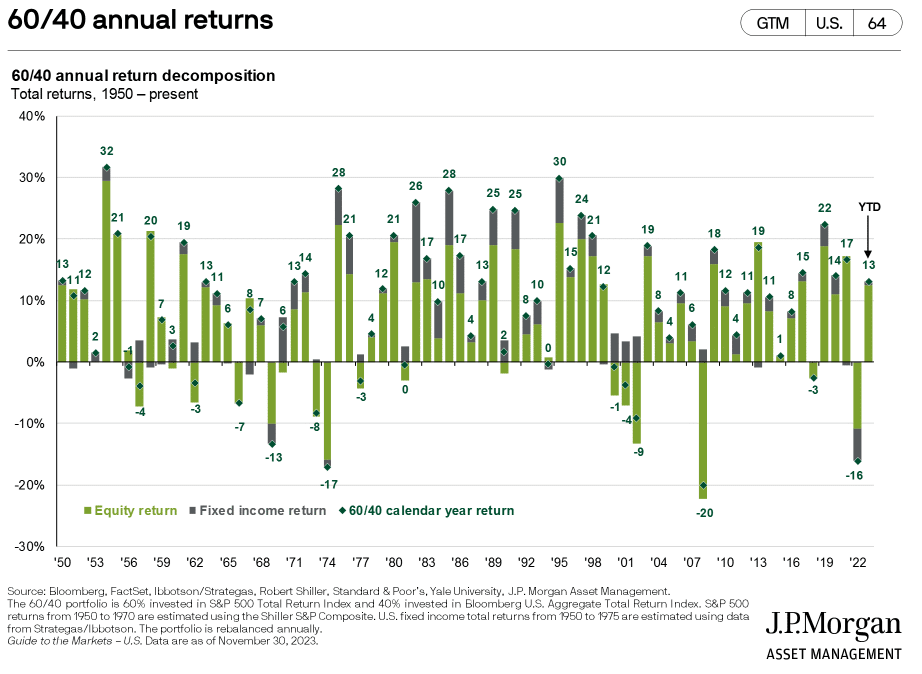
That said, since the rise in inflation, the correlation has reversed. Bonds and stocks are now positively correlated. This is why it is important to understand that this portfolio is quite effective in terms of diversification when the two assets are negatively correlated. Therefore, as long as inflation remains high (i.e. above the target rate), this type of portfolio has concentrated risk.
Integrating Bitcoin into a 60/40 Wallet
As bitcoin spot ETFs are still undergoing SEC approval, it is important to clarify that bitcoin could be integrated into wallets. It is easier for a portfolio manager to integrate an ETF with bitcoin than to integrate bitcoin. ETFs also provide the ability to add bitcoin to tax-advantaged investment accounts. Bitcoin is currently available on external exchange platforms specializing in cryptocurrency and which are not centralized.
Therefore, an investor cannot benefit from the benefits that ETFs can provide such as those offered in tax-advantaged accounts. ETFs will make it possible to attract investors on a larger scale. This is why there have been some studies carried out to see the impacts of integrating bitcoin into a wallet. In the chart below, the curves represent a traditional portfolio by integrating 1-2 and 5% of portfolio in a modified 60/40 model portfolio vs. a traditional 60/40 portfolio.
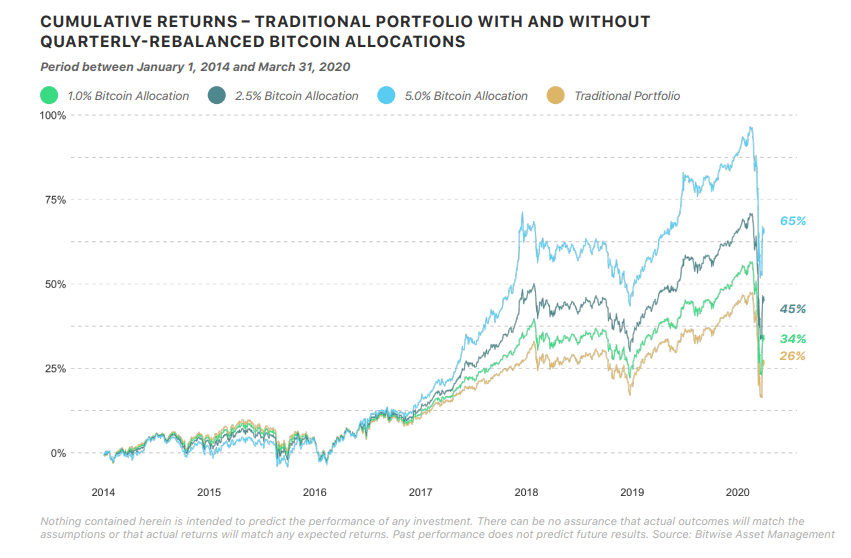
So obviously, this study was carried out taking into account the past performance of bitcoin. But be careful, past performance cannot guarantee future performance. This is even more the case by institutionalizing bitcoin. The more an asset is capitalized, the less volatile its variation will be. This is why small market capitalizations are more volatile than large capitalizations. It’s the same principle with bitcoin and altcoins. Moreover, we can add that each new bullrun in bitcoin is less volatile.
Limits in terms of allocation
As highlighted in the table above, bitcoin allocations are minus 5%. It is highly likely that institutions will not place more than 5% of bitcoin in a wallet. We cannot integrate a large allocation to bitcoin unless we are very comfortable with the risk because the drawdown levels are quite significant. A bitcoin bear market can be quite painful if you are not comfortable with cycles and losses. Here is an idea for a drawdown during bear markets:
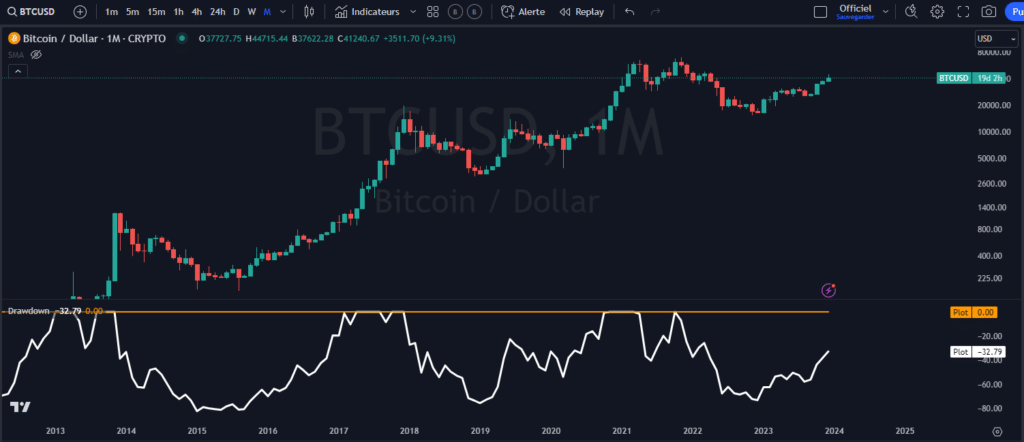
Therefore, losing 70% on a 5% allocation does not have the same impact as losing 70% on a 50% allocation.
The sharpe ratio, a measure of risk to the advantage of bitcoin
This type of financial calculation highlights the relationship between performance and risk. In other words, it makes it possible to measure the risk within a portfolio and the opportunity cost. When the sharpe ratio is greater than 1, this is interesting for an investor because it implies that the reward will be higher in return for the risk taken. From a more technical point of view, the calculation will compare the free risk and the rate of return of the portfolio. Most of the time, the sharpe ratio of bitcoin is higher than that of the S&P500.
CASH allocation vs. risk premium
Today, the risk premium is quite low on stocks. Generally, we compare the return on stocks and that on bonds to see if the risk premium is attractive. This means that currently, bonds are assumed to be cheap relative to stocks. Flows have accumulated in cash because it is better paid because short-term rates are more attractive than those offered in the long term.
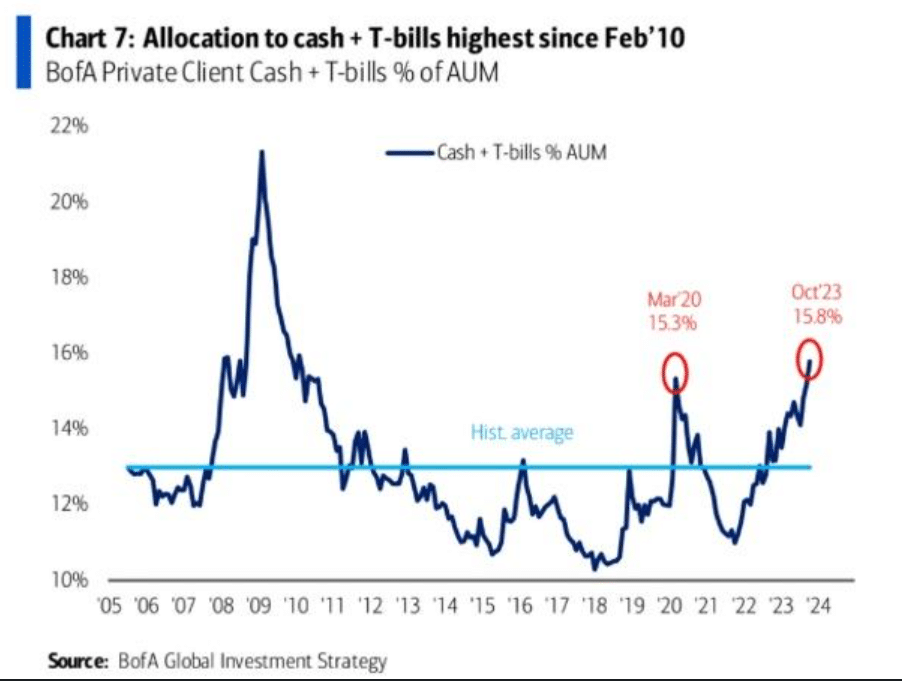
Moreover, the cash yield of around 5% is higher than the profit yield of the S&P500. This is a completely unprecedented situation. That said, as investors still want to seek performance, they may be tempted to turn to bitcoin. Simply including a small allocation can add performance to their cash portfolio. This is where the release of bitcoin ETFs will be a plus for those looking for more performance in return for low risk given the level of allocation.
Diversification with bitcoin, not just a question of performance
When deciding to add bitcoin to the portfolio, it is not just a question of adding performance. There are also fundamentals. Bitcoin has a form of protection against currency devaluation and liquidity injections. One of its particularities remains the fact that it has a limited supply of 21 million. And the other important aspect is the halving which reduces the available supply every 4 years. It also allows countries whose populations do not have bank accounts to have access to bitcoin. From a technological point of view, it popularized blockchain.
CONCLUSION
Depending on your risk tolerance, integrating bitcoin into your portfolio can be an asset in several forms. As it is a fairly cyclical asset, you just have to clearly define the allocation you want to make to it in order to be comfortable with your investment.
Maximize your Tremplin.io experience with our ‘Read to Earn’ program! For every article you read, earn points and access exclusive rewards. Sign up now and start earning benefits.


