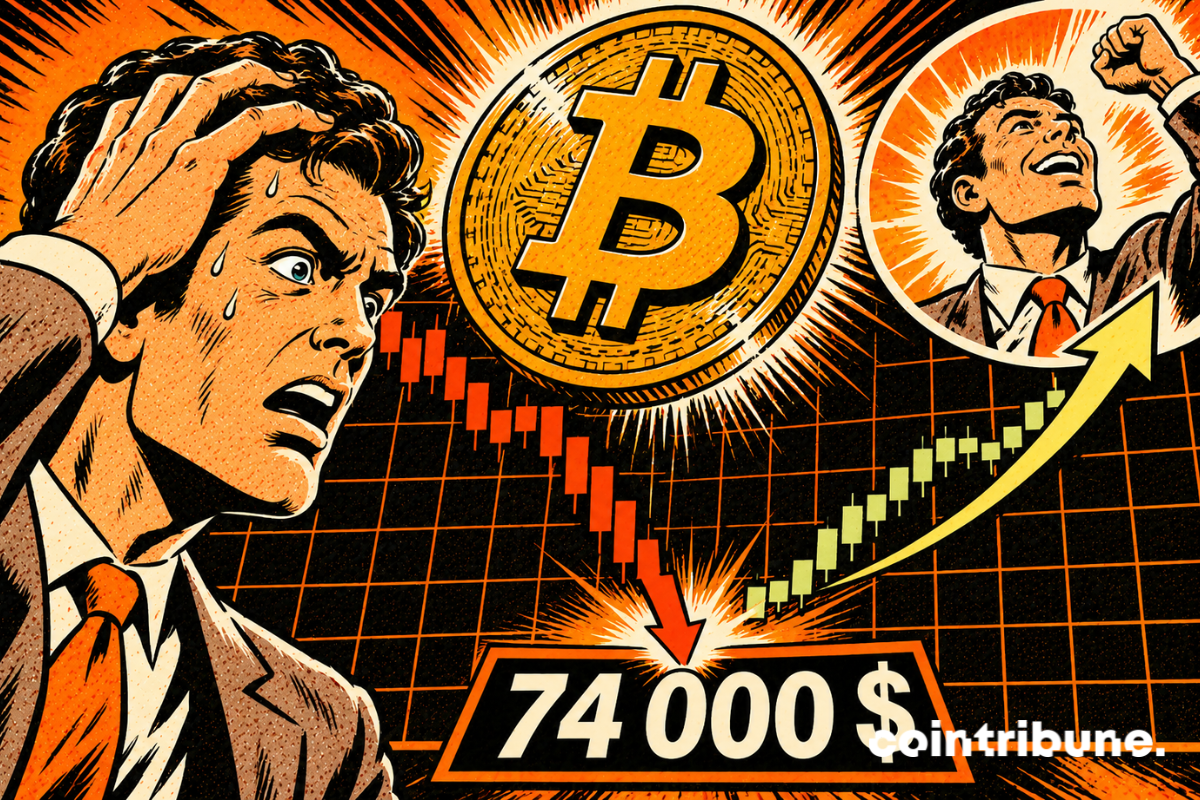
Bitcoin plunged below $74,000 before quickly erasing part of its losses, after two news concerning Nvidia and Iran. More than a simple episode of volatility, this movement shows that crypto now serves as an anticipation market when Wall Street is closed, even if it means suddenly revising its first verdict a few hours later.
In brief
- Bitcoin plunges below $74,000 after revelations about Nvidia and the failure of talks with Iran.
- BTC quickly bounced back above $75,000, erasing much of its losses.
- The crypto market reacts to bad news before Wall Street opens, amplifying price movements.
- More than $1 billion in crypto positions are liquidated in 24 hours, mostly bullish bets.
- Low liquidity and leverage add to volatility, while bitcoin remains exposed to further shocks.
Two alerts are enough to make bitcoin stall
During the night from Sunday to Monday, bitcoin fell to around $73,761, its lowest level since August, before returning above $75,000. Ether followed a comparable movement. It briefly crossed $2100 on the downside, then rebounded towards $2140.
The reaction was triggered by two pieces of information not directly related to cryptos. What they have in common is their ability to quickly change the global appetite for risk.
The market had to simultaneously absorb:
- The opening of an internal investigation at Nvidia regarding Jensen Huang;
- Suspicions of foreign interference surrounding a relationship of the leader;
- The lack of progress in discussions between Washington and Tehran;
- The fear of new tension on oil and inflation.
Jensen Huang admitted to Nvidia employees that he had been unfaithful to his wife. The board of directors, however, is investigating a more sensitive question: has the manager been targeted by a foreign intelligence operation? Nvidia asserts have no evidence that any trade secrets or national security information has been compromised.
The issue goes beyond the private life of the leader. Nvidia has become the leading barometer of the artificial intelligence investment cycle. Any uncertainty regarding its governance, its relations with Washington or its exports to China can therefore weigh on all risky assets.
At the same time, US Secretary of State Marco Rubio called some Iranian demands unacceptable and unrealistic. The apparent failure of the discussions has reinforced fears of a rise in tensions in the Middle East.
Crypto sets a first price before Wall Street
Bitcoin and crypto markets trade without interruption, unlike US stocks. When major news breaks on Sunday, they become one of the few places where investors can immediately reduce their risk exposure.
BTC’s fall therefore does not necessarily mean that news about Nvidia or Iran is reducing its fundamental value. It may simply reflect an urgent search for liquidity in a market accessible at any time.
Tokens representing American stocks have reinforced this role of anticipation. NVDAX, a tokenized product tracking Nvidia, lost around 3.55% while the underlying stock was still closed. It thus signaled the expected drop at the opening of the Nasdaq. Nvidia actually fell by almost 5% in trading preceding the American session.
This alert market function, however, has a major limitation. Weekend exchanges are generally less profound. A relatively large sale can then move prices further and trigger cascading liquidations.
Bitcoin’s rapid rebound above $75,000 suggests that the first reaction was excessive. About 75 minutes was enough to make up for most of the fall. The markets then nuanced the geopolitical scenario: oil prices fell on Monday, after Donald Trump ruled out an immediate escalation with Iran.
The lever turns every alert into extreme movement
The main consequence of this back and forth concerns investors using leverage. More than $1 billion in crypto positions were liquidated in twenty-four hours, including approximately $913 million in bullish bets.
Ether suffered nearly $448 million in liquidations, compared to $272 million for bitcoin. The largest auto-closed position was also in ETH, for around $48 million. These figures show that the violence of the movement came as much from the positioning of traders as from the news itself.
After the drop, futures saw a sharp rise in volumes, while open interest declined. This mixture signals that many positions were closed and part of the capital left the market. At the same time, bitcoin’s one-week implied volatility increased from around 33% to 43%, while demand for options protecting against a further decline increased significantly.
BTC now remains framed by its 200-day moving average, close to $73,150, and its 100-day average, around $77,430. As long as it evolves between these two thresholds, each external news can trigger a sudden movement without giving lasting direction.
So the real lesson is not that Nvidia or Iran controls bitcoin. The crypto market has become the first place where investors express their fear when traditional markets are closed. But in an illiquid and highly indebted environment, this first price seems more like an alarm than a definitive verdict.
Maximize your Tremplin.io experience with our ‘Read to Earn’ program! For every article you read, earn points and access exclusive rewards. Sign up now and start earning benefits.