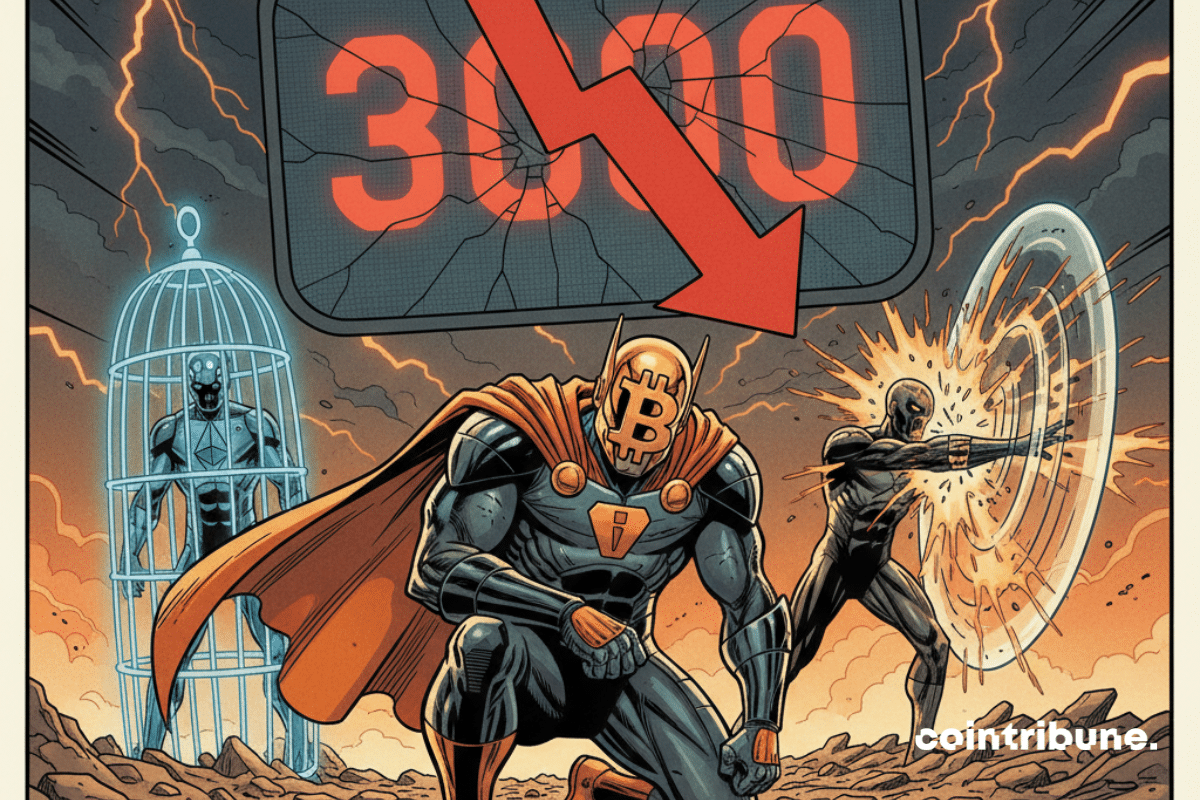
End-of-year periods are rarely synonymous with booms for bitcoin or altcoins. As the holidays approach, liquidity becomes scarce. Investors take their profits, books become empty, and movements become erratic. This cyclical phenomenon weakens the entire crypto market, in full transition below $3,000 billion in capitalization.
In brief
- Bitcoin falls below $87,000, taking Ethereum and altcoins in a synchronized fall.
- USDT growth is slowing sharply, signaling a sharp decline in available liquidity.
- The fear index drops to 11, showing a market worried and ready to capitulate.
- Institutional investors like Strategy buy, accumulating 10,624 BTC at a price deemed appropriate.
Diluted liquidity and depressed sentiment: a difficult cocktail for cryptos
The end of 2025 was no exception to the rule: cryptos are stumbling, and bitcoin is flirting with $86,580 – compared to $86,700 last Monday. In the space of a few days, the overall capitalization went back below the symbolic bar of 3,000 billion. A fall fueled by weakened confidence and historically low volumes. Altcoins are following the same trajectory. Ether lost its luster, falling back below $2,930. XRP, which was attempting to rise, ran into resistance at $1.90.
Analysts point to a widespread decline in sentiment. The fear and greed index has fallen to 11, a level associated with phases of extreme tension. The erosion of technical support reinforces doubts. Now, the $81,000 and $70,000 levels are under watch for bitcoin.
Added to this is another factor: the weakness of institutional demand. ETFs, supposed to play a buffering role, are struggling to stem sales. According to Kuptsikevich, the main cryptos are becoming victims of the change in sentiment among institutional investors, as they reconsider their exposure to risk. This dynamic is not trivial and could herald a more lasting shift.
Bitcoin, altcoins and macro: an increasingly visible interconnection
The link between the crypto market and macroeconomic trends is increasingly visible. In Asia, stock indices, such as the Hang Seng or the Nikkei, recorded notable declines. The fall in hopes around artificial intelligence, concerns about margins, and the caution of central banks have contaminated the markets. Cryptos, although decentralized, no longer escape this interconnection.
Bitcoin and Ethereum react to the same signals as tech stocks. Monetary tightening or poor economic statistics are enough to destabilize buyers. Even altcoins like Solana or Cardano show increased sensitivity to macroeconomic flows. Their dependence on liquidity and sector rotations makes their movements even more violent.
This synchronized shift is pushing investors to rethink their strategies. Some are adopting a wait-and-see attitude. Others, conversely, consider this decline as an opportunity. In this waltz of uncertainties, bitcoin becomes a thermometer of global risk, oscillating between institutional caution and hopes of a restart from 2026.
The silent strategies of crypto whales
Behind the apparent lethargy of the crypto market lies strategic activity. Some institutional entities are taking advantage of the downturns to discreetly strengthen their positions. Strategy, for example, acquired 10,624 BTC for almost $1 billion. This gesture, discreet but significant, shows that part of the capital is not fleeing the market, but is methodically repositioning itself there.
This selective accumulation reveals long-term conviction. Even if prices retreat, the fundamental outlook for bitcoin and major cryptos remains intact. Altcoins, more fragile, undergo more severe corrections. However, certain tokens linked to blockchain innovation or decentralized finance continue to attract interest.
The heart of the problem remains liquidity. USDT growth, for example, collapsed in two months, from $15.38 billion to $4.83 billion. This shows that capital is waiting on the sidelines. The absence of inflows limits the short-term upside potential.
Key takeaways
- The price of bitcoin at the time of writing: $87,027;
- Crypto capitalization has fallen below 3,000 billion;
- USDT growth fell from $15.38 billion to $4.83 billion;
- Strategy acquired 10,624 BTC during the decline;
- Fear index dropped to 11, high stress level.
Despite this gloomy end to the year, there is a light on the horizon. According to a recent projection, bitcoin could experience a record rise before the summer of 2026. This announcement revives hopes of a structural rebound, driven by solid fundamentals and clearer regulation in the United States.
Maximize your Tremplin.io experience with our 'Read to Earn' program! For every article you read, earn points and access exclusive rewards. Sign up now and start earning benefits.