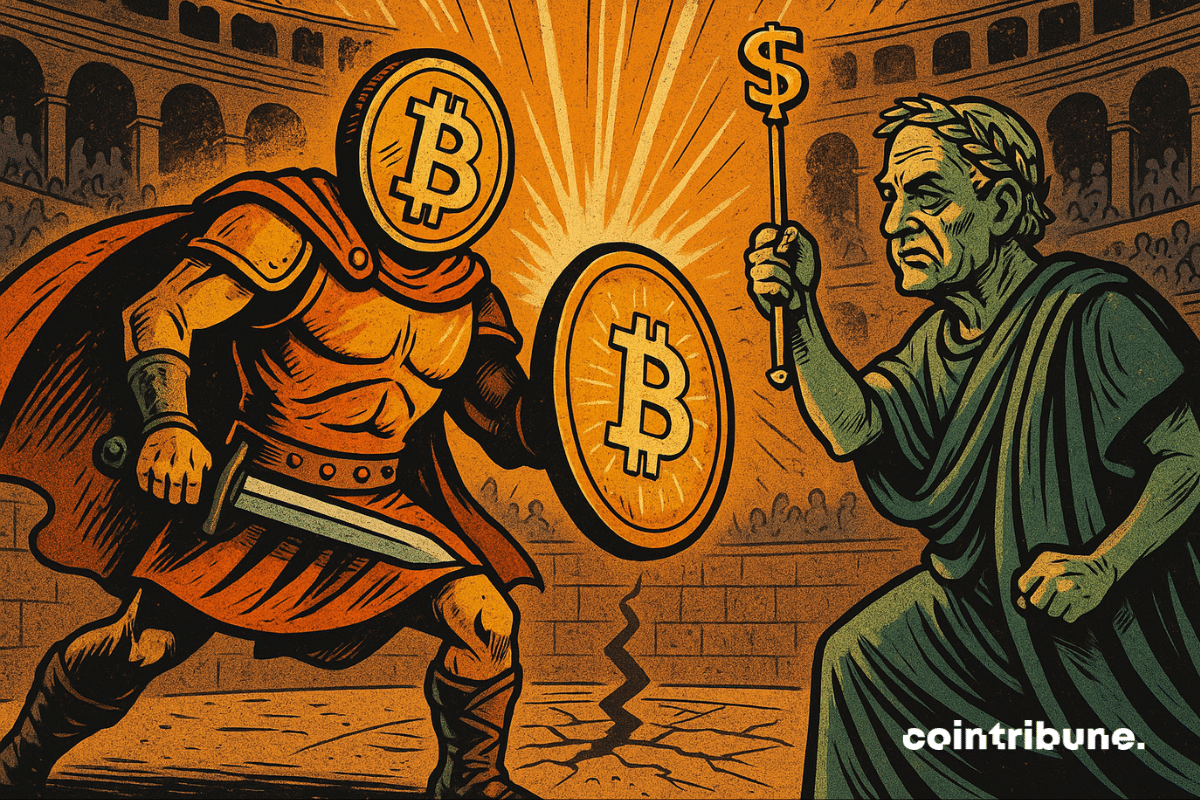
Year after year, the growth of Bitcoin brought him into the closed circle of coins used for international exchanges, in the same way as the dollar and the euro, which does not seem to everyone. Indeed, the former IMF chief economist, Kenneth Rogoff, accuses Bitcoin to participate in the movement of dedollarization of the economy and to weaken the supremacy of the dollar.
In short
- Bitcoin: a currency adopted by the underground economy.
- Why are developing countries in favor of Bitcoin?
- Will Stablecoins save the dollar?
Bitcoin: a currency adopted by the underground economy
Since the appearance of Bitcoin, the confidentiality of transactions on its network has always been an asset for the underground economy, even if it is considered dangerous by states. It should be remembered, however, that this confidentiality is not synonymous with anonymity, but of pseudonymat, since we can follow in complete transparency the transactions of the Bitcoin network without knowing the real identity of the owners of the Bitcoin addresses. Only cryptocurrencies like Monero offer complete confidentiality and are much less used.
Kenneth Rogoff, the former chief economist of the IMF, considers that Bitcoin transactions in the underground economy of emerging countries correspond to 20 % of world GDP. For him, this huge volume of transactions therefore weakens the dollar demand, especially due to growing role of bitcoin in this parallel economy. More and more countries want to find an alternative to the dollar as a currency for international exchanges.
Why are developing countries in favor of Bitcoin?
This boom in the use of bitcoin and other cryptocurrencies in the underground economy of these countries must however question us. It should not be confused with use for illegal activities as could be at the time of Silk Road. Recently, Gérald Darmanin, the French Minister of the Interior, said that the economy of criminal activities mainly used the Intraçable cash, rather than cryptocurrencies. This nuance is important to understand the true role of bitcoin in these economies.
In fact, the growing use of bitcoin and other cryptocurrencies in certain emerging countries (examples in Nigeria, Kenya and Salvador) has three main reasons: Bitcoin is used to protect itself against the constant devaluation of the local currency. It allows you to have a digital means of payment in overly banished savings, because it is not very profitable for large banking groups, and finally, it serves as an alternative to the dollar or the euro. This last reason is important, because the monetary issue also has geopolitical consequences. Using the dollar or euro, these countries remain symbolically under the domination of the issuing countries of these currencies. They are therefore no longer entirely masters of their monetary policy. This is what Salvador learned by being forced by the IMF to abandon the status of official currency given to Bitcoin (even if there is still a legal currency) if he wanted to continue to receive international aid for the development of his country.
Will Stablecoins save the dollar?
The concern of Kenneth Rogoff makes it possible to better understand the highlighting of stablecoins as means of digital and international payments by the American government. Indeed, the centralized stables like the USDT of Tether and the USDC of Circle are collateralized by reserves in dollars and treasury bills. The USDT has a capitalization of $ 153 billion and the USDC of 61 billion. But above all, their volume of exchanges is respectively 75 and 10 billion dollars. The volume of exchanges of these two Stablecoins is therefore greater than that of the BTC (which is around 50 billion dollars per day). It also represents 1 % of the volume of dollar transactions.
Consequently, the rise in centralized stablecoins will lead their issuers to constitute increasingly large reserves in dollars. The more these stablecoins will be present, the more the demand in dollars will increase, promoting American monetary policy.
Satoshi Nakamoto's dream came true. Bitcoin has become a currency widely used in international monetary exchanges and can be compared to large official currencies. But his presence in the informal economy is so important that it is now accused of opposing the hegemony of the dollar.
Maximize your Cointribne experience with our 'Read to Earn' program! For each article you read, earn points and access exclusive rewards. Sign up now and start accumulating advantages.