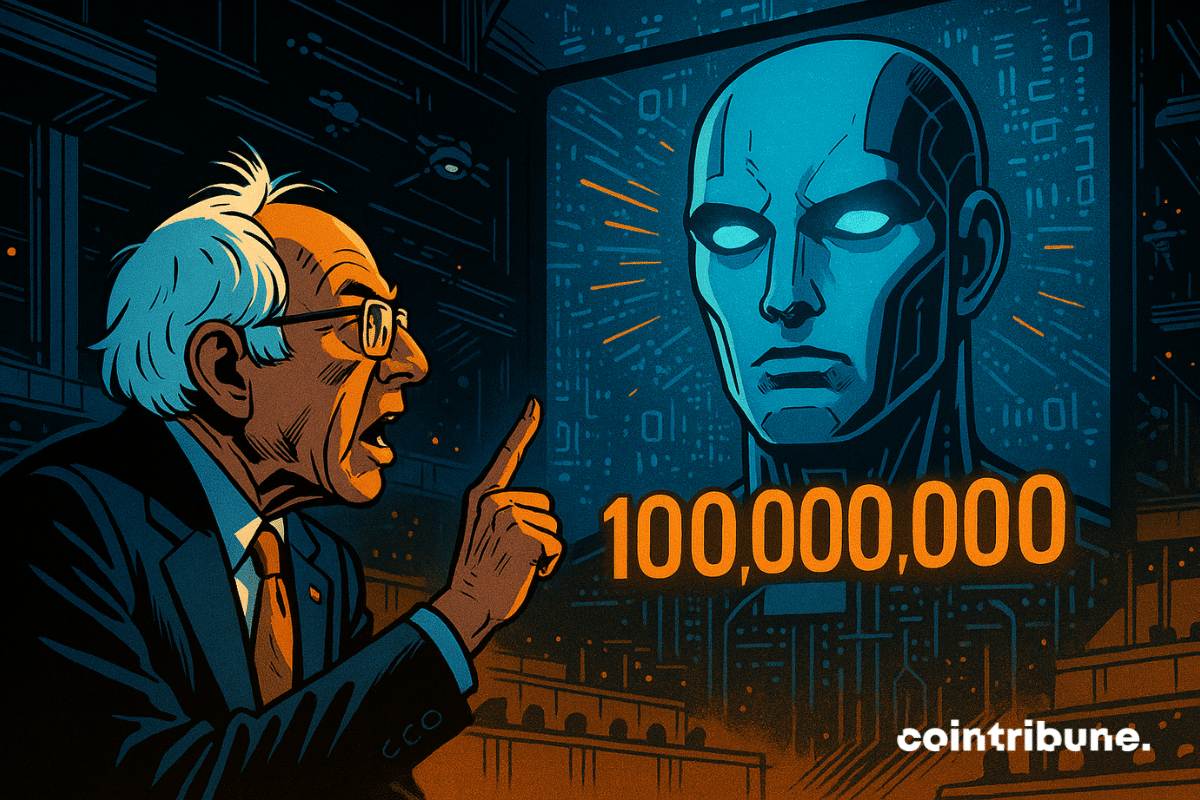
Artificial intelligence no longer just assists humans, but now threatens to replace them on a large scale. Senator Bernie Sanders warns that nearly 100 million American jobs could disappear within ten years. In an official video supported by a Senate report, he accuses tech giants of sacrificing workers for the benefit of automation. For him, inaction in the face of this artificial work revolution risks suddenly worsening social inequalities.
In brief
- Bernie Sanders warns of a possible collapse of the jobs market, with up to 100 million jobs threatened by artificial intelligence.
- A Senate report details the most exposed sectors, such as fast food, accounting and road transport.
- The senator openly criticizes big tech bosses, accused of favoring automation to the detriment of workers.
- To counter this revolution of artificial work, Sanders is proposing strong measures, including a tax on robots and a 32-hour week.
A warning about the collapse of employment
While many see AI as the key to the future of Web3, US Senator Bernie Sanders issued a dire warning in a video posted to YouTube on Wednesday: “ artificial intelligence could eliminate up to 100 million U.S. jobs in the next decade ».
Relying on a report Coming from the Senate Health, Education, Labor and Pensions (HELP) Committee, which Sanders leads from the minority side, this statement is as worrying for its breadth as for its precision.
The document, made public earlier this week, mobilizes OpenAI's AI to analyze job market trends. Indeed, large parts of the economy would be threatened by automation in the short term.
In a direct criticism addressed to big tech bosses, Sanders denounces the massive investments of figures like Elon Musk, Jeff Bezos, Mark Zuckerberg and Larry Ellison: “They are investing hundreds of billions to replace human labor. Is it because they want to improve the lives of the 60% of Americans who live paycheck to paycheck? I highly doubt it”.
The report details the professional categories particularly exposed, in particular those based on repetitive, logistical or administrative tasks. Among jobs threatened in the short termwe find in particular:
- Fast food employees, faced with the widespread use of automatic terminals and robotic kitchens;
- Accountants and administrative assistants, whose tasks can be absorbed by AI tools;
- Truck drivers, a profession weakened by advances in autonomous vehicles.
Beyond these sectoral projections, the document places automation in an overall historical trajectory. Since 1973, the productivity of the American worker has increased by 150%, corporate profits by 370%, while real wages have fallen by $30 per week.
“Building new factories will mean nothing if robots work there instead of people”warns Sanders. In short, the report depicts a dynamic where technology increases margins without redistribution, fueling an already gaping economic divide.
Towards a political response: regulating AI to protect jobs
Bernie Sanders proposes a series of measures to stem the deleterious effects of automation on employment. His plan is based on five axes, the most emblematic of which is the establishment of a 32-hour work week without reduction in salary.
It also calls for the creation of a“robot tax” for any company that replaces employees with machines, as well as an overhaul of corporate governance, with 45% of board seats reserved for employees.
“What we are saying is that if businesses benefit from automation, workers must benefit too”he says. Added to this are proposals for profit sharing, a ban on share buybacks and an extension of union rights.
These measures echo other proposals already formulated in the public debate, notably that of the transhumanist Zoltan Istvan, who defends a universal basic income and the idea of a humanoid robot in every home, so that the prosperity resulting from automation is equitably distributed.
Furthermore, the report reveals a less often mentioned reality: automation is now progressing more quickly in office professions than in production lines. Skilled professions such as software engineers, financial analysts, legal assistants or content creators are also in the crosshairs.
If these legislative options were to be adopted, they could profoundly reshape the relationship with work in the decades to come. However, they also raise many questions: will taxing robots slow down innovation? Will companies accept such a change in governance? And above all, what will the market reactions be? As robots prepare to occupy an increasing space in our economies, the political choices made today will determine whether this transition will result in social collapse or a controlled transformation, while some observers believe that AI is not a revolution.
Maximize your Tremplin.io experience with our 'Read to Earn' program! For every article you read, earn points and access exclusive rewards. Sign up now and start earning benefits.