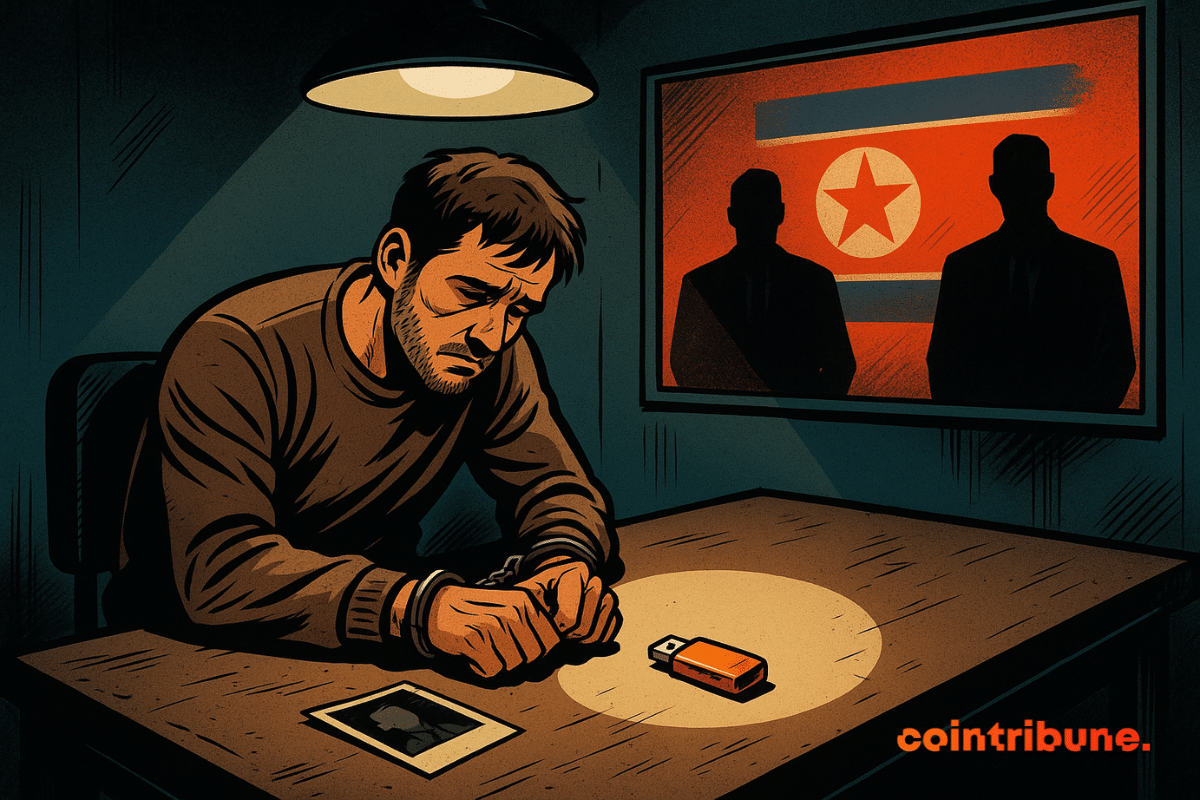
If Pyongyang is not yet launching missiles at the United States, Kim Jong-un has found another way to weaken his enemy: technology. North Korea is quietly but methodically infiltrating American businesses online. The Minh Phuong Ngoc Vong affair illustrates a well-established strategy, where hackers replace soldiers, and laptops become silent weapons.
In brief
- Minh Vong arrested and convicted after helping North Korean hackers infiltrate American tech.
- He collected $970,000 by posing as a developer to American companies.
- The hackers accessed sensitive systems using credentials provided by Vong.
- The investigation reveals an operation financed by Pyongyang via laptop farms and false identities.
The fake developer who trapped American tech
Is this a new move by the Lazarus Group? The mystery remains, but the affair is already chilling. Minh Phuong Ngoc Vong, a 40-year-old American citizen, was recently sentenced to 15 months in prison. His crime? Having lent his identity to North Korean hackers to infiltrate at least 13 American companies, including several under contract with government agencies.
Between 2021 and 2024, Vong usurped the role of developer by displaying a fictitious CV: bogus diploma, fake experience, and even an alleged secret clearance level. All this to allow North Korean agents, including a certain “William James” based in Shenyang, to work remotely under its cover. The companies, believing they were hiring an American, in reality financed, without their knowledge, hacking operations from Asia.
The most serious: Vong even obtained a contract for the FAA, the Federal Aviation Administration, accessing systems linked to national defense. A simple click was enough to open a door to sensitive data.
As summarized by Roman Rozhavsky of the FBI Counterintelligence Division:
North Korea remains determined to finance its weapons programs by defrauding American businesses and exploiting American victims of identity theft, but the FBI is just as determined to disrupt this vast campaign and bring its perpetrators to justice.
Invisible hackers, real salaries
North Korean hackers don't just infiltrate. They cash in. Minh Vong received more than $970,000 in wages, paying a large portion to his accomplices. Officially, he was a developer for thirteen companies. Unofficially, he was the front for a network of digital agents.
“Laptop farms” have become a strategic tool: American homes hosting computers provided by companies, controlled remotely by North Koreans. The scheme is simple: an American lends his papers, his access, his connection. In exchange, he earns a commission, while the real work is done in Pyongyang or Shenyang.
An investigation revealed that one of the developers who recommended Vong during a virtual interview discovered, much later, that the person they met was not the same person as the one in the ID photos.
Like the calls back the DOJ in a press release:
Doe's communications show that he is likely a North Korean national who worked to generate revenue for the North Korean government. As such, the court finds that the conspirators obtained unauthorized access to sensitive government systems.
Meanwhile, Pyongyang is quietly pocketing millions of dollars.
Cryptos, AI, digital sabotage: tech under pressure
North Korean hackers don't stop at sensitive data. They are also attacking cryptocurrencies. By 2025, more than $2 billion in digital assets would have been stolen. Platforms like Upbit and Bybit have been targeted, with increasingly sophisticated methods.
The regime is now banking on artificial intelligence. Since the 1990s, North Korea has invested in research into voice recognition, data processing, and optimization. Today, there are reports of illegal use of Nvidia GPUs to accelerate piracy.
North Korean cybercriminals are exploiting every technological vulnerability, also targeting crypto-startups. They apply, gain access, then siphon digital wallets remotely. Global tech becomes their battlefield.
Some chilling figures:
- More than 13 American tech companies infiltrated by Minh Vong between 2021 and 2024;
- Nearly $970,000 paid for work done by North Korean hackers;
- Only one individual (Vong) allowed access to defense-related systems;
- In 2025, $2 billion in cryptos stolen by North Korea;
- The regime finances its missiles through these discreet cyber operations.
The North Korean threat is no longer virtual, it is very real. Infiltrations in tech and attacks on cryptos continue to grow. Faced with this shadow war, States are closing ranks. Around the world, efforts are increasing to detect, neutralize and prosecute North Korean hackers. The keyboard has become a weapon, and the battlefield, global.
Maximize your Tremplin.io experience with our 'Read to Earn' program! For every article you read, earn points and access exclusive rewards. Sign up now and start earning benefits.