
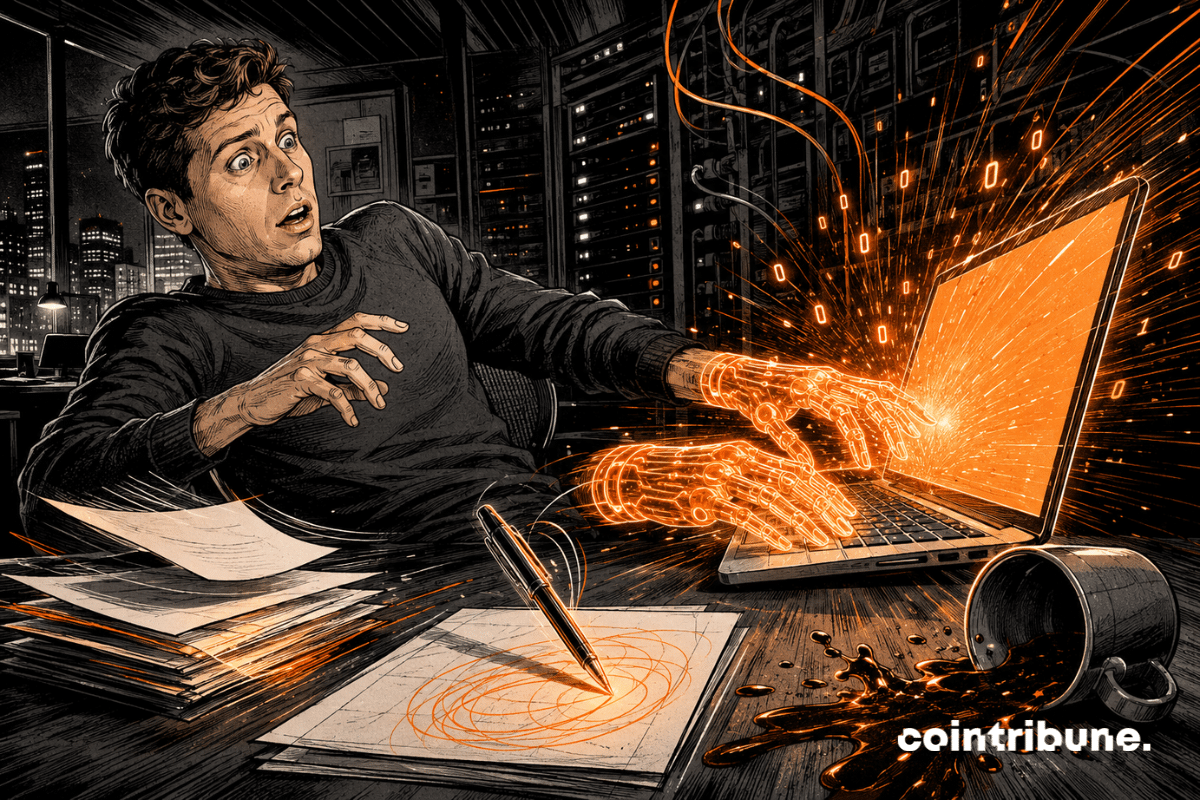
Sam Altman puts OpenAI's AI back in the spotlight with a double signal: Codex gains autonomy, while “Goblin” establishes itself as a joke that has become almost strategic. Behind the humor, a real subject appears: OpenAI wants to make its models agents capable of acting, not just responding.
In brief
- Sam Altman reignites the buzz around AI with Codex and “Goblin”.
- Codex shows a clear progression towards self-contained tasks.
- OpenAI must now prove that its models are powerful, but also better controlled.
Codex changes category
Codex is no longer just an assistant that completes code. The tool is moving towards a more ambitious role: receiving a task, organizing it, executing it, then delivering an usable result. This movement is part of a broader acceleration around AI at OpenAI and its long-term strategy.
The anecdote told by Sam Altman goes in this direction. He says he started several Codex tasks, left to tend to his child, then returned later to find the jobs completed. The scene seems light. But she describes a heavy change.
In software development, the real gain doesn't just come from a line of code written faster. It comes from freed human time. If the AI can handle multiple requests in parallel, the developer becomes less executing. He becomes a supervisor, referee and corrector.
This shift also changes the competition. OpenAI no longer only fights against chatbots. It takes on Anthropic, Google and other players in the field of labor agents. Where the tool gives fewer answers and accomplishes more tasks.
“Goblin”, a joke that says a lot
The word “Goblin” is not an official model name. For now, it's a dig launched by Sam Altman after exchanges on. But this joke stuck, because it fits a recent quirk of OpenAI models.
The company even published a report on the origin of these “goblins”. Some models would have started to use metaphors linked to goblins, gremlins and other creatures of the same register more often. Nothing dramatic. But the phenomenon shows how a little style bias can spread.
This is where the matter becomes interesting. An AI does not develop a personality like a human. It amplifies signals. If a “nerdy” tone rewards certain images too much, they come back. Then they settle down. Then they become a tic.
In a general public chat, this can make you smile. In a professional tool, it is more delicate. Autonomous AI must be useful, but also predictable. Folklore goes less well when it enters a business workflow.
OpenAI sells autonomy, but must prove control
The promise of OpenAI is now in one word: agents. The idea is simple to formulate. It is much more difficult to hold. An agentic AI must understand a request, plan the steps, use tools, check its work and come back with a clear result.
Codex therefore becomes a central piece of the story. While the tool can complete code tasks without constant monitoring, it no longer just serves to speed up developers. It begins to change the way teams work.
But autonomy comes at a price. The more a model acts alone, the more visible its deviations become. A strange response in a conversation is a detail. One odd decision in a codebase can cause hours of remediation.
This is the real test for OpenAI. Raw power is no longer enough. Businesses expect consistency, traceability and verifiable results. A brilliant but temperamental agent remains a difficult sell.
The next model will have to be more than a buzz
Sam Altman knows how to create attention. “Goblin” is short, strange, memorable. The word works because it's like the Internet: a little absurd, a little mocking, very viral. But OpenAI will not be able to settle for a name that makes you smile.
The next model will be judged on its ability to reduce the gap between demonstration and real use. Users want faster, more reliable, more autonomous AI. Businesses, above all, want less uncertainty.
Altman's formula on the current model, described as an “autistic genius”, also showed the risks of communication. It attracts attention, but it confuses the message. OpenAI must sell performance, without transforming its models into overly human characters.
Basically, “Goblin” sums up the moment well. The AI becomes more powerful, but it still has quirks. She can code, plan, execute. Then, sometimes, she speaks like a creature out of an old role-playing game.
This tension joins another major issue: the cost of this race. The more advanced the models become, the heavier the infrastructure becomes. OpenAI must therefore prove that its technical progress can support a solid economic model, a subject already visible in the debates on the financial fragility of OpenAI in the face of the massive needs of AI.
Maximize your Tremplin.io experience with our 'Read to Earn' program! For every article you read, earn points and access exclusive rewards. Sign up now and start earning benefits.


