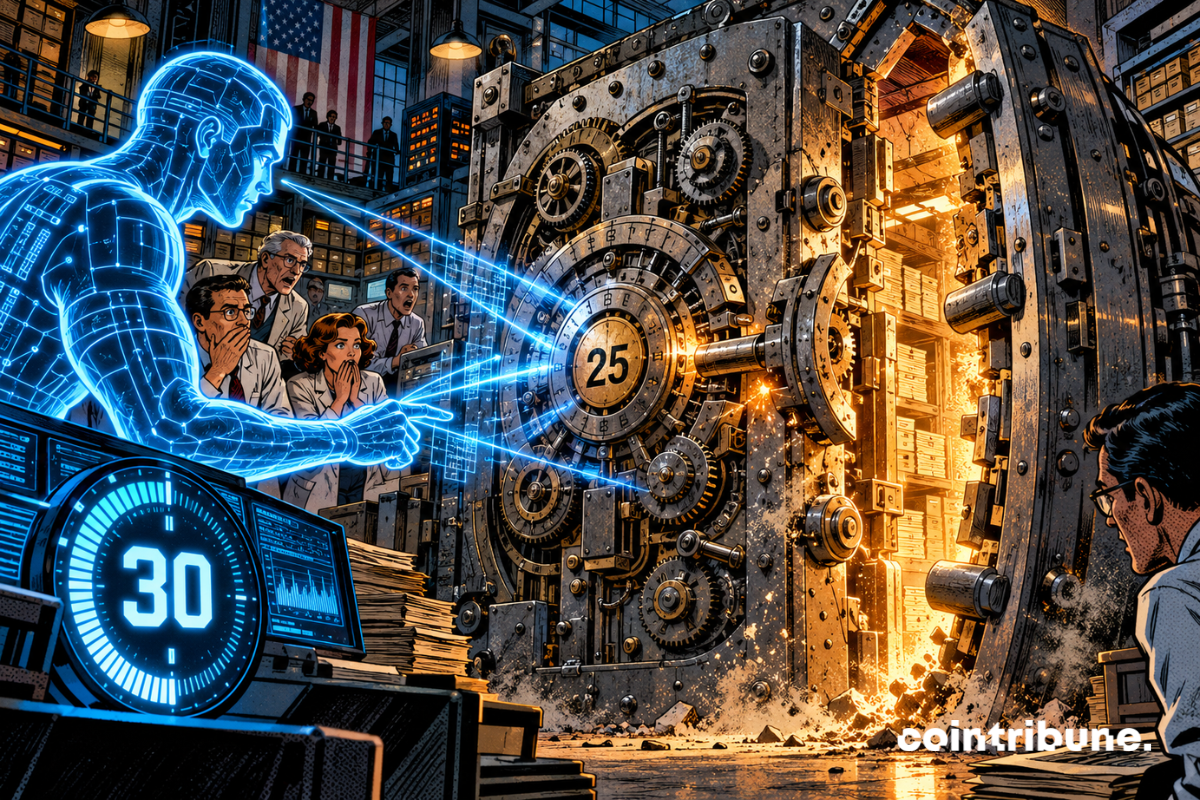
Claude has just solved in less than 30 minutes a cryptographic enigma that had been lying around for around 25 years. Anthropic’s AI model traced the origins of five numbers provided by the NSA for certain elliptic curves standardized by NIST in 2000. Long suspected of hiding a backdoor, they ultimately came from an old pseudo-random generator powered by timestamps from 1997 and 1998.
In brief
- Claude found the origin of five NIST seeds in less than 30 minutes.
- They came from the lrand48 generator initialized with timestamps.
- The discovery does not break any encryption and does not directly concern Bitcoin.
Claude finds what researchers have been looking for for 25 years
The case dates back to the end of the 1990s. The NSA had provided several numbers, called seedsused in the generation of elliptic curves then integrated into the NIST ECDSA standard.
No one knew exactly how these numbers were chosen. This lack of explanation fueled suspicion for years, particularly after revelations about the NSA’s cryptographic activities. Claude had already shown surprising capabilities in cybersecurity, to the point that Anthropic recognized several incidents during tests involving his AI.
This time, the model wasn’t looking for a vulnerability. An Anthropic employee simply asked him to investigate the origin of the seeds, without providing him with the preferred hypothesis until then. Many believed they came from a hash of a humorous phrase chosen by NSA mathematician Jerry Solinas.
Claude has gone elsewhere. He studied the characteristics of old pseudo-random generators available in C libraries from the 1990s. Less than half an hour later, he had a lead.
A simple number generator behind the NSA mystery
The manager is called lrand48. This pseudo-random generator already existed in old C libraries. Claude detected in the seeds a signature compatible with its operation, then reconstructed its internal state.
The model finally found the origin of the seeds of curves P-192, P-224, P-256, P-384 and P-521. For P-256, the program was initialized with a Unix timestamp. He then generated successive candidates. The seed finally published corresponds to the 1,842nd candidate.
Claude also found timestamps between May 1997 and April 1998 for the different curves studied. The result especially changes the historical reading of the file.
For a long time, a hypothesis was that the NSA had tested a large number of parameters before voluntarily selecting a curve presenting a weakness known only to the agency.
Anthropic now considers this possibility much less credible. This does not mean that all the questions are gone. Some apparently valid candidate curves were ignored for no known reason. The origin of several basis points also remains unexplained. One seed, that of B-163, still resists. So Claude hasn’t solved everything. But the five main seeds that fueled the debate now have a reproducible origin.
Bitcoin was not broken by this AI discovery
Accuracy is important: Claude didn’t break either ECDSA nor Bitcoin. Anthropic says this explicitly. No users of the affected NIST curves need to change their keys or systems as a result of this discovery.
Bitcoin uses secp256k1, not P-256. The curve chosen by Satoshi Nakamoto has particularly simple parameters. It leaves much less latitude to secretly select certain values in order to hide a weakness.
Claude’s discovery therefore does not modify the current security of the network. Bitcoin, however, has another potential cryptographic problem: quantum computers. Google has just taken a new step with its Willow processor, without having a machine capable of breaking Bitcoin signatures today.
Above all, Claude’s performance tells something else.
In just a few dozen minutes, an AI explored a path that human cryptographers had been pursuing for years. She identified a statistical structure, tested several old generators, used mathematical network reduction techniques and then verified the result by calculation.
This type of use brings AI even closer to cryptographic and blockchain infrastructures. There was even a reward. A bonus of $36,864 was promised if the solution was found and the money donated to a charity. It will ultimately go to the Internet Security Research Group, the organization behind Let’s Encrypt. Twenty-five years of research. Less than thirty minutes for Claude.
Maximize your Tremplin.io experience with our ‘Read to Earn’ program! For every article you read, earn points and access exclusive rewards. Sign up now and start earning benefits.