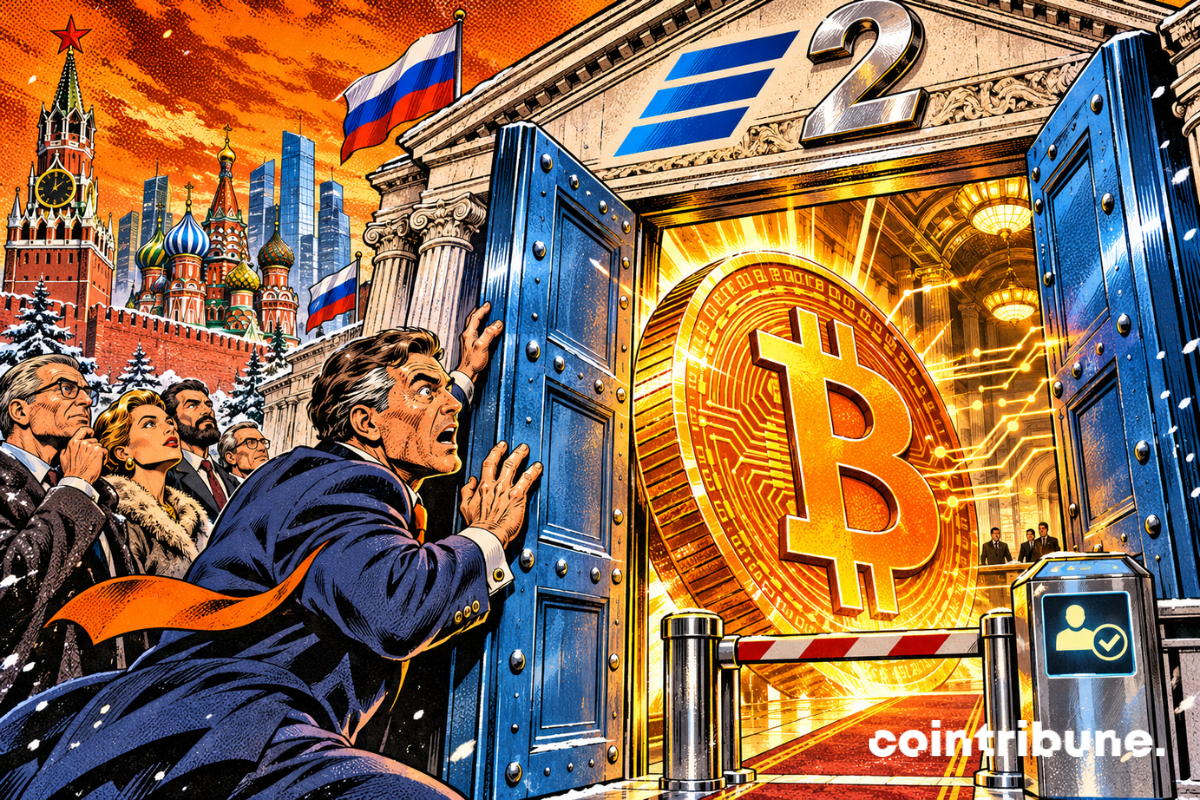
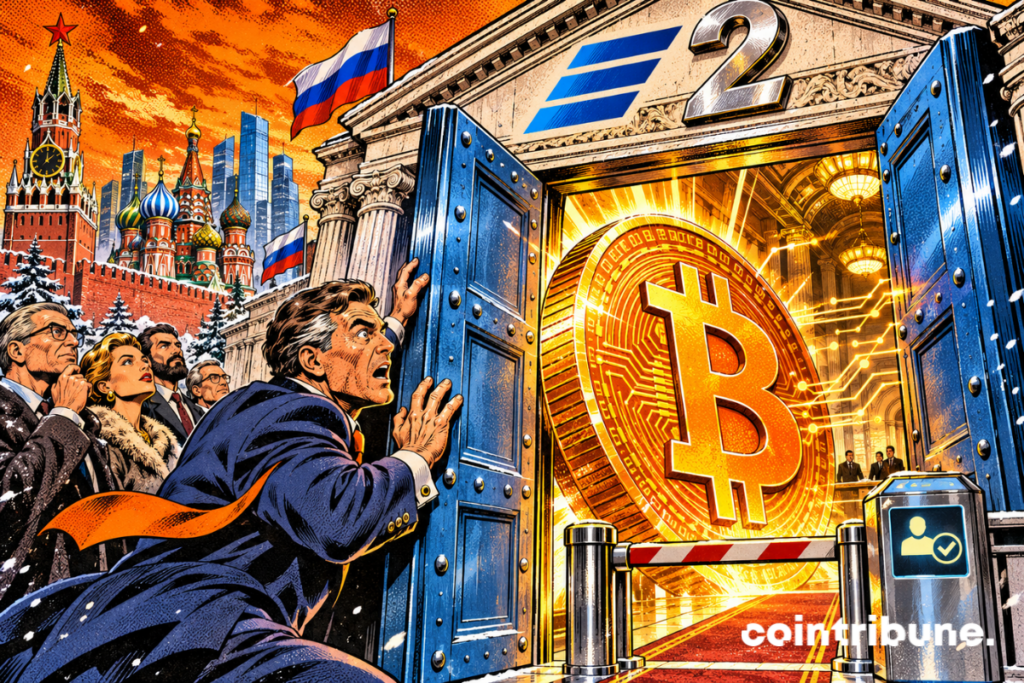
Bitcoin enters the investment app of the second largest Russian bank. Since November 27, 2026, clients of the VTB broker can buy and sell cryptocurrencies directly from VTB My Investments. The service remains for the moment reserved for qualified investors who have passed a mandatory test. This opening comes four days after the presentation of new European sanctions targeting crypto intermediaries linked to Russia.
In brief
- VTB opens bitcoin trading to qualified investors from its app.
- The Bank of Russia imposes a knowledge test requiring seven out of eight correct answers.
- The Moscow and St. Petersburg stock exchanges are preparing their first operations for December 1.
VTB officially opens bitcoin trading
VTB did not wait for December to launch its crypto services. On October 6, Sberbank and VTB obtained the green light from the Bank of Russia to develop their bitcoin-related activities. The country’s second largest bank then announced an opening of trading in November.
The schedule was respected. Since Friday, qualified investors can buy and sell cryptocurrencies in the VTB My Investments application. The first transactions take place over the counter (OTC), outside of organized stock markets.
Clients must open a digital account with the VTB custodian, in addition to their usual brokerage account. The bank itself ensures the purchase, conservation and accounting of assets on Russian infrastructure.
Andrei Yatskov, head of VTB brokerage services, says the establishment will initially focus on buying and selling operations. Other services may follow depending on regulatory developments.
With nearly 31 million customers, VTB has significant distribution potential. However, not everyone will be able to access bitcoin immediately. The bank has not communicated any figures on the volumes exchanged during this first day.
Seven correct answers out of eight to buy bitcoin
The Bank of Russia approved Thursday, November 26 the terms of the compulsory test for crypto investors. The questionnaire includes eight questions relating in particular to regulations, the characteristics of cryptocurrencies, IT security and the risks linked to the volatility or blocking of transactions.
You must obtain at least seven correct answers, for a success rate of 87.5%. In case of failure, a second attempt is possible on the same day, with different questions. Brokers are not allowed to communicate the correct answers to their clients.
The test is free and is valid for one year from successful completion or the last crypto transaction, whichever is more recent. Russia had already allowed bitcoin transactions under a new regulatory framework starting November 22.
Non-qualified investors will be able to access bitcoin, ether and USDT from intermediaries offering these services. Their purchases will be capped at 300,000 rubles per year per intermediary.
Qualified investors are not subject to this cap. The Russian system therefore goes beyond simple identity verification. Even experienced investors should demonstrate a minimum amount of knowledge before purchasing bitcoin.
Russia integrates bitcoin without giving up banking control
VTB shouldn’t be left alone for long. The Moscow Stock Exchange plans to launch its crypto operations on December 1. The one in St. Petersburg is also preparing spot exchanges of bitcoin, ether and USDT against the ruble on the same date.
Sberbank, Russia’s leading bank, is also targeting the beginning of December for its first crypto products. The calendar takes on a particular dimension in view of international tensions. VTB has been subject to US sanctions since February 2022. More recently, the European Union presented new measures against crypto platforms making it easier to circumvent Russian sanctions.
However, there is no evidence that the launch of VTB constitutes a direct response to these new sanctions. The banking project dates back several months. Above all, the Russian approach presents one particularity. By making it easier to purchase bitcoin from banking apps, Moscow is giving investors more familiar access to cryptos while maintaining operations within supervised infrastructure.
Purchasing becomes more accessible, without necessarily offering the autonomy associated with personal custody of bitcoin. Russia is therefore not turning its back on its banks to adopt cryptocurrencies. It makes precisely these establishments the main entry points to its new regulated market.
Maximize your Tremplin.io experience with our ‘Read to Earn’ program! For every article you read, earn points and access exclusive rewards. Sign up now and start earning benefits.