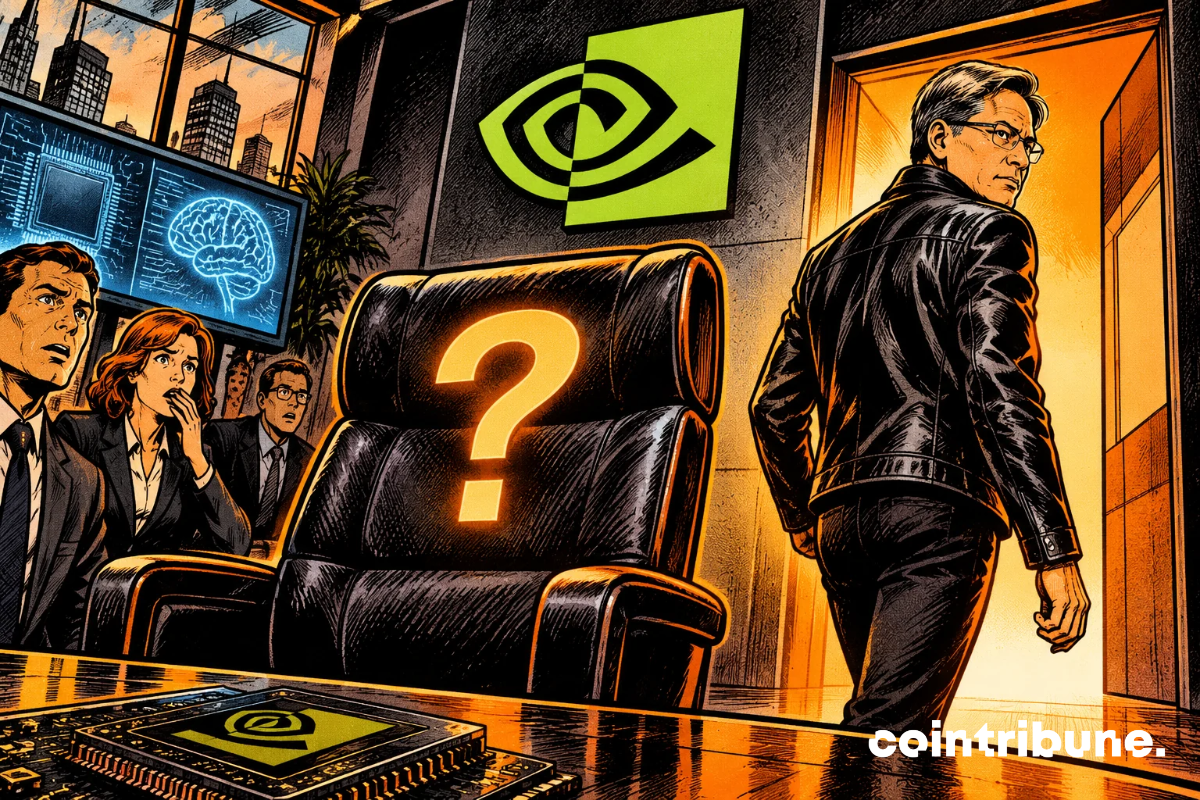
Nvidia must turn an important page in its history. On Thursday, the group announced the immediate departure of its co-founder, Jensen Huang, who leaves both the general management, the presidency and his seat on the board of directors. Colette Kress takes interim helm, while Harvey C. Jones becomes the first chairman in company history. Beyond the change of leaders, this decision raises a much broader question: can Nvidia maintain its lead without the man who shaped its strategy for 33 years?
In brief
- Jensen Huang is simultaneously stepping down as president, CEO and board seat after 33 years at the helm of Nvidia.
- Colette Kress, financial director since 2013, is acting in the interim while awaiting the appointment of a permanent successor.
- With 7.8% of the S&P 500 and more than 1,000 American listed funds among its investors, Nvidia represents a stake that goes well beyond its own governance.
After Huang, who will hold the reins of the Nvidia machine?
The markets did not wait for the official announcement to react. Nvidia has already lost $430 billion in capitalization on November 9 and 10, before losing an additional $182 billion during Thursday’s session.
For his part, the official press release is intended to be reassuring. The company promises that “operations, customer engagements and product roadmap will continue without interruption.” A classic statement when changing direction. It remains to be seen whether reality will follow the speech so easily.
Because Jensen Huang was not content with running Nvidia. For more than three decades, he oversaw major technological orientations, set the pace for new architectures and maintained direct relationships with the main buyers of chips and computing capacities.
In other words, he not only managed a business: he was also its main focal point. Colette Kress knows the group’s finances perfectly, but she will now have to make strategic decisions that go beyond her usual role. And the experience of a manager is unfortunately not passed on with the keys to the office.
This dependence on a central figure represents a real risk for Nvidia. ClearBridge distinguishes two issues in particular: the risk linked to the technological roadmap and that linked to its execution. The first remains relatively readable, since the company plans its innovations several years in advance. The second is more delicate: you have to coordinate teams, suppliers and customers to meet deadlines.
The stock is now trading at around 12 times its forecast earnings, its lowest multiple since 2012. An additional signal of investor caution.
A new president of the board to avoid a vacuum at the top
Another detail of the press release deserves attention: Harvey C. Jones becomes the first chairman of the board of directors of Nvidia. Until now, the company had never separated this function from that of general manager.
Jones knows the house very well, however. A member of the board since 1993, even before Nvidia’s IPO, he also headed Synopsys and chairs the audit and nominations committees. The group is therefore banking on a historic administrator rather than an external personality to supervise this transition.
The composition of the board also provides some guidance. It has eleven members, ten of whom are considered independent. This structure allows directors to make important decisions, particularly regarding general management. However, knowing how to replace a boss does not automatically mean knowing how to preserve your strategic vision.
The situation of Colette Kress also raises some questions. By temporarily combining the functions of financial director and general manager, she will have to manage operations while continuing to supervise finances. A demanding exercise, especially for a company of this size.
The schedule doesn’t give him any respite. Nvidia is scheduled to release its third-quarter 2027 results on November 17, five days after the announcement. It will therefore have to present figures prepared under the former management while reassuring investors about the new organization.
Nvidia facing three scenarios for the next twelve months
The future of the group remains open. However, three main developments can be seen.
First scenario: continuity. Nvidia continues its roadmap without major disruption, retains its major customers and chooses a successor from its own ranks. The market’s reaction suggests this possibility: after opening Thursday down 13%, the stock ended the session down 4.34%. Some investors therefore preferred to maintain their positions rather than give in to panic.
Second scenario: a progressive loss of strategic coherence. The future leader will have to take command of a group whose power relies on the integration of hardware, software and network infrastructure. This organization requires constant arbitration and a solid technical vision. A great manager can keep the machine running, but that doesn’t guarantee that he or she will be able to take it in a new direction.
Third scenario: an erosion of Nvidia’s dominance. Large chip buyers are already looking to diversify their suppliers. On Thursday, AMD and Broadcom advanced, while Micron, Marvell, Intel and Dell fell. These movements show that investors are not uniformly sanctioning the entire technology sector.
If customers accelerate their diversification, Nvidia could gradually lose market share. Not necessarily following a spectacular event, but rather through a succession of contracts won by its competitors.
For the moment, neither of these scenarios is necessary. The council promised an open search, internally and externally, without announcing a specific timetable.
One thing is nevertheless certain: the more than 1,000 American listed funds that hold Nvidia shares, as well as investors exposed to the 7.8% of the S&P 500 represented by the group, will closely follow this transition.
Because when the company that provides a large part of the artificial intelligence infrastructure changes drivers, the entire industry is looking at the dashboard.
Maximize your Tremplin.io experience with our ‘Read to Earn’ program! For every article you read, earn points and access exclusive rewards. Sign up now and start earning benefits.