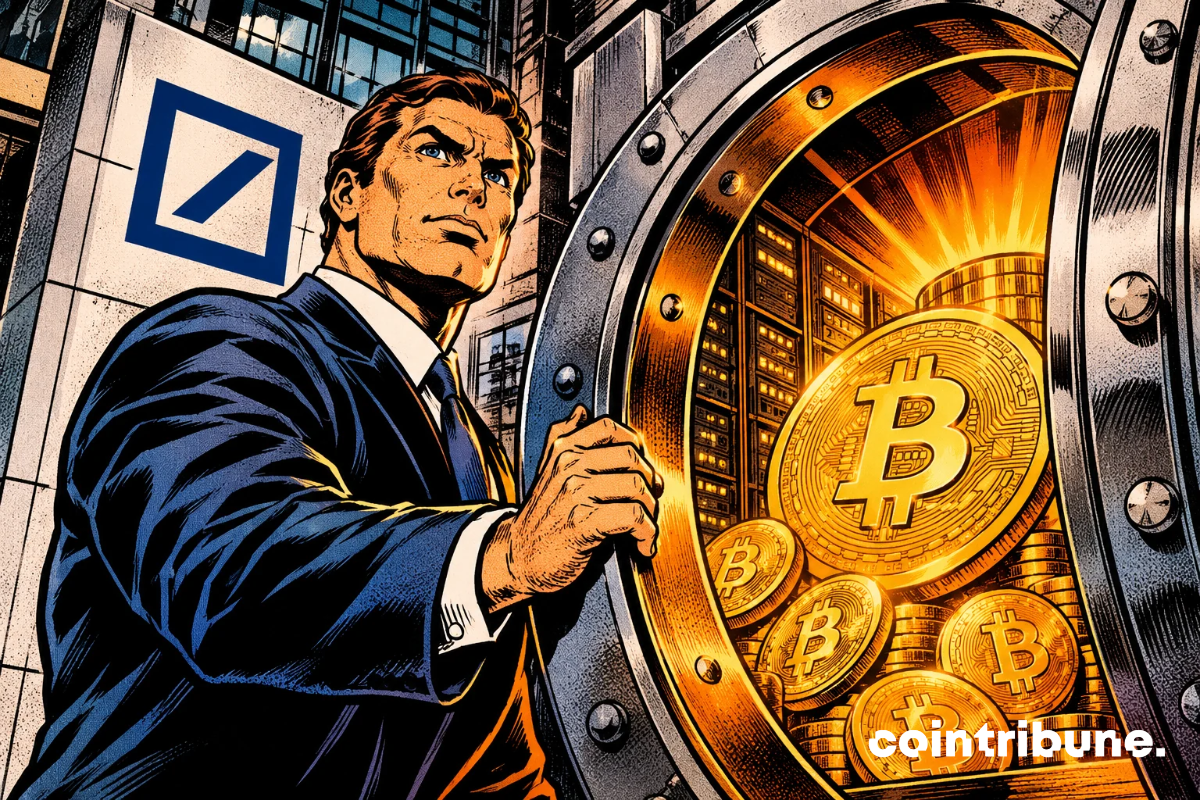
Deutsche Bank is finally moving from theory to practice. The German banking giant has launched its digital asset custody service for businesses and institutional clients in Europe. On the program: bitcoin, ether and three stablecoins. The bank directly supports wallets and private keys. A project announced since 2021 which is now entering its commercial phase.
In brief
- Deutsche Bank supports bitcoin, ether, USDC, EURC and EURAU for its Corporate Bank and Investment Bank clients. It also manages their wallets and private keys.
- The service only covers the custody and transfer of assets. Trading and order execution remain outside the offering.
- The bank has been on the MiCA register since October 12, under Article 60, which provides for a notification procedure for banking establishments.
Five years of preparation before taking action
Deutsche Bank did not embark on this adventure overnight. As of 2021, the establishment was already studying the possibility of offering crypto custody and trading services. In 2023, it filed a license application in Germany, before developing its solution with Bitpanda and its historic partner Taurus.
In September 2026, the bank had announced its intention to launch the service before the end of the year. However, he still had to obtain the regulatory green light.
It is now done. Deutsche Bank is listed ESMA MiCA registerwith BaFin as competent authority. His registration dates from October 12. On November 11, the platform finally went into production.
The bank targets asset managers, hedge funds, custodians, brokers and sovereign institutions in particular. To begin with, it only offers the custody and transfer of crypto-assets. Trading and tokenized financial instruments will eventually complete the offering.
Private keys, cold storage, Deutsche Bank keeps control
At launch, five assets are available: Bitcoin, Ether, USDC and EURC from Circle, as well as EURAU from AllUnity. This choice is not trivial. On the European market, USDC has notably gained the advantage over USDT.
But the particularity of the service lies above all in its operation. Deutsche Bank maintains wallets and private keys directly. Its clients therefore do not need to build their own custody infrastructure or manage the technical aspects alone.
To secure assets, the bank combines hardware key protection modules, hot and cold storage environments, multiple authorizations and segregation of responsibilities. It also provides for redundant systems and controlled backups.
Customers access the service from AutobahnDeutsche Bank’s digital platform. The infrastructure operates from Germany and serves several European markets.
Be careful, however: entrusting your keys to a large bank does not transform cryptocurrencies into traditional bank deposits. Customers remain exposed to price fluctuations, fraud and failures of other players. In addition, crypto-assets do not benefit from the deposit guarantee applicable to bank accounts.
After custody, Deutsche Bank aims for tokenization
The bank does not intend to stop at simply storing cryptocurrencies. In conjunction with the launch, it signed a memorandum of understanding with Deutsche Asset Management, formerly DWS, to explore several applications of digital assets.
The two entities particularly wish to work on tokenized monetary funds, listed products linked to crypto-assets (ETC) and stablecoins. As of September 30, Deutsche Asset Management managed approximately €1.22 trillion in assets.
” HAS In the medium term, we want to provide an integrated and regulated ecosystem that covers the custody, tokenization and settlement of digital assets “, explains Paul Maley, global head of securities and trust services.
This ambition is part of a broader movement, as Europe prepares common standards for tokenized securities.
Maximize your Tremplin.io experience with our ‘Read to Earn’ program! For every article you read, earn points and access exclusive rewards. Sign up now and start earning benefits.