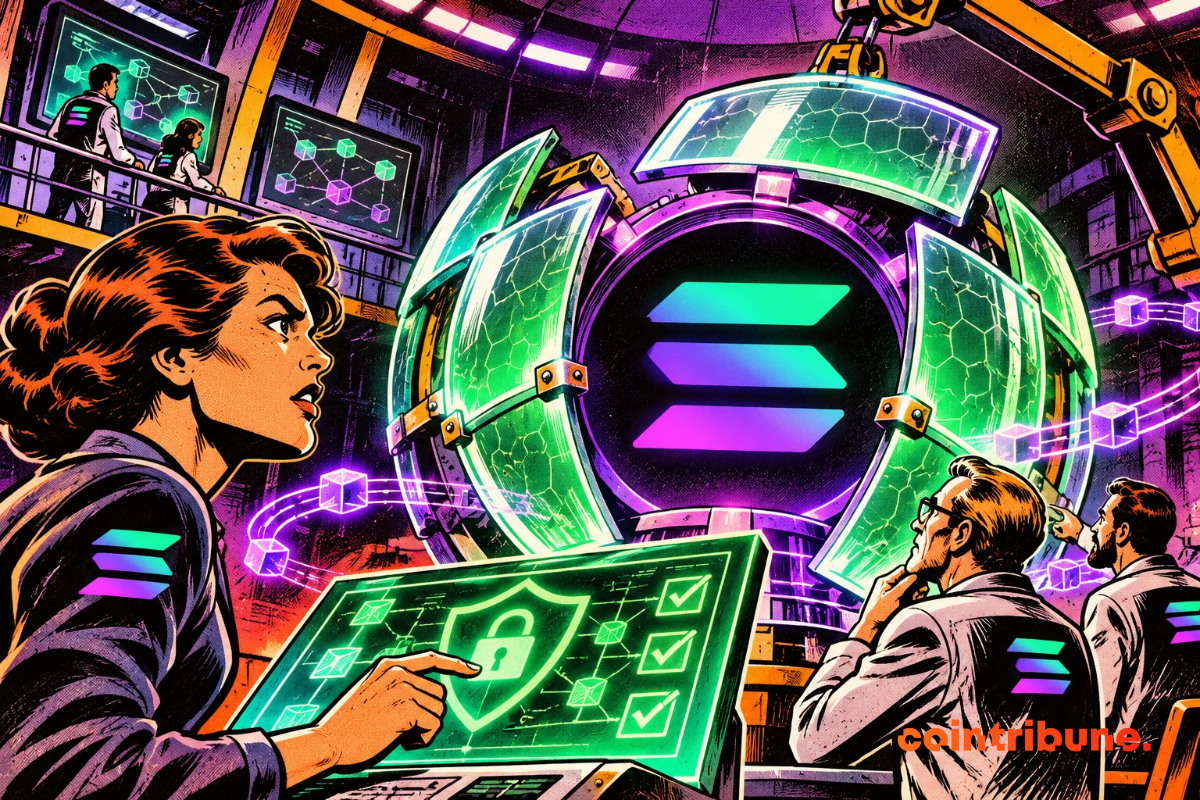
Solana is considering a reform of its technical rules to prevent its validators from interpreting the functioning of the network differently. On October 30, 2026, Anza CEO Brennan Watt proposed bringing blockchain rules together into a single specification. The crypto project already covers 18 technical areas and aims in particular to prevent disagreements that could disrupt crypto transactions. No outages related to this risk have been reported under this proposal.
In brief
- Solana plans to bring together its technical rules in a single document.
- The proposal covers 18 areas, including transactions, consensus and rewards.
- Agave and Firedancer will have to continue to apply the same rules to avoid discrepancies.
Solana wants to correct a hidden risk in its network
The problem is with the software that runs the crypto. Despite Solana’s progress in reliability, its developers still identify a risk linked to the diversity of validator clients. Today, Solana relies on several software programs capable of verifying crypto transactions and participating in network consensus.
One of the main implementations is Agave, developed by Anza. Firedancer, designed by Jump Crypto, uses an agnostic architecture. This diversity presents an important advantage. Indeed, if one software encounters a problem, the others can potentially continue to function normally.
But it also introduces a difficulty. All these programs must apply exactly the same rules. If two validators interpret a crypto transaction or protocol change differently, they could achieve incompatible results.
In the most serious situations, such divergence could disrupt consensus and cause a temporary separation of the network.
Brennan Watt wants to limit this risk. In a proposal published on GitHub on October 30, the Anza leader highlights the dispersion of current rules between the validator code and numerous technical documents, known as Solana Improvement Documents (SIMD).
Developers sometimes need to look at multiple old proposals to understand the exact behavior of the network. Some details are even only in existing code. This organization complicates the work of teams developing new independent clients.
A reform covering 18 technical areas
The proposed solution consists of bringing together the rules of the protocol in an official and constantly updated specification. Brennan Watt has already prepared a first version comprising 18 chapters. The document notably covers the validation of crypto transactions, accounts, consensus mechanisms, communications between validators, fees and rewards.
Each new modification must specify all parts of the protocol concerned. Currently, developers typically submit an independent SIMD proposal. If it is accepted, it gradually joins the rules applied to the network.
With this reform, each modification would appear directly in the common document. Proposals would still follow existing technical reviews and governance procedures.
The official specification would only incorporate changes already enabled on the mainnet. This approach aims to provide a single reference, faithful to the rules actually applied by validators.
This project comes shortly after the activation of Alpenglow on the Solana network, on October 21, 2026. This update replaced the old TowerBFT mechanism and significantly reduced the finality time of crypto transactions, with a target of 150 milliseconds. The proliferation of changes makes technical documentation even more important.
For Firedancer developers, a common repository could notably reduce the need to reconstruct rules from Agave code.
The reform must still convince crypto developers
The project has not yet been adopted. Brennan Watt’s proposal opened a discussion among Solana contributors, several of whom have already commented on how it works. Jacob Creech, contributor to the Solana Foundation, particularly wishes to clarify the allocation of SIMD numbers and the management of modifications during their validation.
Another developer, known by the pseudonym alnoki, wonders about the dependencies between different parts of the crypto protocol. These questions will need to be resolved before possible adoption.
The next step could be to amend document SIMD-0001, which currently defines the procedures for proposing and validating technical changes.
No deployment date has yet been announced. The reform is not expected to result in immediate changes to user transactions. It mainly aims to improve the documentation, review and integration of network rules by different teams.
Indeed, it does not guarantee the disappearance of all bugs either. Two software programs can apply the same specification while containing different errors.
Solana seeks above all to support its technical diversification without weakening its consensus. Tremplin.io had already highlighted the risks associated with the concentration of validation software on Solana. The arrival of independent clients like Firedancer reduces some dependencies, but now requires developers to maintain a common interpretation of the rules. This is precisely the problem that Brennan Watt proposes to solve.
Maximize your Tremplin.io experience with our ‘Read to Earn’ program! For every article you read, earn points and access exclusive rewards. Sign up now and start earning benefits.