
Bitcoin-related exchange-traded funds (ETFs) are going through a tough time. For the first time since the end of July, their cumulative net flows over 30 days have returned to negative territory. The move comes as the market experiences another pullback and investors monitor multiple price levels. However, exits remain limited compared to previous waves of withdrawals. Does this signal reflect a real change in institutional trend?

In brief
- US spot Bitcoin ETFs are negative $292 million over 30 days.
- This is their first negative period since the end of July.
- Outflows remain limited compared to previous waves of withdrawals recorded this year.
- Bitcoin falls 5.3% in seven days and tests the $76,000 support.
Bitcoin ETFs record first net outflows since July
American spot Bitcoin ETFs now show a negative balance sheet over the last thirty days. According to the data relayed by Techgagedtheir net flows reached minus $292 million on October 26. This development marks a first since the end of July, after several months of regular accumulation. It therefore draws attention to the behavior of institutional investors.
However, the scale of these withdrawals deserves more precise analysis. On the historical flow chart, the recent negative bar remains modest. It contrasts in particular with the significant outflows recorded earlier in the year. In other words, the data does not yet show a massive wave of institutional disengagement.
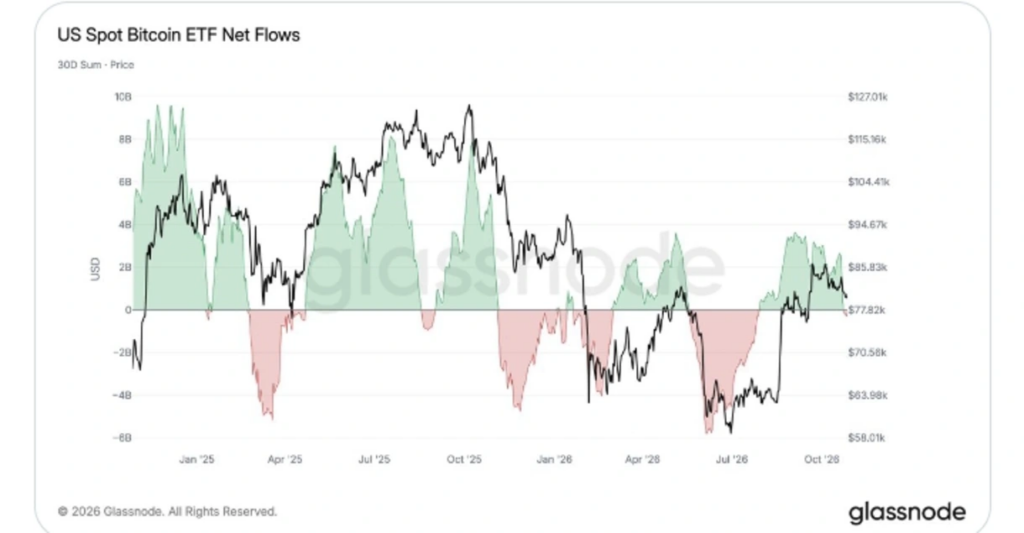
In addition, capital inflows began to increase again during this week. This return to positive territory comes after several sessions marked by withdrawals. It suggests that some investors prefer to temporarily adjust their exposure rather than exit the market entirely. Fund flows therefore constitute an important indicator for monitoring changes in institutional demand.
Bitcoin falls towards $77,000 after flows drop
The deterioration of ETF flows accompanies a new phase of weakness in the market. On October 30, 2026, at 6 p.m. UTC, the price of bitcoin was trading around $77,328. Its price then showed a drop of 5.3% over seven days. This development confirms the difficulties encountered by buyers after several consolidation sessions.
For most of the week, the price was trading in a range between $80,000 and $82,000. However, the market then experienced a rapid decline, bringing it closer to $76,000. This movement interrupted the stabilization phase observed previously. The asset ultimately rebounded slightly, without returning to its former levels.
Now, investors are monitoring several crucial technical thresholds. The $79,000 level represents a first immediate resistance for the price. Conversely, the $76,000 area provides major support for buyers. A further drop below this threshold could accentuate concerns around the current dynamics of bitcoin.
Can institutional flows announce a change in trend?
Despite the market decline, the available data does not yet confirm a lasting turnaround. Net outflows from ETFs remain relatively limited compared to previous withdrawal periods. In addition, the recent return of incoming flows brings an additional element to this analysis. Institutional investors therefore seem to be adjusting their positions in a less favorable market context.
This development does not, however, mean that institutional demand will quickly return to its previous level. The next sessions will notably make it possible to check whether capital inflows are being maintained. A lasting stabilization of flows could reduce selling pressure on American funds. In this scenario, bitcoin could regain support among institutional buyers.
Conversely, a resumption of net outflows would prolong the current difficulties. Maintaining the price above $76,000 will also be an important element to watch. The next movements of ETFs and the evolution of the price will make it possible to better measure the strength of demand. These two indicators will thus give a more precise reading of the market situation.
If inflows into ETFs are confirmed, the current decline could remain temporary. On the other hand, new outflows accompanied by a break of $76,000 would reinforce the downside risks. Bitcoin therefore approaches the next sessions with two challenges: preserving its support and regaining regular institutional demand.
Maximize your Tremplin.io experience with our ‘Read to Earn’ program! For every article you read, earn points and access exclusive rewards. Sign up now and start earning benefits.