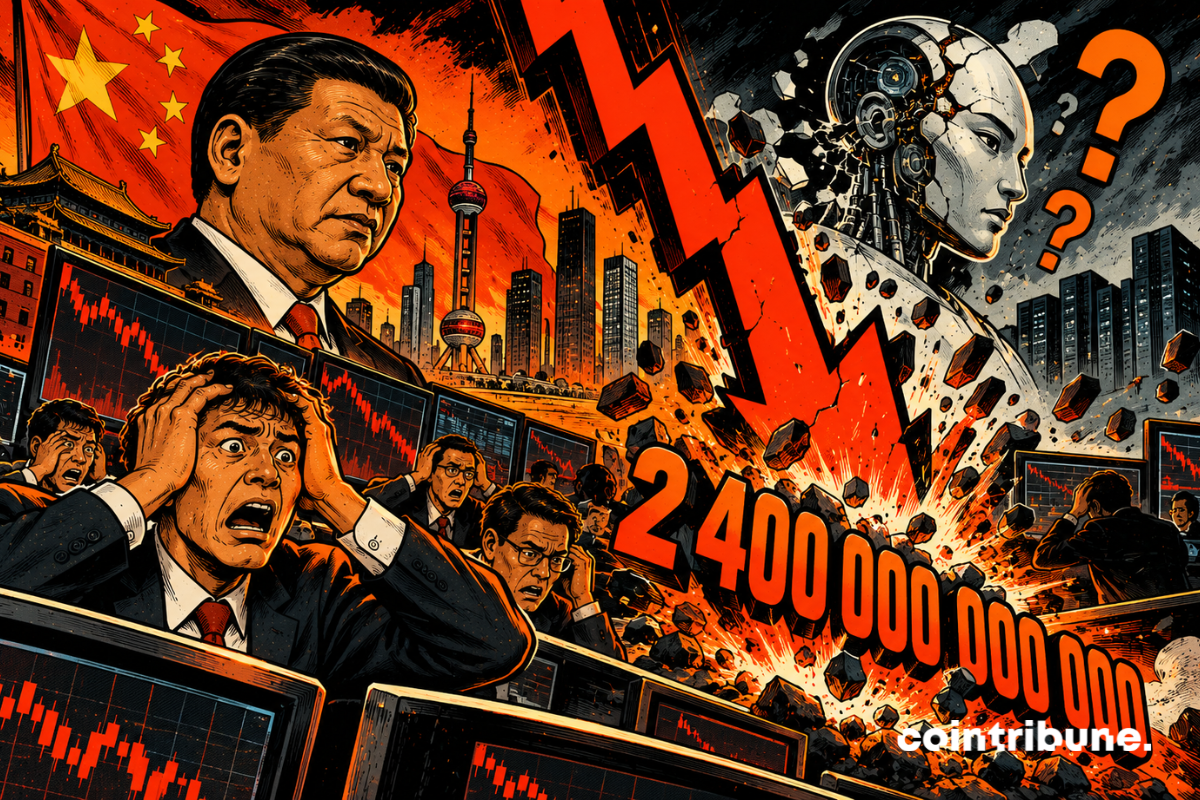
Chinese stocks have lost about $2.4 trillion since May, but the main risk lies beyond investors’ wallets. By depressing valuations and consumer confidence, the correction could deprive AI companies of the capital needed to compete with the United States.
In brief
- The Chinese stock market has lost nearly $2.4 trillion since May.
- Stocks linked to artificial intelligence are among the most affected by this fall.
- The decline in stocks threatens the financing of Chinese technology companies.
- Stock market losses weaken individual investors and weigh on their confidence.
- Despite the correction, valuations remain high and are slowing the return of capital.
Stock market collapse could cut off future funding for Chinese AI
The CSI 300, which brings together the main companies listed in mainland China, has fallen more than 20% since its peak in June. It thus entered a bear market on October 22, while the STAR 50, more exposed to semiconductors and artificial intelligence, lost 40% in less than four months.
This fall wiped out nearly $480 billion from the STAR 50 alone. It comes as Beijing seeks to mobilize national savings to finance the chips, robots, data centers and AI models necessary for its technological autonomy.
Various indicators show why this decline threatens the financing of the sector:
- AI-related stocks represent 42% of Chinese capitalization;
- They concentrate 57% of trade on the markets concerned;
- Robot maker Unitree lost almost half of its value;
- Zhongji Innolight and Eoptolink have fallen about 60% from their peaks;
- Many technology companies could postpone their IPOs.
A high valuation normally allows a company to raise more money by issuing fewer shares. When its price collapses, a new transaction becomes more costly for existing shareholders, because their stake risks being further diluted.
Hong Hao, head of investments at Lotus Asset Management, estimated that the correction will “put a stop to many companies that were looking to get listed”. The crash therefore reduces available resources at a time when Chinese players must finance heavy investments and catch up in certain advanced chips.
Households pay the price of a market that has become dependent on tech
The extent of the decline can also be explained by the concentration of the market around a single theme. When stocks linked to AI represent 42% of capitalization and more than half of trade, their correction mechanically drags down the rest of the stock market.
Retail investors occupy an important place in Chinese markets. Many joined the movement believing that Beijing’s support for strategic sectors reduced their risk. The Unitree IPO received requests representing 8,000 times the number of shares offered.
However, state support for a technology does not guarantee the profitability of each company. China, an influential member of the BRICS alliance, can fund research, foster domestic chips and encourage the adoption of robots without preventing listed companies from suffering intense competition or falling margins.
Dong Baozhen, fund manager in Beijing, observed :
The stock market then moved into a crazy speculative rise. And now we see the bubble burst.
American restrictions aggravate this fragility. Washington limits China’s access to certain technologies and plans to exclude Chinese optical components from American data centers. The companies concerned then lose part of their potential outlets at a time when domestic consumption remains low.
Valuations that are still too high delay the return of capital
The 40% drop in the STAR 50 could give the impression that the excesses have already been corrected. However, the index still trades around 100 times the profits made over the last twelve months, compared to almost 30 times for the American Nasdaq 100.
This level means that investors are still paying a high price for current profits that are still limited. At the peak, the STAR 50 multiple approached 250. The correction therefore reduced the excess without bringing valuations back to the standards of the major international technology indices.
The problem is not necessarily a lack of innovation. DeepSeek showed that a Chinese company could develop a high-performance model with lower costs than several Western competitors. Laboratories also claim to be able to train their models with Huawei chips.
The challenge now is to transform this progress into sustainable income. A price war between chipmakers, model developers and robot builders could boost adoption while squeezing profits.
The loss of 2.4 trillion dollars therefore does not mean that Chinese AI has failed. It shows that Beijing will not be able to finance its technological strategy through stock market enthusiasm indefinitely. To attract household savings again, companies will have to demonstrate their ability to generate profits, and not simply their importance in the rivalry with the United States.
Maximize your Tremplin.io experience with our ‘Read to Earn’ program! For every article you read, earn points and access exclusive rewards. Sign up now and start earning benefits.