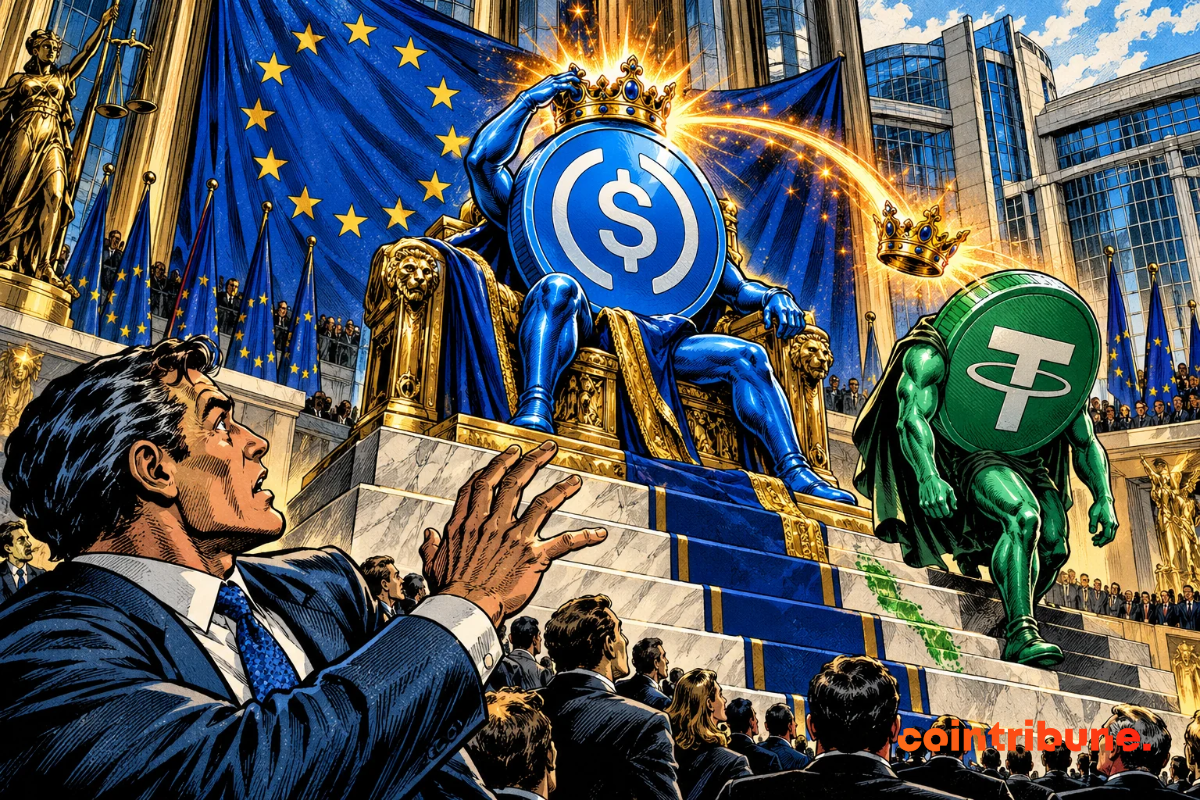
Circle’s USDC has just surpassed Tether’s USDT on crypto exchanges against the euro. According to the latest data from Kaiko, its market share now reaches 56%, up from just 10% in January 2024. The stablecoin is also gaining ground on liquidity, with order books 40% deeper than those of its rival. The European MiCA regulation has greatly accelerated this change.
In brief
- USDC now represents 56% of stablecoin trading against the euro, compared to 10% at the start of 2024.
- Its order books are approximately 40% deeper than USDT’s on Euro pairs.
- The European Banking Authority will strengthen its supervision of USDC starting November 12.
USDC takes 56% of the crypto market against the euro
The ranking of stablecoins has changed on platforms offering exchanges against the euro. USDC now holds the top spot with 56% of volumes, according to Kaiko data released this week. In January 2024, its share did not exceed 10%.
The increase therefore reaches 46 percentage points in less than three years. During this time, USDT suffered from restrictions imposed by MiCA in Europe. Several platforms have gradually removed certain trading pairs accessible to customers in the European Economic Area.
The change is not just about volumes. Kaiko also notes an improvement in the liquidity available on USDC/EUR pairs. Their order books are now around 40% deeper than those of USDT against the Euro.
That is, more buy and sell orders are available around the market price. This depth can facilitate the execution of large trades, reducing their impact on prices.
According to the detailed figures of the study, reported by several specialized media, the USDC/EUR books had a median depth of approximately 27.3 million dollars, compared to 19.3 million for USDT/EUR, on seven platforms observed between September 21 and October 19.
The gap is already considerable. However, it is necessary to clarify what Kaiko measures: exchanges between stablecoins and euros, not all crypto transactions carried out by European investors. And USDC remains a stablecoin pegged to the US dollar, even when purchased with euros.
MiCA changed the rules for Circle and Tether
European regulations explain a large part of this shift. Since the entry into force of the MiCA provisions on stablecoins, platforms must adapt the assets they offer to their European customers.
Circle has obtained the necessary authorizations to market USDC under this framework. Tether has not followed the same path for USDT. In March 2025, Binance announced the removal of several stablecoins, including USDT, from its relevant trading services in the European Economic Area. Kraken has also restricted trading using Tether’s stablecoin.
The effects were rapid. According to detailed data attributed to Kaiko, the share of USDC in trade against the euro would have increased from 25% to 46% during the month of March 2025 alone.
The movement then continued. An academic study published in July 2026 by Nicola Borri and Kirill Shakhnov sheds additional light. Researchers examined fourteen crypto platforms to measure the consequences of European restrictions.
They observe an increase in USDC on platforms exposed to MiCA rules, mainly because USDT volumes are decreasing there. On the scale of their overall sample, market shares change much less.
On October 8, the European Securities and Markets Authority (ESMA) further clarified the obligations of crypto providers. It asks approved platforms to cease services providing access to non-compliant stablecoins. Existing positions must be regularized within a maximum period of three months, with some liquidation or withdrawal operations permitted during this transition. Regulatory pressure therefore continues to be exerted on European intermediaries.
Circle wins in Europe, Tether still dominates the world
USDC has also just reached a new regulatory milestone. On October 14, 2026, the European Banking Authority (EBA) officially classified it as the first “significant” e-money token in the European Union.
This recognition concerns Circle Internet Financial Europe, the entity issuing the stablecoin. Among the 45 electronic money tokens notified in the Union under MiCA, USDC is the first to obtain this status. From November 12, the EBA will exercise direct supervision over several areas, including capital, reserves, liquidity and repayment plans.
The French regulator ACPR will retain certain responsibilities, including governance. For Circle, this new status therefore comes with additional obligations. Europe now represents an important market for USDC, but the global balance of power remains very different.
USDT maintains a circulating supply approximately 2.5 times that of its competitor. Demand remains particularly strong in markets where stablecoins are used for international transfers, payments and custody of digital dollars.
The other distinction concerns stablecoins actually denominated in euros. Circle also offers EURC, the value of which is indexed to the European currency. Its activity had already progressed under the effect of MiCA. USDC and EURC therefore meet different needs: the first allows you to maintain exposure to the dollar, the second to the euro.
Maximize your Tremplin.io experience with our ‘Read to Earn’ program! For every article you read, earn points and access exclusive rewards. Sign up now and start earning benefits.