
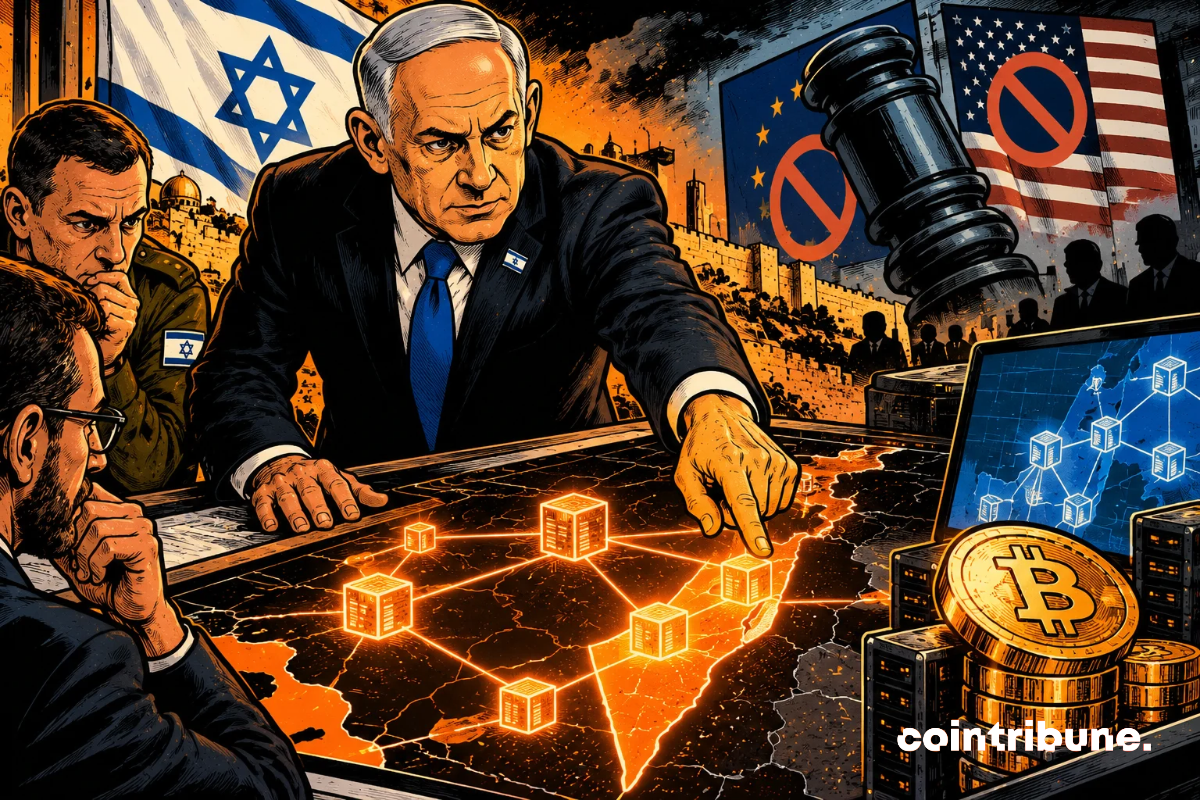
Benjamin Netanyahu has asked his advisers to prepare a plan based on blockchain to reduce Israel’s vulnerability to possible banking sanctions. However, the Prime Minister did not specify the cryptos envisaged, nor those responsible for the project, nor its timetable.
In brief
- Netanyahu calls for blockchain plan to prepare Israel for possible banking sanctions.
- No crypto, blockchain or implementation date has been announced yet.
- Cryptos could facilitate certain payments, but do not guarantee the circumvention of sanctions.
- Exchange platforms and stablecoin issuers remain subject to international rules.
- Israel is also seeking to reduce its dependence on U.S. military aid.
Netanyahu calls for blockchain-based solution
The Israeli Prime Minister mentioned this project on October 23 during an interview with the economic channel Channel 10. He believes that Israel must prepare alternative financial circuits in the event that international restrictions affect its banking system.
When journalist Roy Katz asked him if blockchain could be a solution, Benjamin Netanyahu said answered :
Certainly, this is one of them. I have already requested that a plan be prepared.
This declaration confirms an order, but not the adoption of an operational device. Several essential elements therefore remain unknown:
- The administration responsible for preparing the plan has not been publicly designated;
- No blockchain has been selected;
- Netanyahu did not cite any specific cryptocurrencies;
- No budget or timetable has been announced;
- The project has not yet received a public legal framework;
- No financial or technological partners have been presented.
“We must understand that there could be sanctions, including banking sanctions”has declared the Prime Minister. He added that Israel must “prepare an economy capable of circumventing them”.
His remarks were made four days before the Israeli legislative elections. They also intervene in a context of growing international pressure linked to Israeli military operations, the situation in Gaza and the expansion of settlements in the West Bank.
The United Kingdom and eleven other Western countries have notably announced measures against products from Israeli colonies. These targeted restrictions do not yet correspond to the general banking sanctions mentioned by Netanyahu.
Cryptos do not make a country invisible
A public blockchain can allow direct transfers without going through the traditional banking network. Two players can exchange bitcoin or another digital asset as long as they have access to the network and control their private keys.
This autonomy, however, remains limited as soon as a State wishes to import goods, pay businesses or convert large sums into national currencies. Exchanges, partner banks and stablecoin issuers enforce compliance rules and may block certain addresses.
Transactions made on Bitcoin, Ethereum or other public networks are also permanently recorded. Specialized companies can track movements, link addresses to entities and alert platforms when funds come from a sanctioned actor.
Stablecoins pose another difficulty. Most rely on centralized companies that maintain bank reserves. Their issuers can freeze tokens or refuse transactions to comply with a judicial decision or an international sanction.
A private infrastructure controlled by Israel would offer more control, but it would need foreign partners for international trade. A national blockchain therefore does not automatically create suppliers, liquidity or counterparties willing to ignore restrictions.
A senior Israeli economic official, quoted anonymously by Channel 12, disputed the project. “This idea will certainly not achieve its objective. Just talking about it could hurt the economy”he declared.
Israel also wants to reduce its military dependence
The blockchain project is part of a broader autonomy strategy. Netanyahu also asked the country to prepare for a reduction, then a possible end, of American military aid.
“It’s only a matter of time”he said about this assistance. The Prime Minister wants to strengthen the national production of munitions and military equipment. He spoke of an additional 400 billion shekels, or about $129 billion, earmarked for defense over the coming years.
Netanyahu also believes that Israel could encounter a less favorable American political environment after the departure of Donald Trump. His opponents accuse him, conversely, of having worsened the diplomatic isolation of the country through the choices of his government.
The blockchain plan therefore remains a political intention, not an already designed system. Its effectiveness will depend on its technical form, the assets chosen and the cooperation of foreign companies. It will also be necessary to determine whether it aims at the continuity of legitimate payments in times of crisis or the direct circumvention of international sanctions.
As long as no official document specifies these elements, it would be excessive to present Israel as ready to replace its banking system with cryptos. Above all, the announcement shows that the government is studying alternative solutions to a financial risk that it now considers credible.
Maximize your Tremplin.io experience with our ‘Read to Earn’ program! For every article you read, earn points and access exclusive rewards. Sign up now and start earning benefits.


