
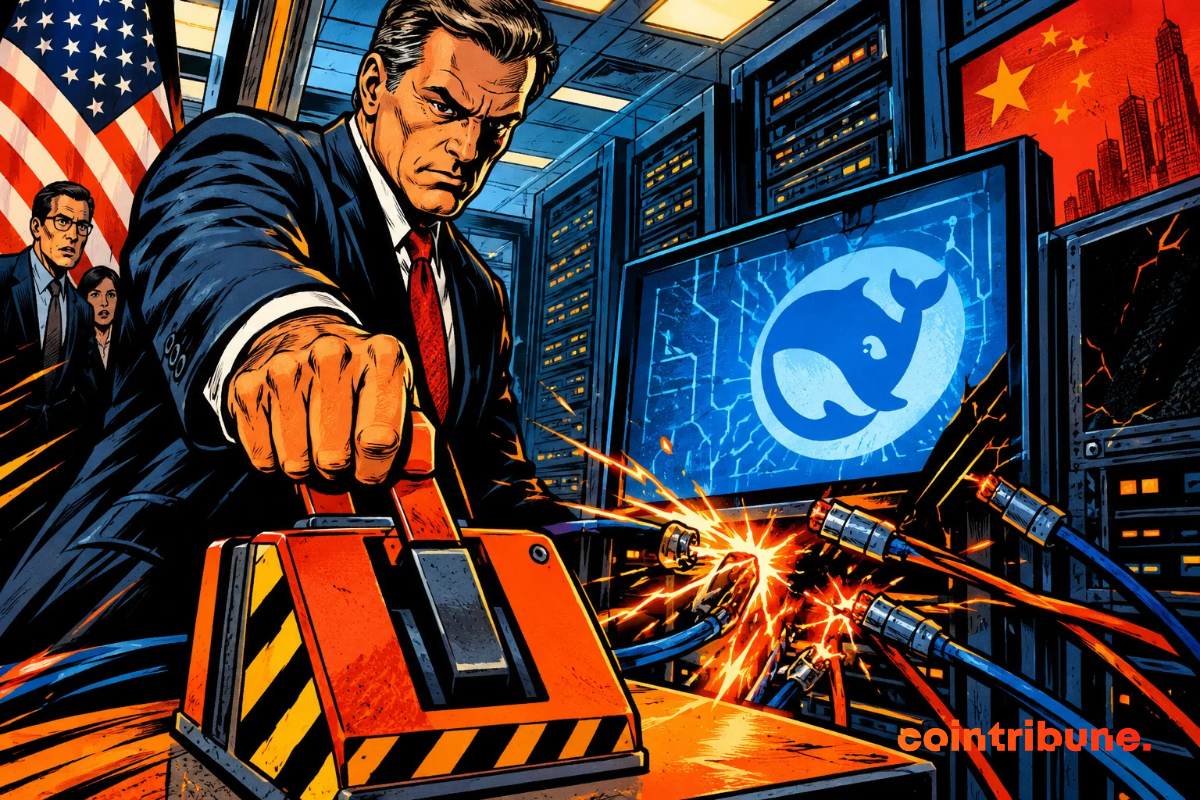
The US Department of Homeland Security is demanding the removal of DeepSeek from the computer systems of federal civilian agencies. Beijing denounces a discriminatory decision and threatens to retaliate. At the same time, Washington sanctions five Chinese entities accused of stealing secrets linked to artificial intelligence (AI).
In brief
- Washington excludes DeepSeek and its affiliates from civilian government procurement and demands the removal of their products from federal systems.
- Beijing calls for the cancellation of these restrictions and promises to take “all necessary measures”.
- The US State Department sanctions five Chinese entities in a case of alleged theft of trade secrets.
DeepSeek removed from public procurement and federal systems
Distrust of Chinese models is not new, DeepSeek and Kimi having already been accused of redirecting requests to Claude without the knowledge of their users.
This time, the American administration is relying on the Federal Acquisition Supply Chain Security Act of 2018 to remove DeepSeek from the federal supply chain. Signed by Markwayne Mullin, the order targets civilian agencies, but excludes national security and intelligence systems.
Concretely, administrations must stop purchasing products from DeepSeek and its affiliates. They must also remove solutions already installed, including certain third-party products based on their technologies.
To justify this decision, Washington cites several risks: the hosting of servers in China, the storage of personal data on Chinese territory, the possibilities of digital tracking and critical vulnerabilities in the iOS application.
A publication date that raises questions
One detail deserves attention: the order indicates an initial distribution date of July 24, 2026, while the Federal Register published it on October 20. However, the text presents its measures as applicable as soon as they are issued.
This difference raises a practical question. Agencies had 60 days after issuance to request a written waiver. By retaining the July date, this deadline would have expired even before the official publication.
In the meantime, the administration recommends monitoring data exchanges, strengthening computer logs and spotting unusual activity. It also provides for an annual review of the measure.
Beijing protests, Washington increases sanctions
The Chinese Ministry of Commerce quickly denounced a decision which arouses its “strong dissatisfaction” and its “firm opposition”. He accuses Washington of ignoring the agreements reached between the two heads of state and calls for the restrictions to be revoked.
For her part, the spokesperson for the Ministry of Foreign Affairs, Mao Ning, criticizes the extension of the concept of national security and promises to defend Chinese companies.
In parallel, the US State Department sanctioned five Chinese entities under the Protecting American Intellectual Property Act. Among the targets are Shanghai Zhisuan Technology and the MiraclePlus incubator, accused along with three other entities of participating in the theft of Google trade secrets.
These measures come as Washington and Beijing initiated a dialogue on AI. They illustrate the persistent tensions between the two powers, while the dispute between Anthropic and the Pentagon reminds us that technological security remains a major issue on both sides of the Pacific.
Maximize your Tremplin.io experience with our ‘Read to Earn’ program! For every article you read, earn points and access exclusive rewards. Sign up now and start earning benefits.


