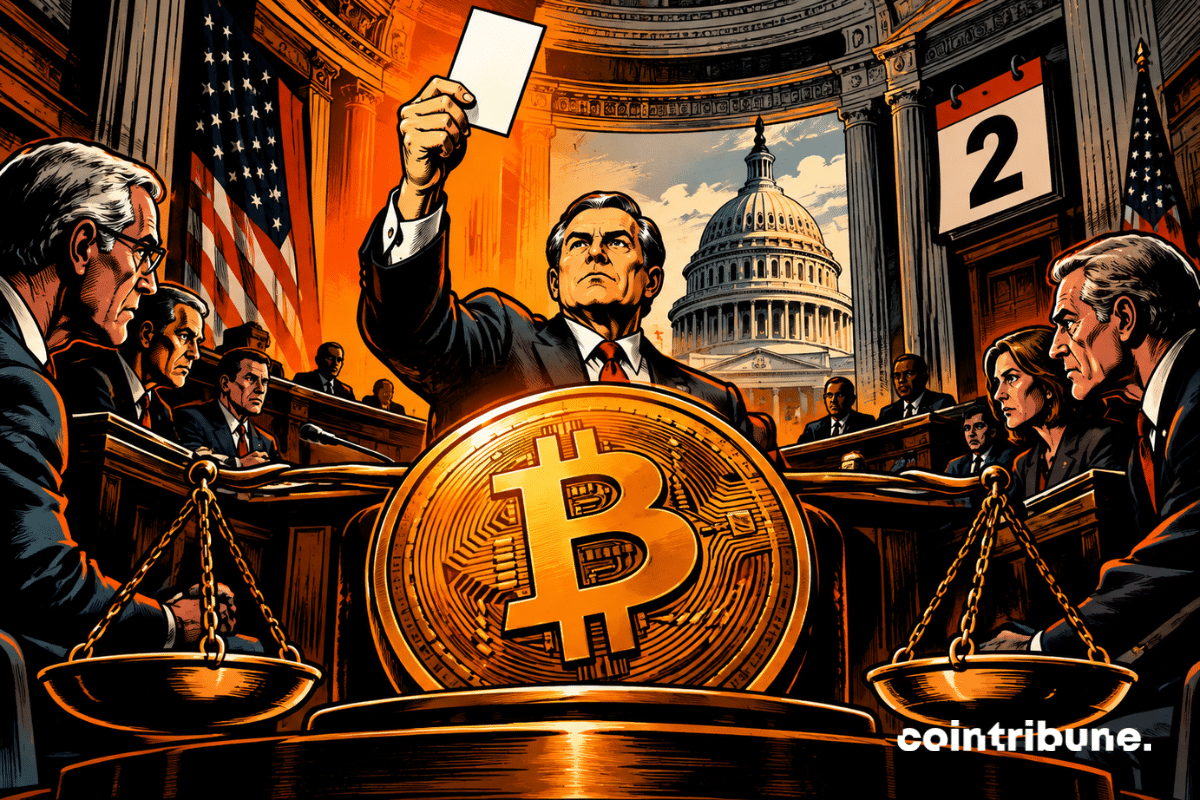
The US Senate is due to vote this Tuesday, September 15 at 2:15 p.m. Washington time, or 8:15 p.m. in Paris, on the advancement of the CLARITY Act, presented as a major text aimed at establishing a global framework for crypto markets in the United States. This procedural vote requires 60 votes to allow the project to continue its legislative journey. The Republicans, who have 53 seats in the Senate, will therefore have to obtain the support of several Democrats or independents. Failure would seriously compromise the adoption of the text before the end of 2026.
In brief
- Closing vote Tuesday at 2:15 p.m. Washington time; 60 votes required to open the debate.
- Final text of 635 pages incorporating 126 modifications requested by the Democrats, reinforced ethical section.
- In the event of rejection, the midterms calendar buries any new attempt before 2027.
John Thune is missing at least seven Democratic votes
The Senate has never voted in plenary session on an overall text on the crypto markets, fourteen months after the green light from the Chamber (294-134) and four months after that of the banking commission (15-9). As Republicans play their last card, the vote is not on substance but on closure, the procedure that ends obstruction and allows debate.
With 53 seats out of 100, Majority Leader John Thune must win at least seven Democratic votes, more if his party defects. Ruben Gallego and Angela Alsobrooks, the only Democrats to have supported it in committee, are not enough.
Without 60 votes, the text has almost no chance of returning before the midterms of November 2026, and the next legislature would start from scratch.
Ethics, developers, stablecoins: The price of compromise
Published Sunday evening, the final text incorporates 126 modifications demanded by the Democrats, presented as their “last and best offer”. The ethics component takes up approximately 80% of the counter-proposal from senators Thom Tillis and Ruben Gallego.
Donald Trump would have agreed to sell his crypto interests or place them in a blind trust, a vehicle managed by an independent agent without the elected official keeping control, according to TheStreet. Chuck Schumer immediately brought his caucus together.
Compromise has a downside. The Blockchain Regulatory Certainty Act, which prevented a free software developer from being considered a money transmission company, now only covers civil suits. Republicans removed the criminal shield from Section 1960, the one that hit Tornado Cash and Samourai Wallet.
A circuit breaker would allow Treasury Secretary Scott Bessent to restrict certain rewards on stablecoins if community bank deposits migrate massively to them, for up to eighteen months. The mechanism extends the GENIUS Act, the 2025 law which governs the issuance of these dollar-backed assets.
The crypto market does not yet believe in the outcome
Coinbase and Circle, issuer of USDC, would emerge strengthened by a clear federal framework after years of regulation by prosecution. Retail sentiment remained “extremely bearish” on CRCL and “bearish” on COIN on Stocktwits on the eve of the vote, while punters at Kalshi and Polymarket noted the likelihood of the text moving forward.
A “yes” would only be the beginning: the text would have to be debated, amended, then reconciled with the Chamber. A “no” would maintain the jurisdictional status quo between the SEC and the CFTC, while the European Union has applied MiCA since 2024.
The verdict will fall in an already busy week: bitcoin enters the Fed week with a significantly less exposed market, enough to cushion a rejection like tempering a green light. The stakes go beyond the course of the day: without the CLARITY Act, the American fate of the sector will remain hanging over regulators and judges until after the midterms.
Maximize your Tremplin.io experience with our ‘Read to Earn’ program! For every article you read, earn points and access exclusive rewards. Sign up now and start earning benefits.