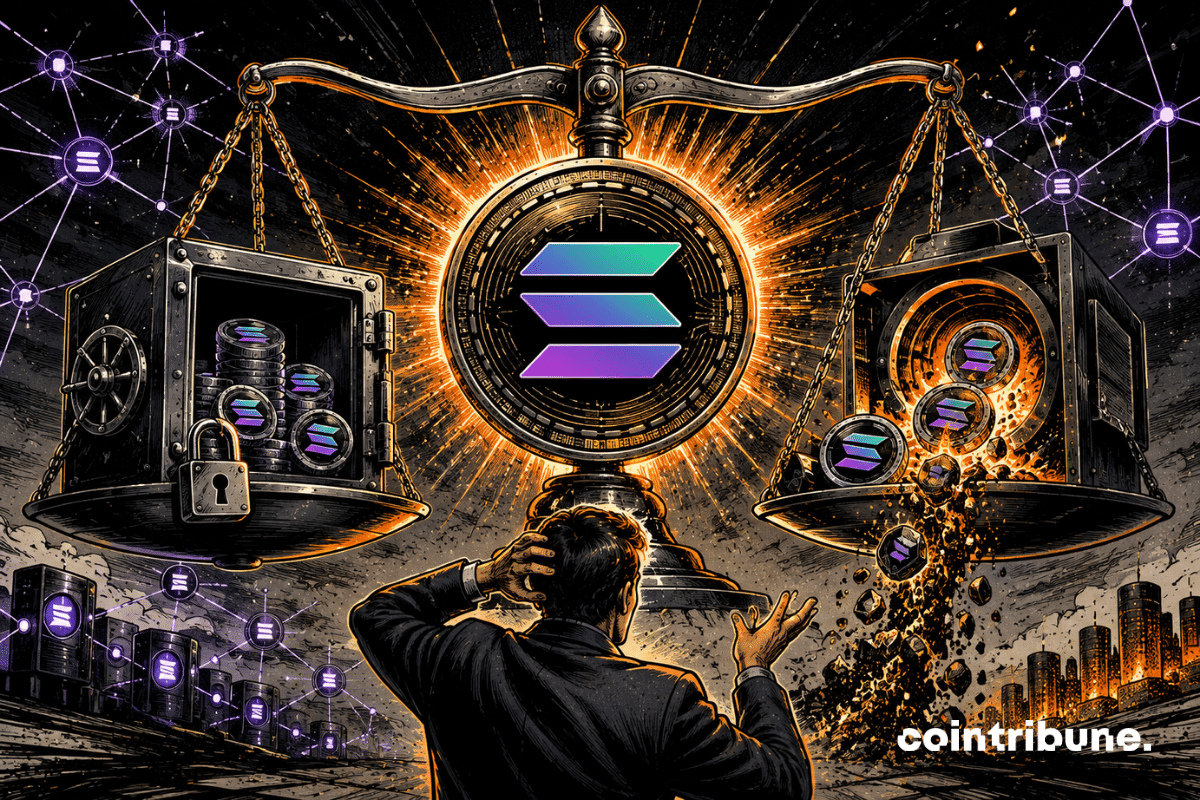
Solana could soon significantly reduce the remuneration of its stakers. Proposal SIMD-550, currently up for community voting, plans to accelerate the decline in SOL inflation. Ultimately, the nominal yield on staking could increase from around 5.25% today to 2.25% in three years. The community must decide between immediate income for stakers and increased scarcity of SOL.
In brief
- SIMD-550 would double Solana’s annual disinflation, from 15% to 30%, to target terminal inflation of 1.5% from the first half of 2029.
- The nominal staking yield would slide to 4.34% in year 1, 3% in year 2, then 2.25% in year 3.
- Two validators out of 738 would become loss-making in the first year, around thirty by the third.
Solana accelerates the decline in its inflation
Voting on SIMD-550 began on August 23. Supported by Helius, the proposal aims to gradually modify the SOL emission curve by doubling the rate of disinflation, from 15% to 30% per year. The aim is to reach the terminal inflation rate of 1.5% much more quickly.
The first votes already show a shared community. Forward Industries and Blueshift spoke in favor of the text, while Everstake and P2P.org voted against. To be adopted, SIMD-550 must collect votes representing at least two-thirds of the SOL staked.
This threshold recalls the precedent of SIMD-228, another reform of the rewards system which obtained only 38.61% of the votes and was ultimately rejected.
Staking would lose part of its appeal
The most visible change would directly concern SOL holders who delegate their tokens to validators.
The nominal yield, currently close to 5.25%, would fall to around 4.34% in the first year following the entry into force of SIMD-550. It would then increase to 3% in the second year, then to 2.25% in the third.
The idea behind this reduction is to limit the creation of new SOL. However, the network will have to find other sources of income to maintain the economic interest of staking.
That’s where SIMD-553 comes in. The proposal, approved in July, increases SOL burns related to compute resources used by transactions. With the current level of activity, daily destruction could increase from around 600-800 SOL to 7,500-9,000 SOL.
However, these burns still remain lower than the current rate of creation of new tokens. The desired effect is therefore above all to gradually modify the trajectory of the supply.
The reform could have another consequence, less visible to investors: the income of validators.
With inflation rewards falling, operators will need to rely more on transaction fees and MEV-related revenue to remain profitable. Estimates cited by 21Shares suggest that two validators could already become loss-making in the first year. This number could reach around thirty after three years, depending on the evolution of operating costs and voting costs.
The question is therefore not only that of the yield of the SOL. It also concerns the economic balance of the infrastructure which secures the network.
The bet on DeFi
At the same time, Solana hopes that the drop in staking yield will push some capital towards decentralized finance applications.
Nearly 67.9% of SOL is currently staked, compared to around 34.1% for Ethereum. Less generous remuneration could encourage some holders to move their tokens towards lending, trading or other on-chain applications.
The math is simple: if network activity increases enough, fees, MEV, and other revenue generated by Solana could gradually take over from inflation.
Matt Mena, senior strategist at 21Shares, believes that inflation should more closely follow economic performance and network growth in order to compensate for the reduction in staking rewards.
For SOL holders, the compromise is now made. Less immediate yield, but also fewer new tokens in circulation. It remains to be seen whether the use of the network will progress quickly enough for this new economy to really be favorable to SOL.
The vote on SIMD-550 will therefore be closely monitored. Its adoption would not guarantee an increase in the price, but it would mark an important change in the way in which Solana arbitrates between remuneration of participants and the scarcity of its token.
Maximize your Tremplin.io experience with our ‘Read to Earn’ program! For every article you read, earn points and access exclusive rewards. Sign up now and start earning benefits.