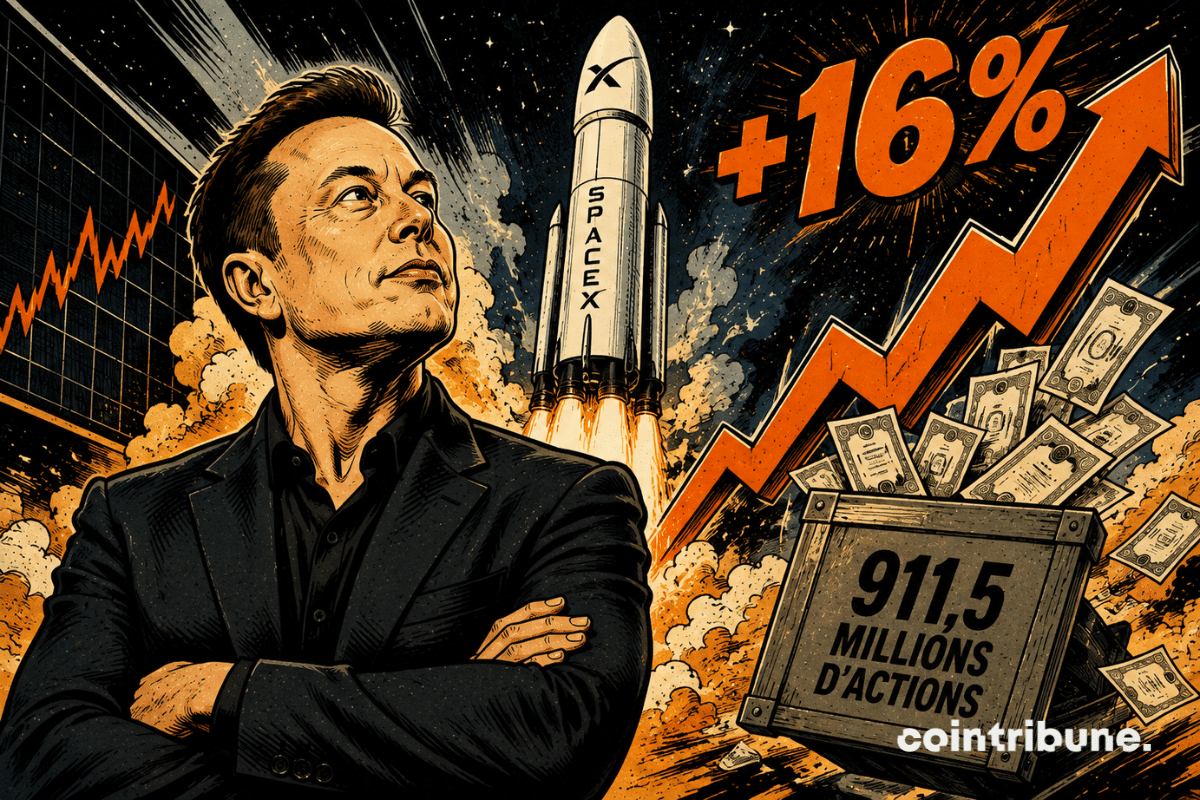
Have the markets just witnessed a shift between traditional finance and blockchain? As nearly a billion shares of SpaceX stock became tradable, many anticipated massive selling pressure. The scenario did not happen. The stock rose 6.1% on August 6, as Web3 platforms recorded nearly $700 million in volume on tokenized stocks in just 48 hours. This unexpected convergence revives the debate on the role of Real World Assets (RWA) in the evolution of financial markets.
In brief
- Despite releasing 911.5 million shares on August 6, 2026, SpaceX stock jumped 6.1% to close at $114.92.
- Crypto derivatives SPCX and SPCXx on Gate, Kraken and Bybit accumulated almost $700 million in volume in 48 hours before the unblocking.
- The lifting of the lockup increased SpaceX’s free float from 4.9% to 11.8% of total shares outstanding.
- Banks like Morgan Stanley and Bernstein are targeting price targets of up to $248.
An unprecedented frenzy on SPCX tokenized stock derivatives
The phase immediately preceding the lifting of sales restrictions saw spectacular activity on crypto exchanges, despite the drop in SpaceX stock. Access to company securities is organized through several major digital channels :
- Gate and the SPCX token: the platform recorded $332 million in volume on August 4, then $360 million on August 5, offering international traders direct synthetic exposure to variations in Nasdaq stock without underlying holdings;
- Kraken, Bybit and the SPCXx token: these platforms offered derivatives issued by the company Backed Assets, backed at a 1:1 ratio by real shares held in escrow by a third party for non-US investors;
- The rise of stock tokenization: This movement reflects a structural trend where Web3 exchanges are packaging newly listed companies to enable seamless, uninterrupted global trading.
The rise of these volumes on crypto platforms allowed traders to anticipate market movements and implement very aggressive hedging strategies well before American banks opened. This synthetic liquidity provided essential space to absorb speculation ahead of traditional sessions.
The mechanics of the unlocking and the unexpected resilience of the share price
The trigger for this volatility lies in the expiry of the lock-up clauses on August 6, making 911.5 million Class A shares previously held by pre-IPO investors and historical employees eligible for sale. This stock injection more than doubled the space company’s free float, increasing it from 4.9% to 11.8% of all outstanding shares.
While such a supply shock usually causes a severe decline, the price jumped 6.1% on the day of the release to then reach $133.11. This rise comes after a fall of nearly 14% on August 5, which pushed the stock to an all-time low of $108.27. Investors were worried about the second quarter results. Despite revenue up 92% year-over-year to $7.8 billion, attention was focused on $23.6 billion in planned capital spending on artificial intelligence and a voidable contract. Nonetheless, the lack of a purge on August 6 suggests that the post-IPO selling pressure, initiated on June 12 at a price of $135, has been fully absorbed from the high of $225.64.
The plebiscite of Wall Street analysts and the strength of the bitcoin balance sheet
This resilience immediately reinforced the optimism of large American investment banks. Morgan Stanley analyst Adam Jonas called the end of the lockdown period a strategic entry opportunity, pointing to SpaceX as a potential “intergenerational value generator”. For its part, Argus Research raised its recommendation to buy with a target of $160, while Citi maintained its positive rating at $200 after the AI segment exceeded profit forecasts by around $1.5 billion. Bernstein, for his part, raised his price target to $248.
On the asset side, IPO documents reveal that SpaceX holds a treasury of 18,712 BTC, originally acquired for $661 million and valued at $1.29 billion upon filing, ranking the firm among the ten largest institutional holders alongside Tesla’s 11,509 BTC. In addition, Elon Musk’s participation, representing more than 40% of the company, remains completely locked until June 12, 2027, eliminating any risk of liquidation coming from the founder in the short term.
Furthermore, the neutralization of this major supply shock highlights the growing maturity of interconnected markets. The surge in volumes on tokenized equity products demonstrates that price discovery now occurs in real time via Web3 infrastructures, providing continuous liquidity that precedes and sometimes mitigates the volatility of traditional trading sessions. The combination of a partly bitcoin-backed treasury, massive banking support and Elon Musk’s long-term alignment offers sustainable stabilization prospects for the coming quarters.
Maximize your Tremplin.io experience with our ‘Read to Earn’ program! For every article you read, earn points and access exclusive rewards. Sign up now and start earning benefits.