
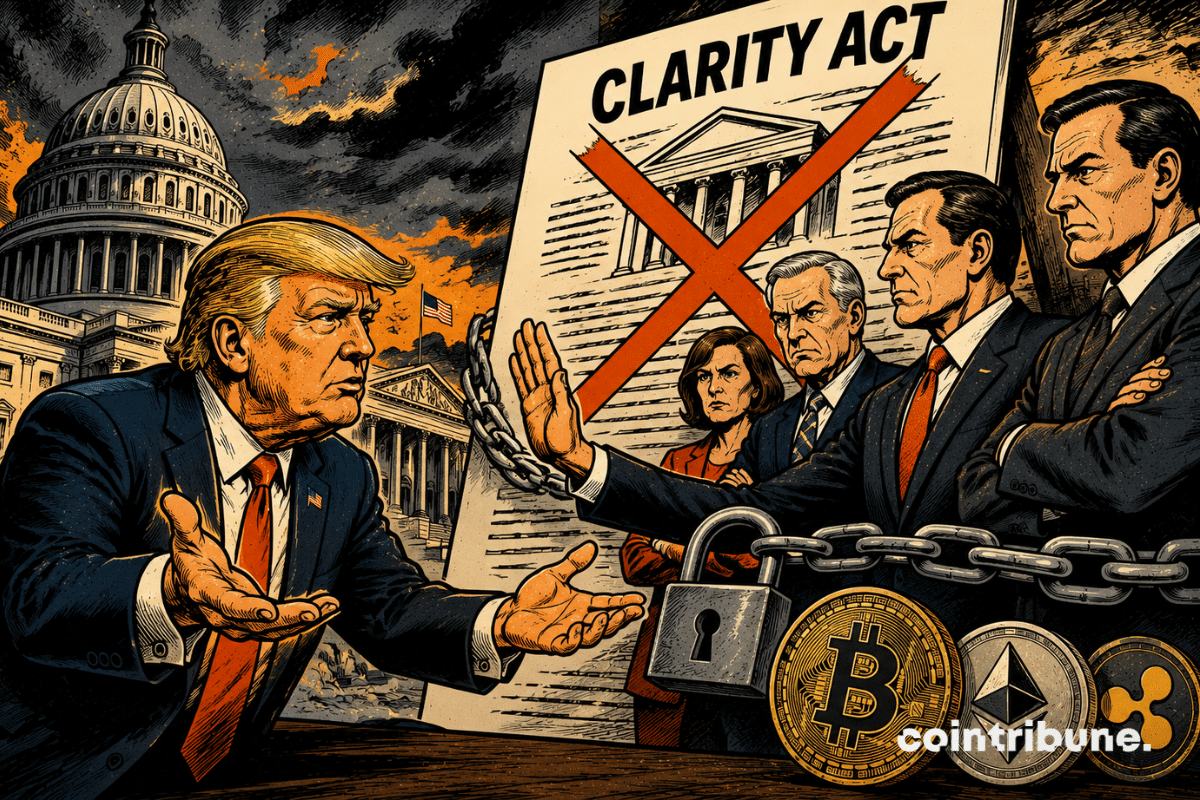
The United States finally thought it had the text capable of offering a regulatory framework to the crypto market. This is not the case. Indeed, the CLARITY Act finds itself mired in a political confrontation which now goes beyond questions of financial supervision. The debate shifted to the ethics rules governing political leaders holding cryptos, with Donald Trump at the center of the discussions. His latest attempt at compromise was not enough to unblock the issue, further postponing the adoption of a reform eagerly awaited by the industry.
In brief
- Donald Trump has validated a revised ethics clause in an attempt to unblock the CLARITY Act before the end of the parliamentary session.
- The opposition considers the measure “very weak” and contests the control role assigned to the Department of Justice.
- Donald Trump reported nearly $1.4 billion in crypto revenue in 2025, intensifying fears of conflicts of interest.
- Without at least 7 Democratic votes before the parliamentary recess on August 8, the bill risks being postponed indefinitely.
The White House compromise swept away by Democratic refusal
The bill on the structure of digital financial markets took a decisive step on July 20 when Donald Trump officially agreed to a revised ethics clause, an amendment that Republican strategists presented as the last obstacle before a vote in plenary session.
This arrangement had been carefully negotiated four days earlier, on July 16, during a summit meeting bringing together the American president, senators Bernie Moreno and Cynthia Lummis, as well as Patrick Witt, the crypto advisor to the White House. The Republican administration immediately welcomed this agreement, calling it “the most comprehensive and broad ethical provision in history”. For his part, Senator Bernie Moreno asserted that it was the most stringent text ever included in legislation passed by Congress.
Here are the important facts which make up this ethical aspect now at the heart of the clashes:
- The scope of restrictions: the revised clause aims to regulate the ability of the president, vice president, members of Congress and senior federal officials to acquire, destroy, exchange or profit from cryptos during their mandate;
- The opposition of the minority: one of the only two elected Democrats to have voted to advance the law in committee, Senator Ruben Gallego, brushed aside the White House proposal by openly calling it “very weak”;
- A requirement for bipartisanship: Senator Cory Booker firmly reiterated that only a real transpartisan agreement would make it possible to advance the bill;
- The conflict over the control body: Democrats denounce the attribution of ethics supervision to the Department of Justice, even though Todd Blanche, Donald Trump’s personal lawyer, is currently engaged in the confirmation process to take the helm.
Presidential revenues and the technical architecture of the CLARITY Act bill
The harshness of the debates is mainly explained by the direct financial revelations concerning the executive. Thus, the personal financial statements made public on 1er July have in fact revealed that Donald Trump generated nearly $1.4 billion in revenue linked to cryptos during the year 2025. The majority of these colossal sums comes directly from the activities of the company World Liberty Financial (WLF) and the memecoin bearing his image. These exceptional amounts captured by a sitting president make the ethical aspect particularly sensitive and legitimize, according to the Democratic wing, a much stricter level of regulatory control than a simple facade commitment.
On the technical side, the CLARITY Act nevertheless aims to bring real stability to the industry by entrusting the majority of market surveillance to the Commodity Futures Trading Commission (CFTC), while maintaining assets assimilated to financial securities under the supervision of the Securities and Exchange Commission (SEC). The project also contains measures to protect customer funds in the event of bankruptcy and a regulatory tolerance regime for decentralized finance developers.
Parliamentary impasse and the race against time in the Senate
Arithmetically, the legislative calendar now resembles an almost impossible race against time. The Republicans currently hold 53 seats in the Senate and absolutely need at least 7 Democratic votes to reach the threshold of 60 votes necessary to avoid procedural blockage. To date, no Democratic senator publicly supports the amended text. Senate Majority Leader John Thune has an extremely short window before parliamentarians leave for summer vacation, scheduled for around August 8, 2026.
The extreme tension that reigns behind the scenes is also reflected in logistical reshuffles at the highest level of the State. Patrick Witt had to postpone his annual training within the Georgia Army National Guard to lead the negotiations, while his deputy director, Harry Jung, formally announced his departure from the administration within two weeks.
Ultimately, the CLARITY Act finds itself in a vice where legal technique is completely neutralized by politics. If players in the crypto industry still hope for the adoption of a clear framework before the parliamentary recess in August, mutual distrust around the enrichment of political leaders seriously jeopardizes the text’s chances of success. A possible lack of agreement by the August 8 deadline would postpone the debates until the fall, keeping the American crypto sector in a regulatory gray area damaging to its international competitiveness.
Maximize your Tremplin.io experience with our ‘Read to Earn’ program! For every article you read, earn points and access exclusive rewards. Sign up now and start earning benefits.


