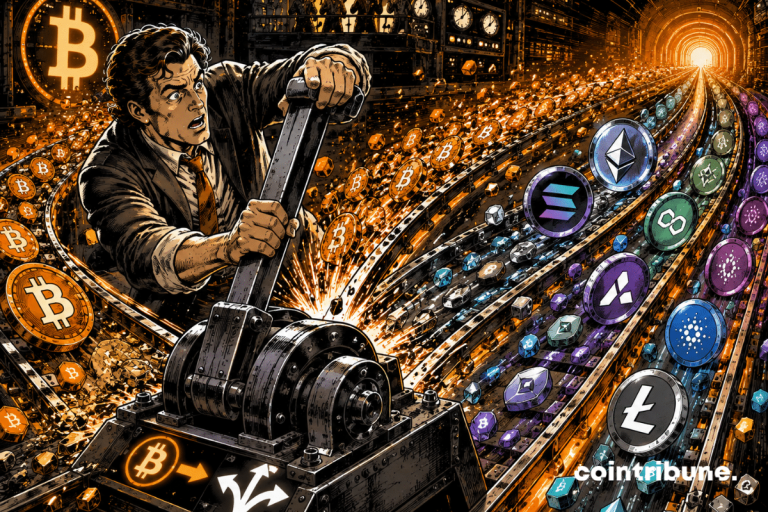
Tokenization is shaking up the backstage of global finance. Touted as the next wave of innovation, it could attract millions of investors and billions of dollars in the years to come. Between traditional banks, crypto start-ups and regulators, bets are piling up on the form this new ecosystem will take. The International Monetary Fund enters the arena with a more reserved message: yes, tokenization is a game changer. But it also brings systemic risks that should not be underestimated.
In brief
- Tokenization promises efficiency gains, but can trigger rapid and uncontrollable collapses.
- The lack of interoperability between digital platforms weakens liquidity and blocks the exchange of tokenized assets.
- Automated markets amplify volatility, making crashes more frequent and difficult to contain.
- States, alerted, are preparing their return to regulate this programmable finance and prevent systemic abuses.
Tokenization & finance: speed that weakens
With tokenization, everything becomes faster: transactions, settlements, executions. The promises are enormous. No more need for intermediaries or banking delays. BlackRock, via its BUIDL fund, and Franklin Templeton have understood this well: they tokenize American Treasury bonds, reap the gains and boost efficiency.
But the IMF pull the handbrake. This speed could well trigger flash crashes more violent than ever. Coded automation is unforgiving: in the event of a bug or panic, the markets fall before a human even has time to react.
The IMF warns: stacked on top of each other, smart contracts can fall like digital dominoes. This local imbalance could then transform into a global shock, instantly propagated throughout the entire tokenized system.
Automation is formidable. She pushes at maximum speed, but without a safety net. And when machines dictate the rules of the game, the flaws can become systemic. The challenge is no longer technical, but structural: how to slow down a market launched at full speed?
Siled platforms: the tokenization divide
In the collective imagination, tokenization evokes a fluid world, without barriers. However, the reality is much more fragmented. Each actor – bank, start-up or DAO – builds its own architecture. Result: technological islands incapable of communicating with each other.
The IMF and IOSCO are concerned about this absent interoperability. Platforms that “don’t talk to each other” cause a depletion of overall liquidity, with stranded assets, distorted prices, and reduced efficiency.
As the specialist media points out The Paypers :
Interoperability is an important point. There is still a lot of work to be done in this area.
This fragmentation even affects stablecoins, although they are presented as the pillars of digital finance. Everyone applies their own rules: reserve, audit, convertibility. Result: confusion, duplication, and growing distrust.
And what about disputes? If two platforms tokenize the same asset in different ways, who does it really belong to? Without shared standards, legal security falters. And in finance, insecurity is synonymous with crisis.
States at the meeting: regulation in ambush for tokenized finance
Tokenization does not live above ground. It is part of a monetary history punctuated by state interventions. From the Bretton Woods system to the collapse of the gold standard in the 1970s, each shift has seen governments regain control.
Today, the IMF reminds us that history could well repeat itself:
Governments have rarely been content to remain in the background during major monetary developments.
Behind the scenes, JPMorgan and Citi are already fine-tuning their own private tokens. JPM Coin allows continuous transfers on the blockchain, 24 hours a day, while Citi Token Services is moving towards closed B2B applications. No anarchy here. But private, centralized finance, in the hands of the giants.
Will tokenized finance be a decentralized utopia or a technological remake of dominant institutions? If the state enters the arena, the response could quickly lean towards strict regulations, licenses, and imposed safeguards.
The 5 major dangers according to the IMF and IOSCO
- Amplified flash crashes: automation and speed create uncontrollable mini-crash;
- Extreme volatility: absence of immediate mitigation mechanisms;
- Lack of interoperability: incompatible platforms, brake on liquidity;
- Legal risks: vagueness on the actual ownership of digital assets;
- Imminent state intervention: reinforced surveillance and supervision.
Tokenized markets represent more than just a technological shift. They are rewriting the rules of investment, transforming rigid assets into fluid, splittable instruments accessible to all. The tokenization of RWA could well become the link between the traditional economy and a programmable future. On condition that we secure this new bridge before it wobbles under its own weight.
Maximize your Tremplin.io experience with our 'Read to Earn' program! For every article you read, earn points and access exclusive rewards. Sign up now and start earning benefits.